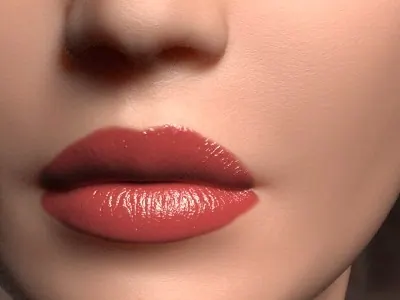
Subsurface scattering / SSS. Jensen et al.: Practical Model for Subsurface Light Transport, 2001.
Typeface · Cormorant Garamond
Jensen et al.: BSSRDF face render, SIGGRAPH 2001.Henrik Wann Jensen, Steve Marschner, Marc Levoy and Pat Hanrahan / Stanford Graphics.View source ↗
Prompt
Apply a subsurface scattering effect to suitable skin, waxy, or stone-like surfaces, adding soft internal light diffusion, warm translucent thin edges, and gently glowing backlit areas. Preserve fine surface texture and opaque boundaries while softening internal shadow transitions; avoid an all-over luminous haze. Keep the original subject and composition.
In 2001, Henrik Wann Jensen, Steve Marschner, Marc Levoy, and Pat Hanrahan presented apractical model for light transport under surfaces. It combines an accurate single scattering model with adiffusion approximation for multiple scattering. The authors demonstrate materials such as skin, milk, and marble. Their deliberately simple facial model uses few triangles, minimal texture, and only one light source to clearly illustrate the difference between the light models.
Distinction
Subsurface scattering is not simply soft focus and is not the same as glassy transparency. Excessive scattering can quickly make skin appear waxy.
Further examples · 8 images
02Subsurface scatteringA 3D monkey head model exhibits orange light passing through its translucent ears. This demonstrates how subsurface scattering allows light to penetrate and illuminate thinner parts of a mesh from within.Piotrek Chwała · CC BY-SA 3.0 · Wikimedia Commons03Skin Subsurface ScatteringHuman fingers are backlit by a bright light source, appearing red and glowing. The effect captures real-world light transport through tissue, where light enters the skin and scatters through internal layers.Davepoo2014 · CC BY-SA 4.0 · Wikimedia Commons04Blender3D LightPointSmallSSSA white light point is cast onto a black surface with a small scattering radius. The tight, soft glow illustrates the initial stage of light diffusion into a translucent material.SoylentGreen · CC BY-SA 3.0 · Wikimedia Commons05Sterkfontein Caves - Subsurface scattering of rockA flashlight illuminates a rock formation in the Sterkfontein Caves. The glow around the contact point shows natural light transport through mineral structures, highlighting real-world geological subsurface scattering.Soul Train · CC BY-SA 3.0 · Wikimedia Commons06ShellOpticalDescatteringThree sea shells are displayed with different optical descattering treatments. The variations show how light interacts with the shells' structure, affecting the visible surface detail and perceived translucency.Meekohi · CC BY-SA 3.0 · Wikimedia Commons07SSS-DragonOrangeLight-00A 3D dragon model is backlit by an orange light within a rendering interface. Light bleeds through the thin ridges of the dragon's back and head, demonstrating simulated translucency in a complex geometry.Gnagyusa · CC BY-SA 4.0 · Wikimedia Commons08PDW Measurement Dispersion Red LightA red light source illuminates a turbid liquid from within. The soft glow spreading through the volume demonstrates how light scatters multiple times inside a medium before exiting, a fundamental physical behavior subsurface scattering simulates.Skilbride21 · CC BY-SA 4.0 · Wikimedia Commons
Question
Which observation is more indicative of SSS than of glass transparency?
Show possible answer +Hide answer −
Asoft, colored light distribution without asharp image through it, such as on thin ears or in wax.