Stop-motion animation. 1900s–1910s as an early animated film sensation. An enduring form of animation.
Typeface · Bree Serif
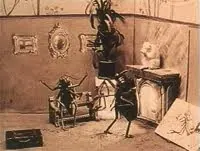
Ladislas Starevich: The Cameraman's Revenge (1912).
Temporal effect: still image or image sequence.Ladislas Starevich / Khanzhonkov; Wikimedia Commons reproduction; Commons page marks public domain;unknown still source;200×151px original.View source ↗
Prompt
Transform this image into a Stop-Motion Animation frame with tangible handmade models, painted miniature scenery, and tactile clay, fabric, or carved surfaces. Include tiny fingerprints, uneven seams, subtly stiff poses, shallow miniature-scale depth of field, and practical studio shadows rather than digital smoothness. Keep the original subject and composition.
Tangible figures often move with a[slight jerkiness]. Small irregularities1betray the fact that they were handmade.
Principle
Areal object is [moved minimally between individual photographs]. The sequence of images2creates the [illusion of independent movement].
Example
Ladislas Starevich: The Cameraman’s Revenge, 1912.
Try it out
Photograph apaper object twelve times. Move it slightly after each picture and play the images back as asequence.
Background
Precursors existed before 1900; object animation by the 1900s at the latest. The 1900s and 1910s saw it as an early animated film sensation; alasting form of animation. 1912 marks asignificant work, not aclaim of invention. Pixilation animates living people using the same frame-by-frame principle.
Recognize: Three-dimensional, tangible figures; often with deliberately slightly jerky movements.
Mechanism: Areal object is moved minimally between individual photographs. The sequence of images creates the impression of independent movement.
Example: Ladislas Starevich: The Cameraman’s Revenge, 1912, with preserved insects.
Practice: Photograph apaper object 12 times, moving it slightly after each shot. The texture and small irregularities often reveal the physical work involved between the photographs. What detail would be missing in asmooth computer animation?
Areal object is moved minimally between individual photographs. The sequence of images creates the impression of independent movement.
Three-dimensional, tangible figures; often with deliberately slightly jerky movements.
Photograph apaper object 12 times, moving it alittle bit after each picture.
1912 is aconcise work, not an invention. Pixilation animates living people using the same single-frame principle.
Distinction
1912 is aconcise work, not aclaim of invention. Pixilation animates living people using the same single-frame principle.
Aftermath
From King Kong to Aardman and LAIKA; also as adigitally imitated handmade look.
Further examples · 12 images
02Stop-motion-cooking-hfl-mediaA hand uses a cleaver to slice a yellow paper object into smiley face discs. This illustrates object animation where paper figures are incrementally moved and photographed to simulate cooking.Thoapham.ntk · CC BY-SA 4.0 · Wikimedia Commons03Stop motion animation of Odia Wikisource 2 badge rolling upA badge and lanyard are shown on a blue textured surface alongside a small yellow toy. The frame-by-frame movement of these real objects creates the illusion of independent, autonomous motion.Subhashish Panigrahi · CC BY-SA 4.0 · Wikimedia Commons04Stop-motion-cookingA metal knife appears to slice through a red felt tomato on a wooden board. It demonstrates the technique of manipulating tangible, handmade materials to represent fluid actions like food preparation.Stop Motion Cooking ASMR · CC BY-SA 4.0 · Wikimedia Commons05Example - Stop motion of a Spinning ChairA black office chair is positioned in the center of a domestic living room. By incrementally rotating the chair between photographs, the animator creates a sequence showing it spinning on its own.Erock23432 · CC BY-SA 3.0 · Wikimedia Commons06Moving PennyA single penny is seen moving across a wooden surface in a grainy sequence. This simple object animation relies on minimal changes in position between frames to suggest movement.Matthew850 at English Wikipedia · Public domain · Wikimedia Commons07Armature Puppet – Winder System Tiny XY Axis V2 Aluminium 2021A mechanical winder system designed for an armature puppet is displayed. This specialized tool allows for the precise, microscopic adjustments necessary to achieve smooth frame-by-frame animation of figures.Danylo Maliuha · CC BY-SA 4.0 · Wikimedia Commons08Steel Animation Hands with Aluminum Wire Fingers – Armature Puppet (2021)A set of five aluminum wire fingers is attached to a steel armature base. The flexible wire allows for the manual manipulation of hand gestures required in stop-motion puppet animation.Danylo Maliuha · CC BY-SA 4.0 · Wikimedia Commons09Frankelda's Brothers Ambriz Stop-Motion film animation characterA detailed female puppet holds a book in front of a miniature set. The figure's tangible, handmade quality and articulated joints are characteristic of professional stop-motion character design.Lizardi Saucedo · CC0 · Wikimedia Commons10Lego sto motionA top-down view shows a colorful building constructed from plastic toy blocks. This style of animation involves adding or removing individual blocks between frames to show construction.Gknor · CC BY-SA 4.0 · Wikimedia Commons11Stop motion studioA professional animation studio setup includes puppets, lighting rigs, and a city silhouette backdrop. It captures the physical environment where tangible figures are methodically photographed for film production.Tchikhinachvili · CC BY-SA 4.0 · Wikimedia Commons12Iguanodon from Fifty Million Years AgoA clay-like Iguanodon figure is shown interacting with a prehistoric tree. This is an example of early creature animation where real, physical models were used to represent extinct life.Service Film Corporation · Public domain · Wikimedia Commons