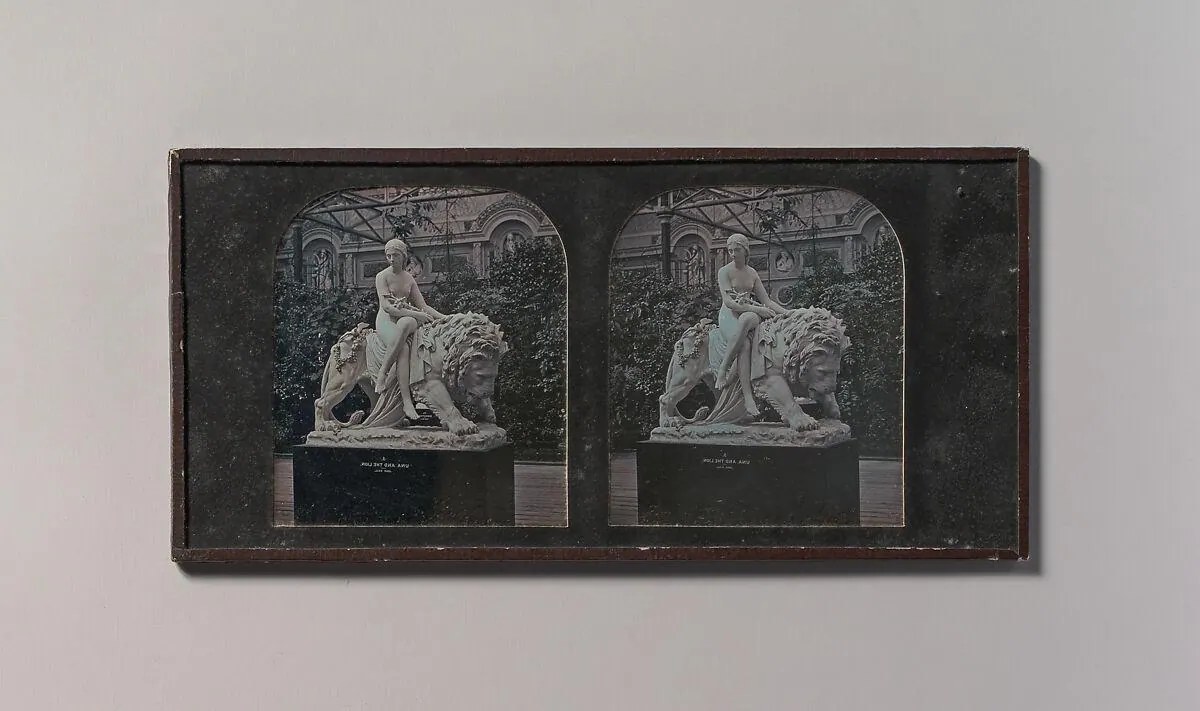
Stereoscopy / stereograph. Boom after the London World's Fair of 1851
Typeface · Playfair Display
London Stereoscopic Company: Crystal Palace, Una and the Lion, 1854–1862. Historical stereo image…London Stereoscopic Company / The Metropolitan Museum of Art. The Met Open Access / Public Domain.View source ↗
Prompt
Transform this image into a Stereoscopy card with two nearly identical photographs placed side by side on cream cardstock. Introduce subtle horizontal viewpoint differences and convincing foreground-background parallax, using matching sepia tones, fine grain, and softly rounded print corners. Keep the original subject and composition within each view.
[Two almost identical photos]side by side. Slight shifts in perspective1reveal that [each eye receives adifferent view].
Principle
Astereoscope2presents separate images to the eyes. The brain combines them to create a[sense of spatial depth].
Example
London Stereoscopic Company: Crystal Palace, 1854–1862.
Try it out
Photograph astationary subject twice, slightly offset from the side. Look for shifts between the foreground and background.
Background
Wheatstone's stereoscope in 1838; Brewster's compact lens viewer in 1849. Its popularity surged after the Great Exhibition in London in 1851, later becoming amass-market domestic medium. Detailed mechanism: Two slightly offset images are presented separately to the eyes. The brain combines the different perspectives to create asense of depth. The two views are not simply duplicates: look for the subtle differences in perspective.
Distinction
Two views are not merely aduplicate: look for the subtle differences in perspective.
Aftermath
Stereo 3D, VR and spatial photography.
Further examples · 8 images
02Stereoscopy - Cameras mounted on tripod with eye distanceTwo digital cameras are mounted on a tripod at a distance matching human eyes. This setup demonstrates the physical method of capturing two offset perspectives required for a stereoscopic image.Bert Niehaus · CC BY-SA 4.0 · Wikimedia Commons03VR headset insert smartphone stereoscopy imageA smartphone displaying side-by-side images of a park bench is placed next to a headset. The lenses in the viewer isolate each eye's view to simulate spatial depth from the two perspectives.Bert Niehaus · CC BY-SA 4.0 · Wikimedia Commons04Broken wood stereoscopyThis image shows two views of tangled branches with subtle horizontal shifts in perspective. It exemplifies how binocular parallax helps the brain distinguish complex foreground textures from the background.Bert Niehaus · CC BY-SA 4.0 · Wikimedia Commons05Durlach Aue - stereoscopy imageThe landscape view contains a large evergreen tree and distant hills in two side-by-side panels. The lateral shift between the tree and the horizon demonstrates how stereoscopy creates depth over large distances.Bert Niehaus · CC BY-SA 4.0 · Wikimedia Commons06Holzfigur stereoscopyA wooden sculpture is photographed from two slightly different angles. The varying visibility of the sculpture's sides in each frame provides the binocular cues necessary to perceive its three-dimensional form.Bert Niehaus · CC BY-SA 4.0 · Wikimedia Commons07Kabelrolle background match anaglyphThe image displays a red-green anaglyph of a cable reel. It demonstrates a method of stereoscopy where two offset views are superimposed and filtered by color to provide different information to each eye.Bert Niehaus · CC BY-SA 4.0 · Wikimedia Commons08Ocular Stereoscopy diagram (7)This optical diagram shows the paths from two separate points of view to a single focal area. It illustrates the geometric theory behind how separate ocular perspectives converge to create a perception of depth.Unknown artistUnknown artist · Public domain · Wikimedia Commons