Combination printing. Artistic debates since the late 1850s
Typeface · Libre Baskerville
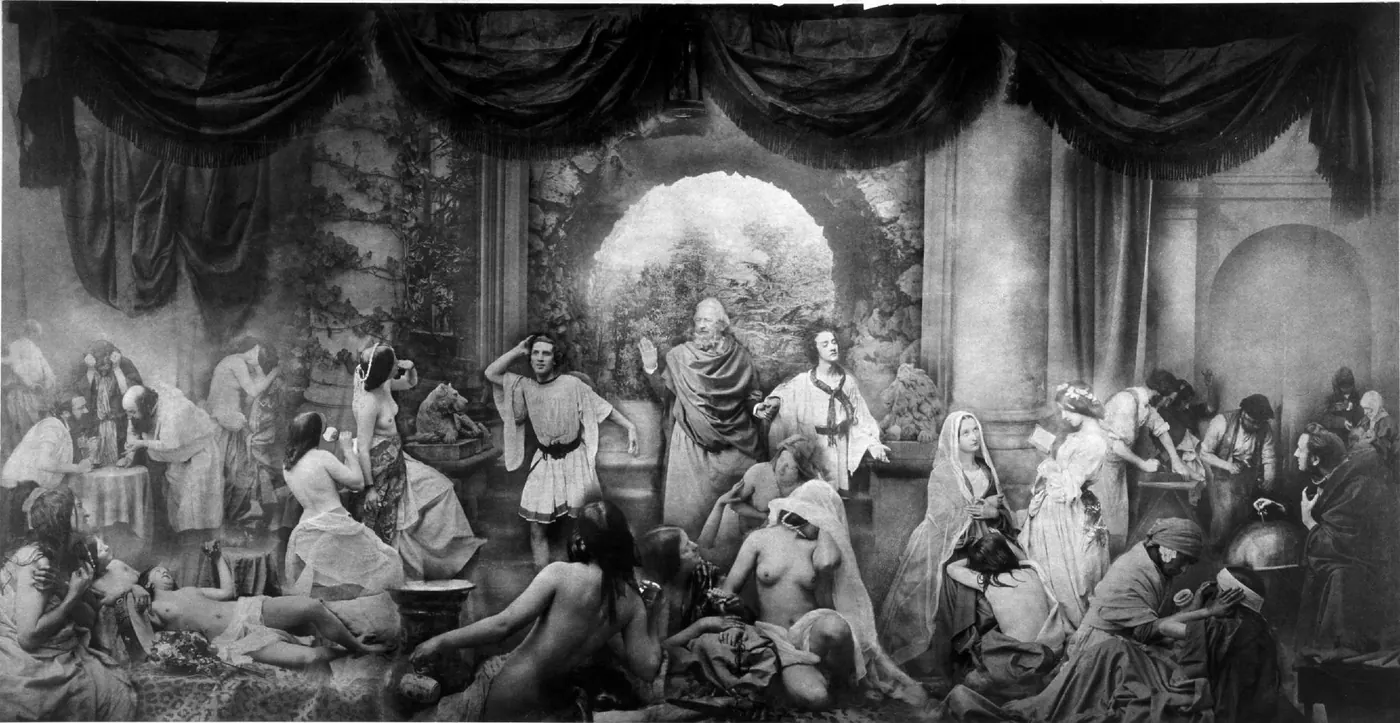
Oscar Gustav Rejlander: The Two Ways of Life, 1857. Historical combination print.Oscar Gustav Rejlander / Wikimedia Commons. Public domain / faithful reproduction on Commons.View source ↗
Prompt
Apply a Combination Printing treatment with seamlessly blended tonal regions, carefully balanced local exposures, and coherent illumination across the scene. Use warm monochrome silver-print tones, fine paper grain, subtly softened masking transitions, and rich but detailed shadows, avoiding visible collage seams. Keep the original subject and composition.
Acarefully arranged [scene appears seamless], even though its components may have been created at different times.
Principle
[Masks1expose parts of several negatives2]successively onto one sheet of paper. The [individual exposures form asingle composition].
Example
Rejlander: The Two Ways of Life, 1857, over thirty negatives.
Try it out
Create asimple montage from two images. Use the same perspective, lighting, and edges so that the combination holds together.
Background
Used by several photographers in the 1850s, most notably Rejlander and Robinson. Artistic photography gained attention and sparked debate from the late 1850s onward. Detailed mechanism: Several negatives are successively copied onto asingle sheet of paper using masks. Parts of different photographs form aseemingly coherent scene. Photographic compositing existed long before digital image processing.
Distinction
Photographic compositing existed long before digital image editing.
Aftermath
Layers, masks, photobashing, and digital composites.
Further examples · 7 images
02An Effect of the Sun, NormandyThis seascape combines two separate exposures for the sky and the water. Le Gray used this technique to overcome the limited dynamic range of early emulsions, ensuring both the horizon and clouds remained properly exposed.Unknown · Public domain · Wikimedia Commons03Rejlander, 1873 double selfportraitThe photographer appears twice in a single frame, portraying two different characters. This effect was achieved by masking half of the lens or paper during one exposure and then switching the mask for the second exposure.Oscar Gustave Rejlander · Public domain · Wikimedia Commons04Oscar Rejlander Laughing - Crying 1871-72The image displays four separate photographic studies arranged into a single print. It exemplifies a literal application of joining multiple negatives, though here the boundaries remain visible as a deliberate study of expression.Oscar Gustave Rejlander · Public domain · Wikimedia Commons05Henry Peach Robinson, Fading Away, 1858This scene by Robinson uses five different negatives to overcome depth-of-field limitations. The sky, window, and figures are separate exposures joined seamlessly to create a narrative composition with uniform focus.Henry Peach Robinson · Public domain · Wikimedia Commons06Bringing Home the May, H. P. Robinson, The Practical and junior photographer, vol 1, No 9, April 1901, p 257This large-scale composition by Robinson was created by combining multiple negatives. It demonstrates the technique's ability to assemble a complex group of figures in a landscape that would be difficult to capture in one exposure.Henry Peach Robinson · Public domain · Wikimedia Commons07Henry Peach Robinson, Lady of ShalottRobinson combined various negatives to create this literary scene. The water, boat, and background foliage are integrated from separate shots to produce an atmospheric, painterly image following the Pre-Raphaelite style.Henry Peach Robinson · Public domain · Wikimedia Commons