H 124 / 3211950s

Stereoscopic 3D Cinema

Stereoscopic 3D cinema. 1952–1954: first major Hollywood 3D boom.

Typeface · Monoton

Norman McLaren: Now Is the Time to Put On Your Glasses (1951); flat still image.
Norman McLaren: Now Is the Time to Put On Your Glasses (1951); flat still image.National Film Board of Canada;via British Film Institute; Film still; no open license stated.View source ↗

Prompt

Apply a Stereoscopic 3D Cinema anaglyph effect with subtly offset red and cyan contour pairs, stronger separation in foreground details, and gentler offsets in distant areas. Preserve a stable central subject, layered depth cues, restrained film grain, and slight projection softness. Keep the original subject and composition.

Identify

Objects appear to be in front of or behind the canvas.

Principle

The left and right eyes receive slightly offset images. Glasses separate the views. The brain interprets these differences as depth.

Example

Norman McLaren, 1951. Bwana Devil, 1952. House of Wax, 1953.

Try it out

Close one eye at a time. Observe how a nearby finger jumps against the background.

Background

Stereoscopic photography in the 19th century; 3D film experiments long before 1950. 1952–1954: first major Hollywood 3D boom. The 1950s boom also used polarized projection1, not just red-cyan anaglyphs2. 3D here means stereo, not CGI.

Notice: Objects appear to be behind or in front of the canvas. A flat reproduction cannot show this effect. Mechanism: The left and right eyes receive slightly offset images. Glasses separate the two views; the brain interprets the differences as depth. example: Norman McLaren: Now Is the Time to Put On Your Glasses, 1951; Bwana Devil, 1952; House of Wax, 1953. Practice: Close one eye alternately and observe how a nearby finger jumps against the background.

The left and right eyes receive slightly offset images. Glasses separate the two views; the brain interprets the differences as depth. Objects appear to be positioned behind or in front of the canvas. A flat reproduction cannot show this effect. Close one eye at a time and watch a nearby finger jump against the background. The 1950s boom also used polarized projection, not just red-cyan anaglyphs. 3D here means stereo, not CGI.

Distinction

The 1950s boom also used polarized projection, not just red-cyan anaglyphs. 3D here means stereo, not CGI.

Aftermath

Recurring 3D waves; today also VR stereo.

Further examples · 7 images

Illusion of Depth and Space (10 22) - 3D Anaglyph (Red and "Green") Stereoscopic Glasses - Shadowless (3386183538)
02 Illusion of Depth and Space (10 22) - 3D Anaglyph (Red and "Green") Stereoscopic Glasses - Shadowless (3386183538)A pair of paper stereoscopic glasses features one red and one cyan lens without any shadow. These filters allow the viewer's brain to combine offset images into a single three-dimensional scene.Dominic Alves · CC BY 2.0 · Wikimedia Commons
Kraftwerk - 3D glasses, Düsseldorf 2013
03 Kraftwerk - 3D glasses, Düsseldorf 2013An audience wears polarized stereoscopic glasses during a projection. This illustrates the collective viewing experience and the hardware required for the brain to perceive a single three-dimensional image from offset projections.Franz Schuier · CC BY 2.0 · Wikimedia Commons
SAKURAKO - 3D glasses. (6606021737)
04 SAKURAKO - 3D glasses. (6606021737)A child wears 3D glasses in a cinema setting. The image shows the physical apparatus used to separate the left and right eye views, which is essential for the stereoscopic effect.MIKI Yoshihito from Sapporo City, Hokkaido, Japan · CC BY 2.0 · Wikimedia Commons
Anaglyph glasses
05 Anaglyph glassesCardboard glasses with red and cyan filters are shown. These anaglyph glasses use color filtering to provide each eye with a slightly different image, creating the illusion of depth.Snaily · CC BY-SA 3.0 · Wikimedia Commons
Enjoying a 3D tour of ISS ESA15632619
06 Enjoying a 3D tour of ISS ESA15632619A crowd of children and adults wear polarized glasses while watching a film. It demonstrates the widespread application of the stereoscopic technique for public entertainment.European Space Agency · CC BY-SA 3.0 igo · Wikimedia Commons
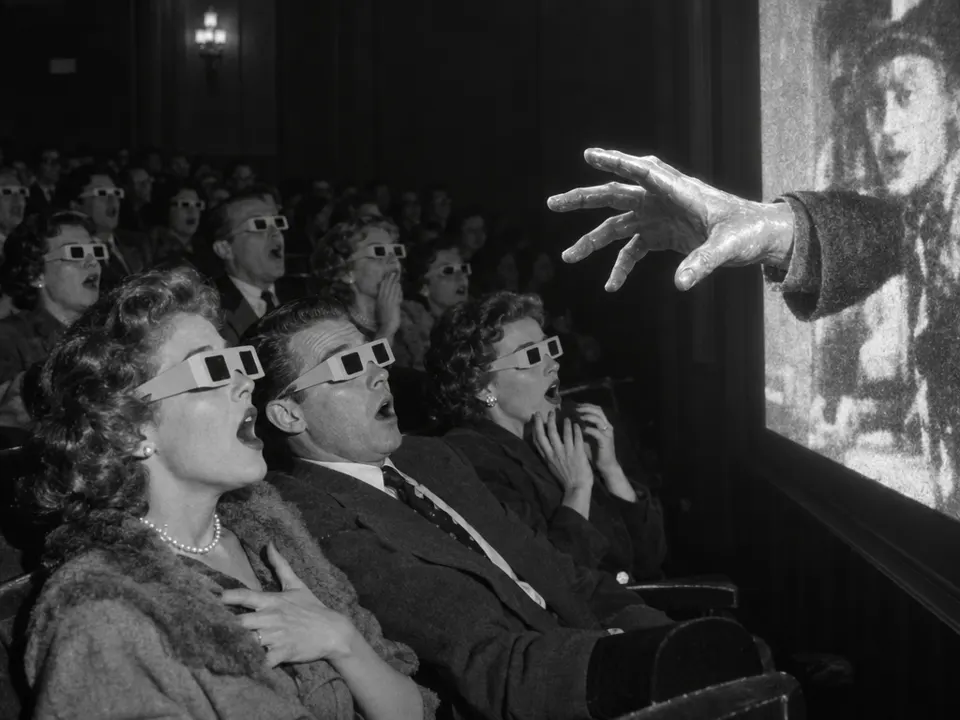
AI illustration: A theater audience wears polarized glasses while a hand appears to emerge
07 AI illustration: A theater audience wears polarized glasses while a hand appears to emergeA theater audience wears polarized glasses while a hand appears to emerge from the screen. This illustrates the perceived depth and off-screen projection typical of 1950s 3D cinema.Illustration generated for the Atlas (AI)

Sources