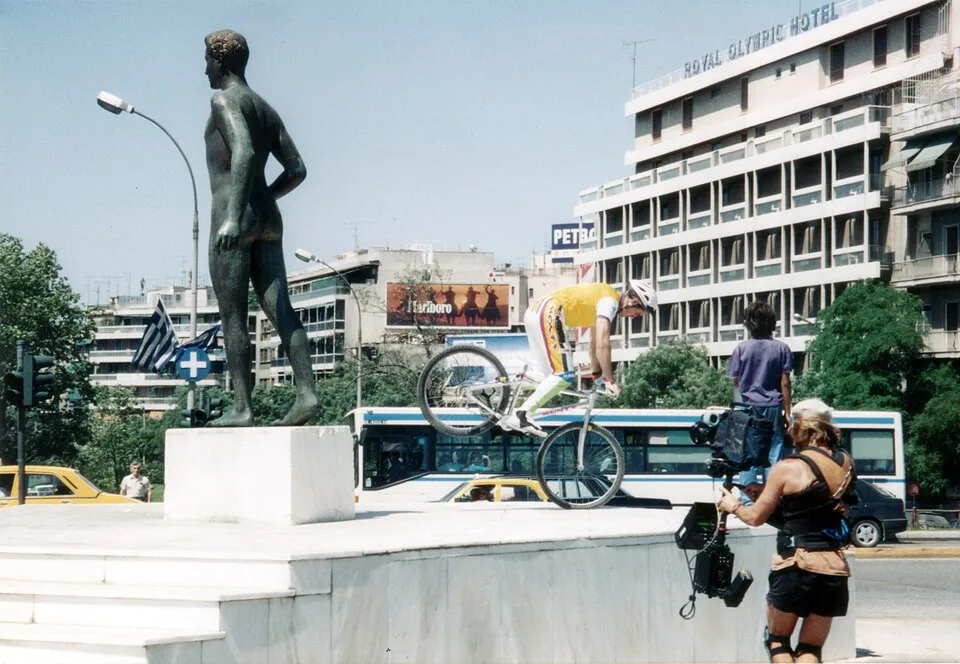
Steadicam Operator Following a Cyclist. A harnessed camera operator films a cyclist balancing on a raised stone platform in a city square.Pattymooney · CC BY-SA 3.0 · via Wikimedia CommonsView source ↗
Prompt
Transform this image into a cinematic stabilized-camera float frame, with a perfectly level horizon, a sharply anchored subject, gentle directional blur in peripheral scenery, and subtle foreground parallax cues. Use natural lighting and smooth tonal transitions to suggest unhurried gliding rather than handheld shake. Keep the original subject and composition.
You see a[smooth, gliding camera movement]that follows asubject perfectly. The shot feels unhurried and floating, even over rough ground.
Principle
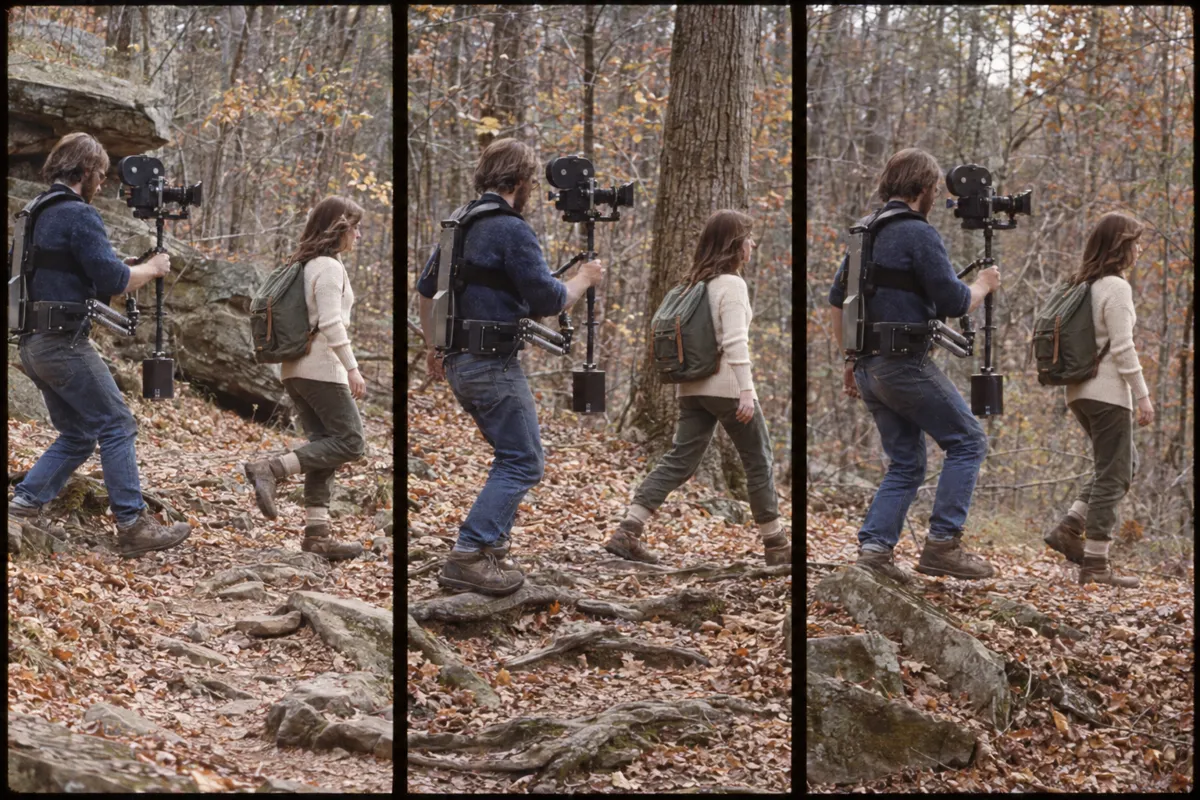
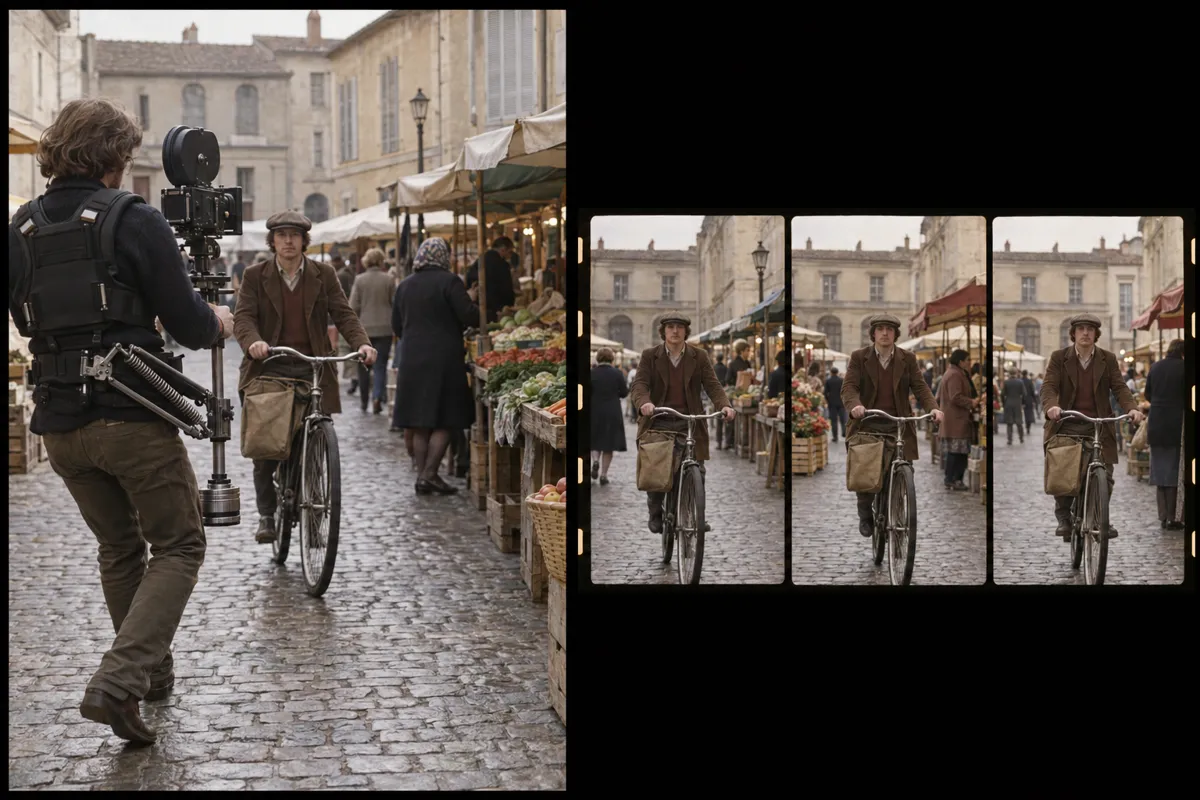
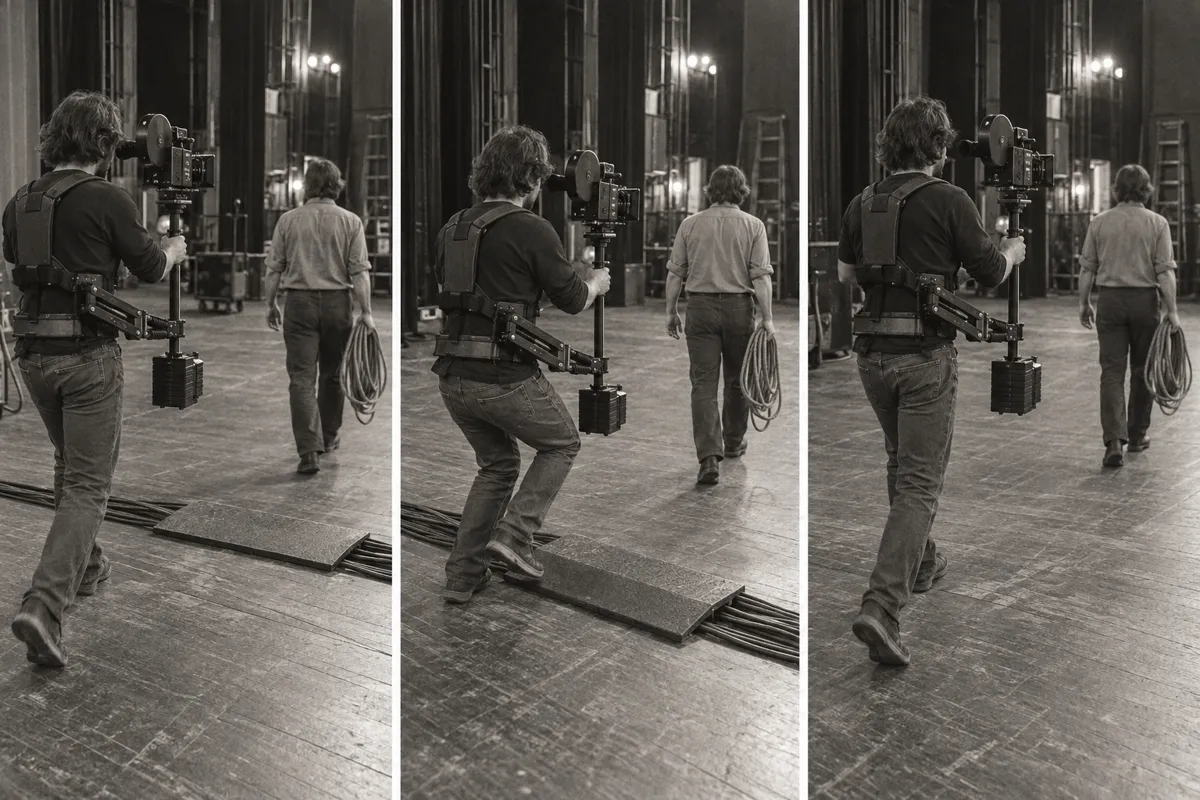
A[mechanical harness1isolates the camera]from the operator's body movements. Springs and counterweights2[absorb steps and bumps]to keep the lens level.
Example
Stanley Kubrick: The Shining, 1980.
Try it out
Walk briskly while holding acup filled to the brim with water; notice how your elbow acts like ashock absorber.
Background
Before 1975, filmmakers had two main choices for moving the camera. They could push aheavy dolly3on metal tracks, or they could hold the camera by hand. Tracks were smooth but took hours to build. Handheld shots were fast but shaky. Inventor Garrett Brown solved this by creating abody-mounted harness with an articulated arm. This system used heavy counterweights and springs to separate the operator's footsteps from the camera. The result was adevice that let aperson run up stairs or through forests while keeping the shot perfectly stable.
Distinction
Unlike adolly shot which moves in fixed straight lines, aSteadicam can turn freely and fit through tight doorways. Unlike handheld shots, it does not jitter when the operator walks.
Aftermath
It teaches us how isolating the camera's center of gravity unlocks absolute physical filming freedom.
Further examples · 7 images
02Harness-Supported Camera Beside an AircraftA vested camera operator aims a suspended camera sled at a presenter beside an aircraft while an assistant holds a light. The worn harness and counterbalanced sled demonstrate the mechanical isolation underlying Steadicam float, although movement cannot be assessed in this still.Brad Fallin · Public domain · Wikimedia Commons03Steadicam Support Arm in UseA camera operator wearing a support vest films a woman seated on aircraft steps beside a lighting assistant. The visible articulated support arm demonstrates how a Steadicam suspends the camera independently of the operator's body movements.Brad Fallin · Public domain · Wikimedia Commons04Studio Demonstration of a Steadicam HarnessA group gathers in a studio around a harnessed participant and camera stabilization equipment. The practical demonstration of a worn camera-support system illustrates the operator isolation used to achieve Steadicam float.Christian R. F. Schaller · CC BY 3.0 · Wikimedia Commons05AI illustration: Stabilized camera operation on uneven forest terrainA triptych shows an operator navigating a rocky forest path while wearing a camera harness with a spring-loaded arm. The sequence demonstrates how the counterweighted rig remains level and steady despite the uneven terrain and the operator's active steps.Illustration generated for the Atlas (AI)06AI illustration: Cinematography rig following a subject through a marketThis image captures a wide shot of a camera operator following a bicyclist through a cobblestone market, paired with film strip previews of the resulting shot. It provides a clear comparison between the mechanical rig in motion and the smooth, centered perspective it produces.Illustration generated for the Atlas (AI)07AI illustration: Mechanical isolation of camera movement on a soundstageA series of black and white frames shows an operator stepping over cables on a studio floor without disturbing the camera's orientation. The articulating arm of the vest is shown absorbing the vertical movement, illustrating the 'float' characteristic of the technique.Illustration generated for the Atlas (AI)
Question
Why does the Steadicam operator wear a vest?
Show possible answer +Hide answer −
The vest distributes the heavy weight of the camera and arm across the operator's hips and shoulders. This prevents severe back strain during long filming sessions.