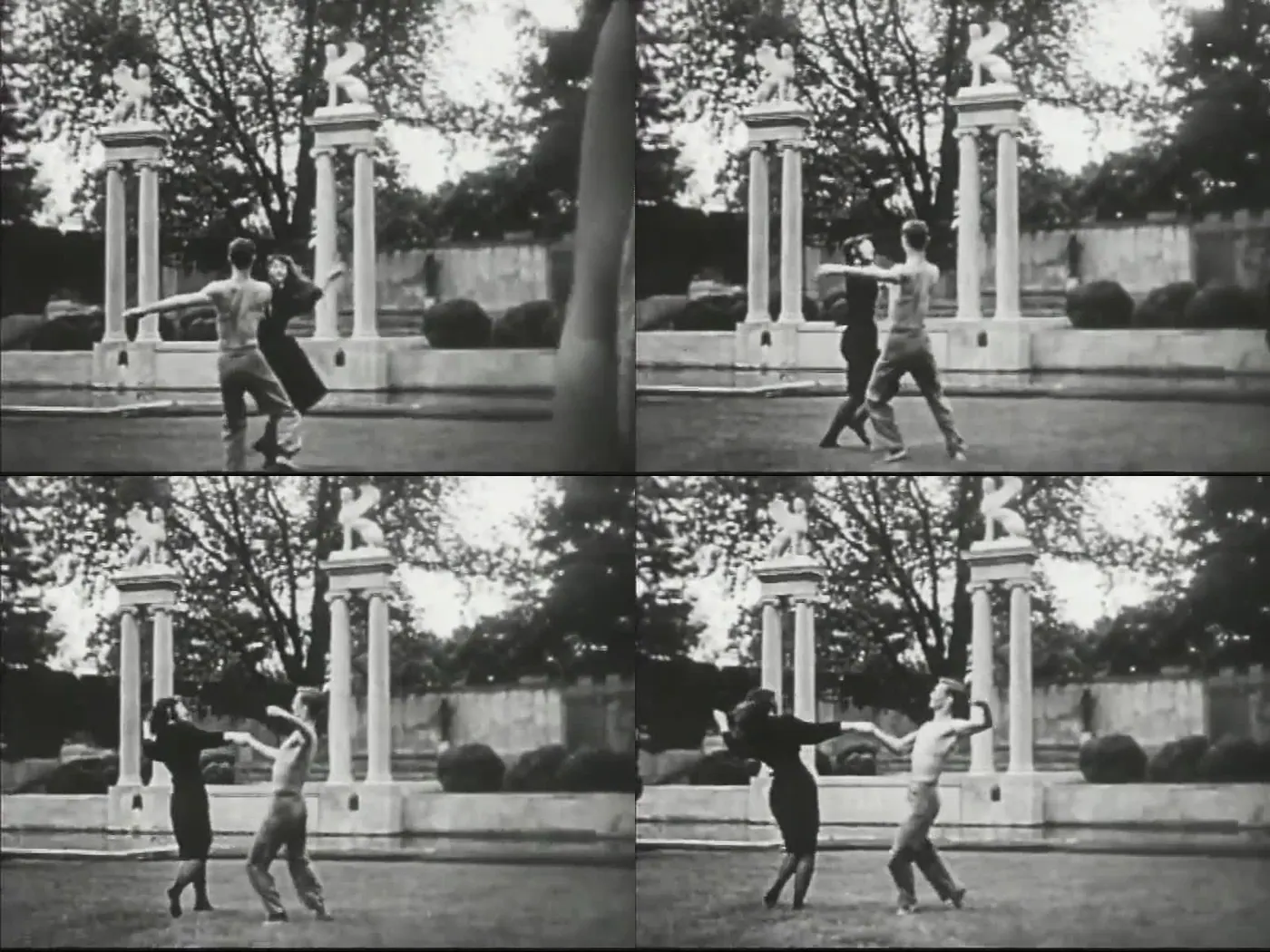
Slow motion / overcranking. 1920s experimental examples; later sports, advertising and action.
Typeface · Montserrat
Maya Deren: Ritual in Transfigured Time (1946). Four phases of movement; slow motion in the clip.
Temporal effect: still image or image sequence.Maya Deren / Rights Holder; Educational clip, Columbia Film Language Glossary.View source ↗
Prompt
Apply a Slow Motion photographic treatment, suggesting an extended instant through finely resolved airborne particles, gently trailing fabric or hair where present, and restrained translucent motion echoes around moving edges. Keep stationary forms sharp, with soft cinematic lighting and smooth tonal transitions. Keep the original subject and composition.
Slow motion makes invisible movement details visible or stretches out emotion and tension. Vertov used it in 1929; Maya Deren used it to emphasize dance in 1946. Classic overcranking increases the recording rate. Playback at normal rate then takes correspondingly longer. Modern software can estimate intermediate frames, but these are reconstructions and can be inaccurate in cases of occlusion or complex movements.
Distinction
Subsequently slowed-down footage does not provide new motion phases without intermediate frame calculations. The image sequence in the presentation shows the sequence of events, not the actual speed.
Aftermath
Slowed-down playback and ahigh recording frequency are different decisions.
Further examples · 8 images
02Slow Motion Sequence With Panasonic Gh4A modern digital camera is setup to record a high-frame-rate sequence. The live view screen shows the capture of moving subjects, which will appear as slow motion when played back at standard speeds.Robin Férand · CC BY 3.0 · Wikimedia Commons03Cup of tea (High Speed Photography)-MJThe image captures liquid spilling from a falling cup in mid-air with sharp detail. It demonstrates the result of a high frame rate recording, allowing individual droplets to be seen without motion blur.ŇÄĵŵÅ Ă. Мǻŗǻƒįę from KUWAIT · CC BY-SA 2.0 · Wikimedia Commons04High speed photographyLiquid is captured at the moment of impact, forming a complex crown-like structure. The absence of blur reveals the invisible movement details typical of high-speed cinematography used for slow-motion playback.Henningklevjer · CC BY-SA 2.5 · Wikimedia Commons05High speed photography test (6931313531)A splash resulting from an object dropping into liquid is captured with high precision. This illustrates the 'overcranking' result where fast action is made visible through high-speed capture.Syahmir · CC BY 2.0 · Wikimedia Commons06Low Cost High Speed Photography (16146346015)The photo shows the physical setup for high-speed photography, including a camera on a tripod and lighting. It documents the apparatus and environment needed to achieve slow-motion visual effects.Astro · CC BY 2.0 · Wikimedia Commons07Johnnie Walker SplashWhiskey splashes upward out of a glass, frozen mid-motion. The high-speed capture isolates the fluid dynamics, providing a representative look at a slow-motion film frame.Feel free to use my photos, but please mention me as the author and if you want send me a message. or (rufre@lenz-nenni · CC BY-SA 3.0 at · Wikimedia Commons08Jean-Martin Charcot chronophotographyThe grid of images documents a sequence of physical gestures over a brief period. This photographic decomposition illustrates how increasing the number of captured frames per second allows for a slower, detailed analysis of movement.Jean-Martin Charcot · Public domain · Wikimedia Commons
Question
What frequency do you need for five times slow motion at 24 fps?