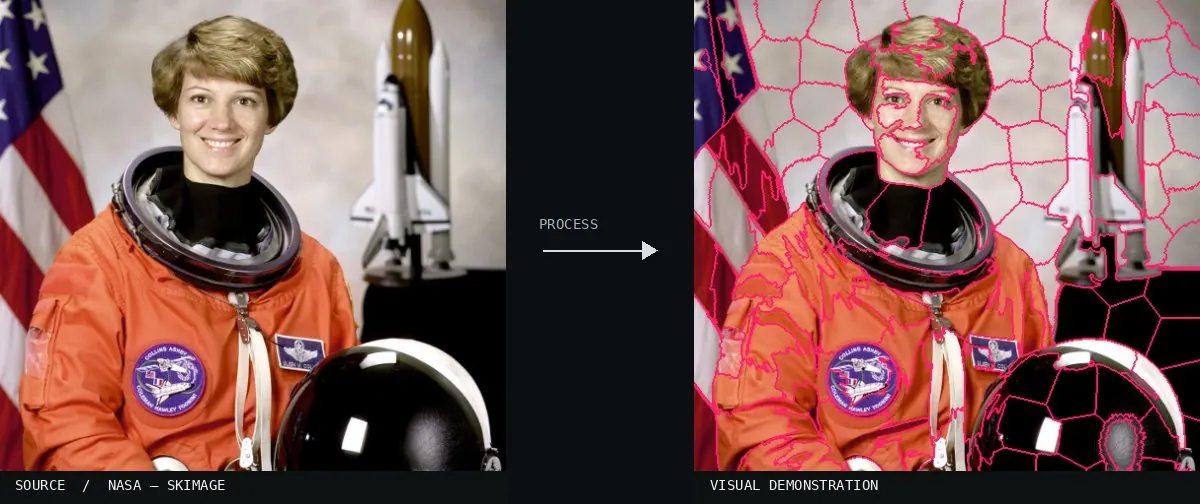
Real-world algorithm demonstration, applied to a NASA portrait.Image: NASA / Eileen Collins · scikit-image (public domain)View source ↗
Prompt
Apply SLIC Superpixels to divide the photograph into compact, connected, roughly equal-sized color cells that follow meaningful object boundaries. Fill each cell with its average local color and separate cells with thin dark seams, replacing fine texture with an orderly irregular mosaic. Keep the original subject and composition.
02The inference process of the two coupled dynamic Markov networks to obtain the joint video object discovery and segmentationThe image shows a 'Superpixels' stage in a computer vision pipeline. It displays a photograph partitioned into small, irregular, color-consistent clusters, which is the primary output of the SLIC algorithm.Bikingdog · CC BY-SA 4.0 · Wikimedia Commons03SLIC Superpixels, applied to “Cirrhopetalum Elizabeth Ann ‘Buckleberry’ 08Nov29a”Yellow boundaries outline clusters on an orchid flower. The segments adapt to the pink flower patterns and darker background leaves based on color proximity.池田正樹 (talk)masaki ikeda (photo); processed for the Atlas · Public domain · Wikimedia Commons04SLIC Superpixels, applied to “Kopenhagen (DK), Innenhafen -- 2017 -- 1699”Metal rings on stone are segmented into irregular cells. Smaller, more compact superpixels adhere to the complex textures and edges of the metal and masonry.Dietmar Rabich (photo); processed for the Atlas · CC BY-SA 4.0 · Wikimedia Commons05SLIC Superpixels, applied to “360° Schadonapaß”A mountain panorama is divided into a grid-like mesh of cells. The sky regions show high spatial compactness, while ground cells follow the rocky terrain contours.böhringer friedrich (photo); processed for the Atlas · CC BY-SA 2.5 · Wikimedia Commons06SLIC Superpixels, applied to “Steelport 6-Inch Chef Knife (2026)-104A7331”A chef knife on a rock surface is partitioned by yellow lines. The algorithm groups pixels by similar tones, respecting the sharp edges between the blade and the textured stone.Frank Schulenburg (photo); processed for the Atlas · CC BY-SA 4.0 · Wikimedia Commons07AI illustration: A portrait is segmented into irregular, non-uniform cellsA portrait is segmented into irregular, non-uniform cells. These clusters represent SLIC superpixels, where pixel groupings are determined by local color similarity and spatial proximity.Illustration generated for the Atlas (AI)