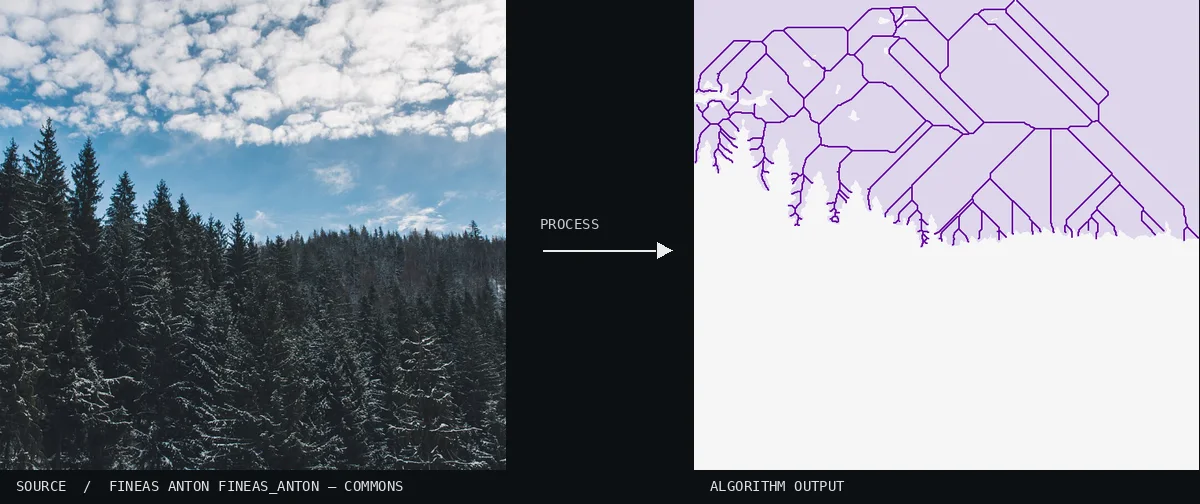
Atlas demonstration: the free source photo and the computed Skeletonization. A scenic landscape features a range of mountains and a line of evergreen trees. The purple lines perfectly trace the central axes of the mountain peaks and the individual branches of the firs.Image: Fineas Anton fineas_anton · CC0 (via Wikimedia Commons), processed for the AtlasView source ↗
Prompt
Transform this image into a Skeletonization visualization, reducing foreground shapes to thin white centerlines on black. Preserve their branching structure, connectivity, and enclosed loops, using nearly single-pixel strokes instead of exterior outlines. Remove solid fills and photographic texture while retaining the recognizable arrangement of forms. Keep the original subject and composition.
You see solid shapes reduced to a[topological skeleton1]made of thin lines that [trace their central paths].
Principle
Amorphological algorithm2repeatedly [peels away pixels]from the boundary of an object. It stops when only acontinuous backbone remains.
Try it out
Watch how complex outlines collapse into asimple network of intersecting branches.
Classification
Calculated image processing result.
Further examples · 9 images
02Skeletonization, applied to “Narrow Neck Beach (Unsplash)”A coastal scene displays rocky formations meeting the sea with clouds floating above. The purple web-like structures clearly define the geometric center of each geographic and atmospheric mass.Artem Verbo artemverbo (photo); processed for the Atlas · CC0 · Wikimedia Commons03Skeletonization, applied to “AERIAL FOOD COURT (Unsplash)”A detailed close-up of a snowflake or frost crystal formation. The intricate ice branches are perfectly distilled into thin, single-pixel backbones that follow every radial symmetry.Martin Sanchez zekedrone (photo); processed for the Atlas · CC0 · Wikimedia Commons04Skeletonization, applied to “Ripples on a mountain lake (Unsplash)”A wide view of a coastal cliffside meeting the sea. The large solid rock faces have been eroded in the image to reveal a structural grid of central topological lines.Braxton Stuntz braxton (photo); processed for the Atlas · CC0 · Wikimedia Commons05Skeletonization, applied to “Perfect Day at Coachella (Unsplash)”A complex scene with multiple layers of foliage or debris. The algorithm has systematically thinned every solid shape until only a dense, interconnected mesh of purple lines remains.Eric Ward ericjamesward (photo); processed for the Atlas · CC0 · Wikimedia Commons06Skeletonization, applied to “Train to catch (Unsplash)”The image appears to show a complex mechanical subject, perhaps an aircraft or automotive parts against a light background. Thin violet structures represent the reduced geometry of the various interlocking components and panels.Ryan Tang ryz0n (photo); processed for the Atlas · CC0 · Wikimedia Commons07Skeletonization, applied to “Train (Unsplash)”This composition depicts the silhouette of a modern high-speed train or aircraft fuselage. A network of lines illustrates the internal pathways within the solid purple masses of the vehicle's body.Mattias Diesel mattiasdiesel (photo); processed for the Atlas · CC0 · Wikimedia Commons08Skeletonization, applied to “Horse in New Mexico mountains (Unsplash)”The portrait focuses on the head of a cat, with its distinctive ears visible against a broader background. The lines form a topological map that follows the contours of the animal's face and the surrounding negative space.Lisa Lyne Blevins lisablevins (photo); processed for the Atlas · CC0 · Wikimedia Commons09Skeletonization, applied to “People standing on the beach (Unsplash)”A scenic landscape featuring a distant mountain range and a foreground shoreline. The processing has reduced the complex mountain peaks and rocky edges into a sparse network of purple geometric paths.Caleb George seemoris (photo); processed for the Atlas · CC0 · Wikimedia Commons