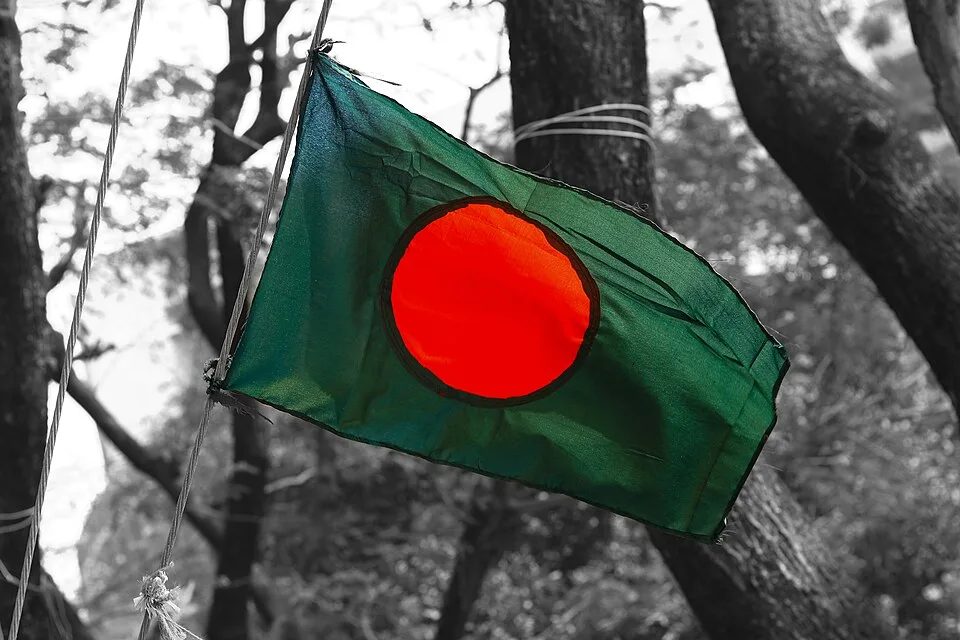
Colored Flag Against Monochrome Trees. A Bangladeshi flag retains its green field and vivid red disc against monochrome trees.A S M Jobaer · CC BY-SA 4.0 · via Wikimedia CommonsView source ↗
Prompt
Apply a Selective Color effect by retaining vivid natural color in one prominent existing object or clearly bounded area. Convert everything else to neutral grayscale with rich shadows and gentle highlights, using precise masks and clean edges without color spill or halos. Keep the original subject and composition.
You see an image that is [mostly black-and-white]. Asingle object or area retains its bright, natural color.
Principle
Film editors use [digital masks]to isolate aspecific item. They then [desaturate1the rest]of the image into grayscale.
Example
Steven Spielberg: Schindler's List, 1993.
Try it out
Look at acolorful photo and squint until only the brightest red or yellow object stands out from the background.
Background
Selective color creates stark contrast to guide the viewer's eye. Early filmmakers hand-painted dyes onto black-and-white film frames. The 1990s introduced digital compositing2instead. Editors scanned film into computers and mathematically removed color data from unselected pixels3. By drawing adigital boundary around an object, they preserved its original hues. This process turns normal color footage into black-and-white, except for the masked area. The technique highlights narrative importance. It famously marked innocence amidst ablack-and-white tragedy.
Distinction
Selective color digitally removes surrounding hues from an original color image. Hand-tinting physically adds colored dye to ablack-and-white image.
Aftermath
It teaches how stark contrast isolates subjects and forces audiences to notice specific narrative details.
Further examples · 11 images
02Pink Rose in Grayscale FoliageA bright pink rose rises among grayscale leaves and stems. The isolated color of the blossom against the desaturated foliage clearly demonstrates selective color.SavidgeMichael · CC BY 4.0 · Wikimedia Commons03Red House Beneath a Monochrome HillsideA red house and its enclosing wall stand beneath a grayscale hillside. The architectural surfaces retain their vivid color while the surrounding landscape is desaturated, demonstrating selective color.Ricardo de Vreede · CC BY-SA 4.0 · Wikimedia Commons04Yellow Daisy Centers in GrayscaleWhite daisies display bright yellow centers against dark, monochrome foliage. Color retained in the flower centers contrasts with the desaturated vegetation, clearly demonstrating selective color.SavidgeMichael · CC BY-SA 4.0 · Wikimedia Commons05Golden Gosling in a Monochrome GardenA golden-yellow gosling feeds among monochrome grass and flowers, with a blurred bird in the foreground. The gosling alone retains its warm coloration, clearly demonstrating selective color.SavidgeMichael · CC BY 4.0 · Wikimedia Commons06Yellow Facade in a Monochrome StreetscapeA columned building retains yellow facade accents beside a grayscale street, palms, and sky. Color isolated to the building distinguishes it from the desaturated surroundings, clearly demonstrating selective color.Dey.sandip · CC BY 3.0 · Wikimedia Commons07Orange Garnish in a Monochrome CaféAn orange garnish crowns a tall dessert glass in a black-and-white café scene. The garnish alone retains vivid color, clearly demonstrating selective color against a desaturated setting.Bhullargraphic · CC BY-SA 4.0 · Wikimedia Commons08Turquoise Weevil on Gray GroundA turquoise weevil with orange leg segments crosses a dark, textured surface beneath a blurred gray background. The insect retains its distinctive colors while its surroundings appear desaturated, exemplifying selective color.Ryan Hodnett · CC BY-SA 4.0 · Wikimedia Commons09Red Taillights and Monochrome ChromeA red automobile taillight projects from polished chrome, with another red lamp visible in the background. Red lenses and their reflections remain colored while the surrounding cars are grayscale, demonstrating selective color.Thomas Vogt from Paderborn, Deutschland · CC BY 2.0 · Wikimedia Commons10Red Bench Beneath Gray BranchesA red bench sits beneath an arching mass of pale gray branches, partly obscured by a tree trunk. Its retained red color stands out against the desaturated vegetation and ground, clearly displaying selective color.zeevveez from Jerusalem, Israel · CC BY 2.0 · Wikimedia Commons11Yellow-Centered Flowers in a Grayscale HandA grayscale hand cradles white flowers with luminous yellow centers against a dark gray background. Color preserved in the flowers contrasts unmistakably with the desaturated skin and surroundings.WKA Zisan · CC BY-SA 4.0 · Wikimedia Commons
Question
Why did filmmakers wait until the 1990s to widely use this effect in live-action movies?
Show possible answer +Hide answer −
Isolating moving objects frame-by-frame requires precise tracking. Digital software finally made this masking process fast and mathematically accurate.