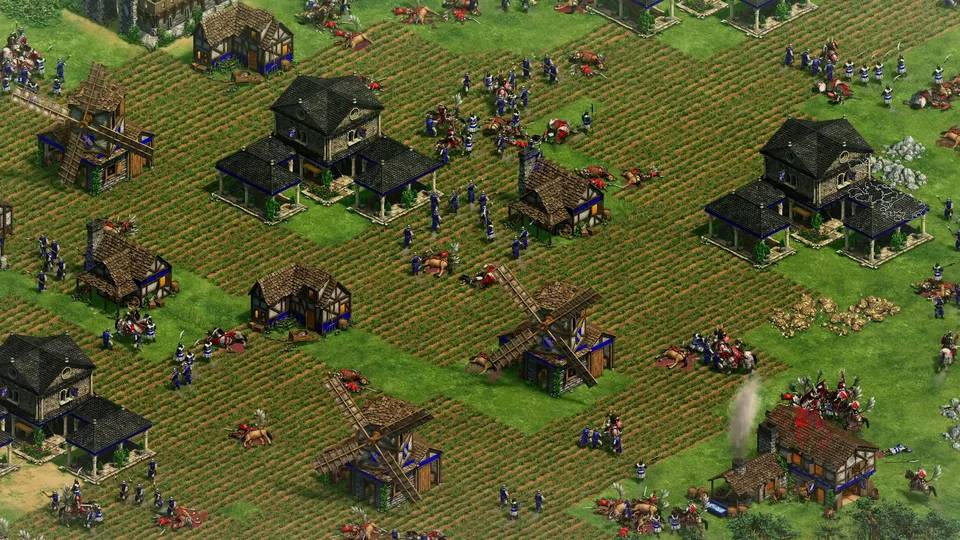
Medieval Isometric Strategy Game Scene. A bustling medieval village with farms, buildings, and tiny soldiers is depicted from a high, angled vantage point.Age of Empires · CC BY 3.0 · via Wikimedia CommonsView source ↗
Prompt
Transform this image into Isometric Pixel Graphics with parallel diagonal axes, no vanishing points, and consistent object scale regardless of depth. Build recognizable forms using crisp stair-stepped pixel edges, diamond-shaped surface grids, limited colors, and compact stepped shadows, retaining the existing arrangement. Keep the original subject and composition.
You see athree-dimensional world drawn on aflat grid [without vanishing points1]. Objects remain the same size whether they are near or far away.
Principle
Artists draw scenes using [parallel projection2], typically rotated 45 degrees and tilted down. Every pixel line follows a[rigid mathematical stepping pattern3].
Example
Maxis: SimCity 2000, 1993.
Try it out
Look at aboxy object in an isometric game and notice that its parallel lines never meet or converge.
Background
In the 1990s, computer hardware lacked the power to render complex 3D environments in real time. Developers solved this by pre-drawing 2D sprites and placing them on adiamond-shaped grid. True isometric projection uses athirty-degree angle. However, digital artists used atwo-to-one pixel stepping ratio instead. This created an angle of about 26.5 degrees. This specific ratio prevented jagged lines from appearing on low-resolution monitors. Players felt they were looking down into adeep, tactile miniature world. This allowed for vast, detailed strategy and role-playing games.
Distinction
Unlike true 3D graphics, isometric pixel art cannot rotate freely. The camera angle is permanently fixed by the artist's original drawings.
Aftermath
It demonstrates how technical constraints can create abeloved, timeless visual aesthetic.
Further examples · 10 images
02Assorted Isometric Pixel Art BlocksSeveral distinct, floating technological and architectural blocks are rendered in sharp digital detail against a white background. The uniform scale and parallel lines of the structures beautifully illustrate the fixed perspective and mathematical precision of isometric digital art.Drummyfish · CC0 · Wikimedia Commons03Isometric City Infrastructure SimulationA complex city infrastructure featuring towering skyscrapers, bridges, and transport networks is displayed from a diagonal overhead perspective. The pixel-perfect parallel projection ensures all structures remain identical in scale whether near or far, a hallmark of this graphic style.https://github.com/OpenTTD/OpenGFX/blob/master/README.md#60-credits https://www.openttd… · CC BY-SA 3.0 · Wikimedia Commons04Basic Geometric Isometric Pixel Art ShapesA pixelated cone, rectangular prism, and sphere are presented under a stylized sun alongside a numbered color palette. The sharp, stepped pixel edges of the prism unmistakably demonstrate the 2:1 geometric ratio required to create convincing isometric volume.Insnesnakos · CC BY-SA 4.0 · Wikimedia Commons05Snowy Isometric Industrial Logistics CenterA snowy industrial facility is populated with red-roofed buildings, cargo trucks, and a dense network of paved roads. The precise alignment of the vehicles and architecture along diagonal grid lines clearly showcases the fixed parallel projection of isometric graphics.KamuiZero · CC BY-SA 4.0 · Wikimedia Commons06Complex Isometric Train Yard SimulationAn expansive transit yard features multiple parallel train tracks, stacked cargo, and intricate rail intersections stretching across the landscape. The highly structured scene relies entirely on a strict mathematical grid without perspective foreshortening, highlighting the technical precision of isometric pixel art.KamuiZero · CC BY-SA 4.0 · Wikimedia Commons07Projection Angle Diagram for Isometric PixelsA diagram illustrates the specific angles and mathematical projections used to render three-dimensional cubes on a two-dimensional grid. It directly demonstrates the 2:1 pixel stepping ratio, yielding an angle of approximately 26.5 degrees, that forms the foundation of isometric pixel graphics.Datumizer · CC BY-SA 4.0 · Wikimedia Commons08Isometric Pixel Medieval SettlementA sprawling medieval settlement and harbor are depicted from a fixed, angled vantage point. The scene is constructed using 2D pixel sprites that adhere to a precise mathematical grid, showcasing depth without vanishing points.Age of Empires · CC BY 3.0 · Wikimedia Commons09Isometric Pixel Battle SceneArmies clash around intricately detailed medieval structures in this vibrant tactical view. The lack of perspective distortion allows units to remain consistently scaled, relying on stepped pixel lines to maintain the rigid isometric projection.Age of Empires · CC BY 3.0 · Wikimedia Commons10Isometric Pixel Transport MapA vast transport network weaves through a detailed, miniature landscape visible behind a game menu. The terrain and infrastructure are built from precise, tiled 2D pixel art strictly aligned to a mathematical isometric grid.OpenTTD for OpenGFX basic set, Saimmx for the screenshot · CC0 · Wikimedia Commons
Question
Why did digital artists use a 2:1 pixel ratio instead of a true 30-degree angle?
Show possible answer +Hide answer −
Astrict 2:1 ratio draws perfectly neat diagonal lines on ascreen. Atrue 30-degree angle creates messy, jagged pixel staircases.