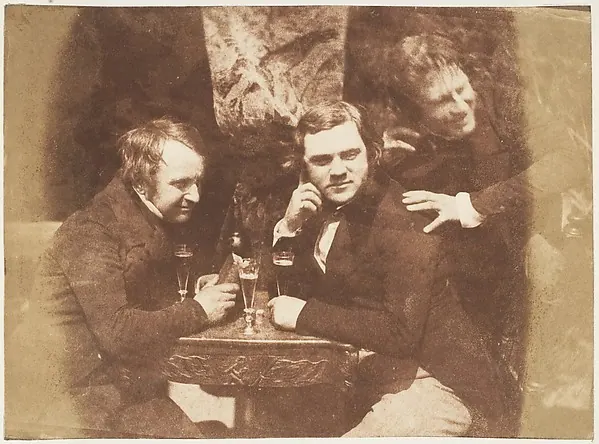
Salted paper print. From 1840 onwards; widespread before albumen paper
Typeface · IM Fell English
Hill and Adamson: Edinburgh Ale, circa 1844. Salted paper print.The Metropolitan Museum of Art / Hill and Adamson / Public DomainView source ↗
Prompt
Transform this image into a Salted Paper Print with muted reddish-brown shadows, creamy highlights, and gentle tonal gradations. Emphasize an uncoated matte surface, visible paper fibers, softened fine details, faint uneven sensitization, and lightly faded edges, with no glossy reflections or dense blacks. Keep the original subject and composition.
[Matte paper surface], soft details and [visible fiber structure].
Principle
Salt and silver nitrate1form [light-sensitive silver chloride]in the paper.
Example
Hill and Adamson: Edinburgh Ale, circa 1844.
Try it out
Compare image edges, paper texture, and detail contrast with albumen2.
Background
Talbot developed the salt paper print from his early experiments with light-sensitive paper. Anegative is placed directly on the prepared sheet and printed using daylight. The image substance is embedded in the paper fibers, which is why the texture plays amore significant role than with asmooth egg white layer. In the 1850s, albumen paper increasingly replaced the process; later art photographers rediscovered its material properties.
Distinction
Asalt print is the positive paper image. Calotype primarily refers to the process for the paper negative. Both can be related, but remain different stages of the photographic process.
Aftermath
The same negative can appear differently on different paper.
Further examples · 10 images
02Salted paper-kittyA cat rests on a striped surface next to a decorative pillow. The image shows the characteristic matte finish and soft edges where the light-sensitive silver chloride embedded into the paper fibers.Zwiebeltuete · CC BY-SA 3.0 · Wikimedia Commons03Salted Print Portrait of Noah Miller LudlowThis portrait of Noah Miller Ludlow features a man with a white beard. The visible grain and lack of a glossy surface layer demonstrate the direct absorption of the image into the paper.Mrs. Ida Franklin Ludlow · Public domain · Wikimedia Commons04UntitledThe photograph displays a medical study of a foot with a lesion. The soft tonal transitions and visible paper texture illustrate the diffusion of silver particles within the fibrous support.anonymous · Public domain · Wikimedia Commons05The Nelson Column in Trafalgar Square under ConstructionNelson's Column is shown under construction in Trafalgar Square. The print exhibits the low contrast and textural interference typical of Talbot’s early daylight printing process on prepared paper.William Henry Fox Talbot · Public domain · Wikimedia Commons06Architecture salt print, Roger Fenton, c1857-8A Gothic stone archway is depicted with figures standing at the entrance. The matte appearance and lack of fine highlight detail contrast with later albumen processes that used egg white.Roger Fenton · Public domain · Wikimedia Commons07Unaltered 1854 paper negative salt print (24345062027)A sailing ship is docked near a bridge and stone walls. The reddish-brown tone and lack of surface sheen are hallmarks of a salted paper print from a paper negative.Ernie Murphy · Public domain · Wikimedia Commons08Copy of a Large Italian Print, Reduced in the Camera by Henry Fox TalbotThis reproduction of an Italian print shows a high-arched bridge. The uneven, hand-coated borders clearly show where the silver nitrate was brushed onto the paper substrate.William Henry Fox Talbot / Luigi Rossini · Public domain · Wikimedia Commons09Nathaniel Hawthorne by John Adams Whipple, c. 1853, salted paper print, from the National Portrait Gallery - NPG-8800126C 2Nathaniel Hawthorne is presented in an oval-cropped portrait. The soft focus and integration of the image with the paper's physical texture are characteristic of 1850s salted paper technology.John Adams Whipple · CC0 · Wikimedia Commons10Salted-paper print, c. 1855, of one of Rome's oldest medieval buildings, digitally post-processed. (37859253605)This architectural study from 1855 demonstrates the characteristic matte finish of a salted paper print. The image is embedded in the paper fibers, resulting in a soft texture and a warm, reddish-brown tonal range.Ernie Murphy · Public domain · Wikimedia Commons
Question
Salt paper or calotype: Which refers to the positive sheet here?
Show possible answer +Hide answer −
The salt paper print; the calotype negative can provide its template.