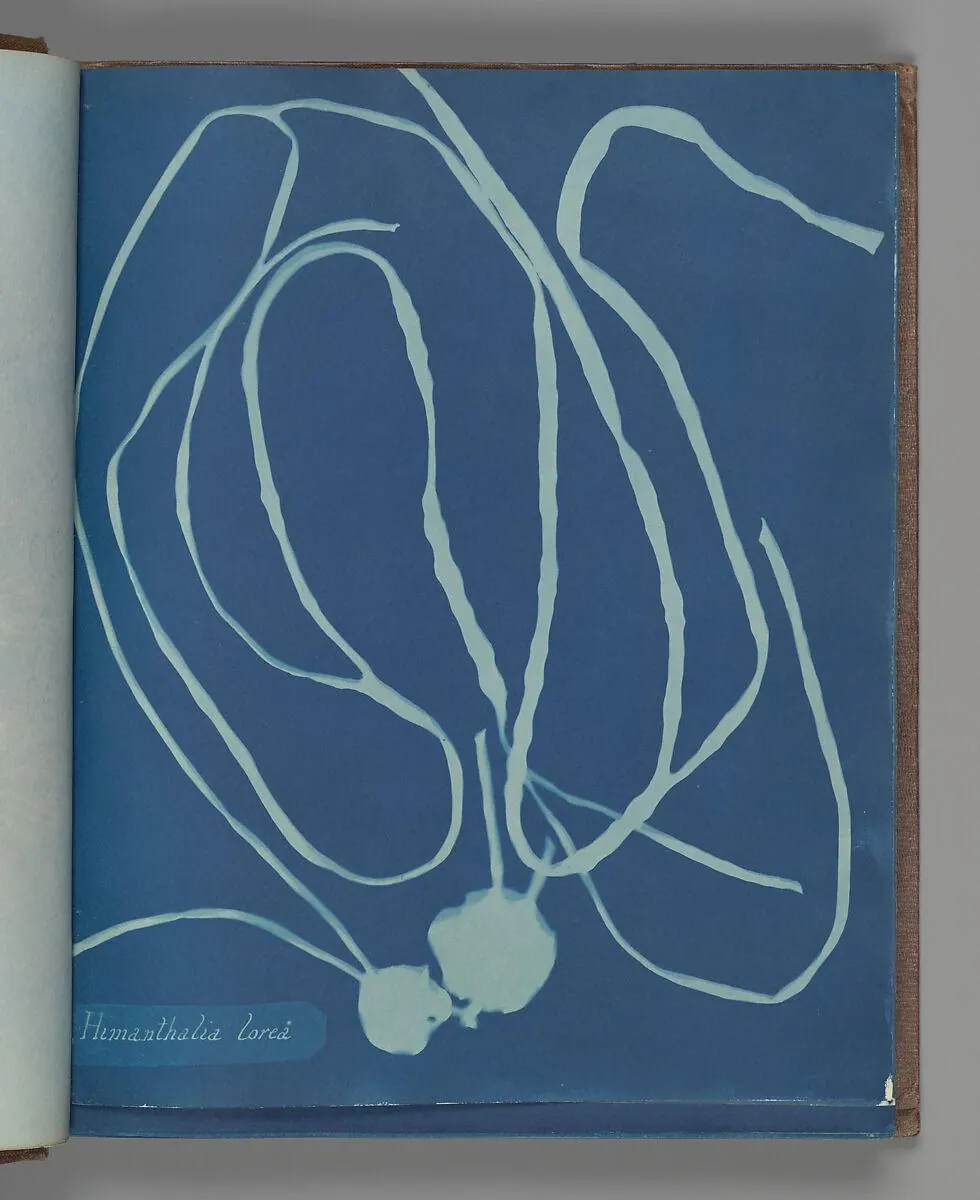
Cyanotype / blueprint. Invented in 1842, Atkins' picture books from 1843 onwards.
Typeface · Josefin Sans
Anna Atkins: Himanthalia lorea, c.1853, from Photographs of British Algae. Historical cyanotype…Anna Atkins / The Metropolitan Museum of Art. The Met Open Access / Public Domain.View source ↗
Prompt
Transform this image into a Cyanotype with deep Prussian blue shadows, pale blue intermediate tones, and clean paper-white highlights. Add matte watercolor-paper fibers, subtle coating irregularities, delicate translucent tonal transitions, and softly brushed blue borders, avoiding any other ink colors. Keep the original subject and composition.
[Prussian blue1areas]with [light silhouettes]and delicate transitions through semi-transparent objects.
Principle
[UV light alters iron salts]on paper. After washing, ablue print appears, either from the negative or as acontact print2.
Example
Anna Atkins: Himanthalia lorea, around 1853. Project started in 1843.
Try it out
Place aplant on ready-made cyanotype paper. Compare the contact print with adigital Cyanotype filter.
Background
John Herschel's process from 1842. Anna Atkins used it from 1843 onwards for botanical illustrations; later disseminated as ablueprint. Detailed mechanism: Iron salts react with UV light. After washing, Prussian blue areas and lighter areas remain; possible as aphotogram or from anegative. Cyanotype refers to the chemical process; photogram refers to the application of objects. An image can be both.
Distinction
Cyanotype refers to the chemical process; photogram refers to the placement of objects. An image can be both.
02Cyanotype - 4755148787Plant stems are arranged on green light-sensitive paper within a frame. It demonstrates the initial contact stage of the cyanotype process before UV exposure.Jodimichelle · CC BY-SA 2.0 · Wikimedia Commons03Cyanotype - 4755149743A blue print is submerged in water as the image develops. It shows the washing phase where unexposed iron salts are removed to reveal the blue color.Jodimichelle · CC BY-SA 2.0 · Wikimedia Commons04Cyanotype - 4755148699A blank sheet of treated green paper rests on a white towel. This represents the prepared substrate ready to receive objects for a photogram.Jodimichelle · CC BY-SA 2.0 · Wikimedia Commons05Cyanotype - 4755149293A contact frame containing plants and paper sits on grass for sun exposure. This illustrates the use of natural UV light to trigger the chemical reaction.Jodimichelle · CC BY-SA 2.0 · Wikimedia Commons06Cyanotype - 4755148861A piece of coated paper is placed under a glass plate on a wooden surface. This shows the assembly of materials required for a sharp contact print.Jodimichelle · CC BY-SA 2.0 · Wikimedia Commons07Cyanotype - 4755150037The blue image of a plant is visible through a layer of water in a tray. This captures the transition from green salts to stable Prussian blue.Jodimichelle · CC BY-SA 2.0 · Wikimedia Commons08Cyanotype - 4755150393Several finished cyanotypes with white botanical silhouettes are lined up outdoors. These show the high-contrast results typical of the 1840s historical method.Jodimichelle · CC BY-SA 2.0 · Wikimedia Commons09Cyanotype - 4755150255A single blue print displays a clear white silhouette of a flower. The sharp boundaries exemplify a successful botanical photogram application.Jodimichelle · CC BY-SA 2.0 · Wikimedia Commons10Cyanotype - 4755789402Dried plants are held against green paper by a glass pane and binder clip. This setup ensures direct contact for capturing delicate botanical transitions.Jodimichelle · CC BY-SA 2.0 · Wikimedia Commons11Cyanotype - 4755149451Multiple flower specimens are arranged on sensitized paper under glass in a field. It illustrates the portability of the cyanotype process for botanical field studies.Jodimichelle · CC BY-SA 2.0 · Wikimedia Commons