1842, Sir John Herschel's experiments with plant juices
Typeface · EB Garamond
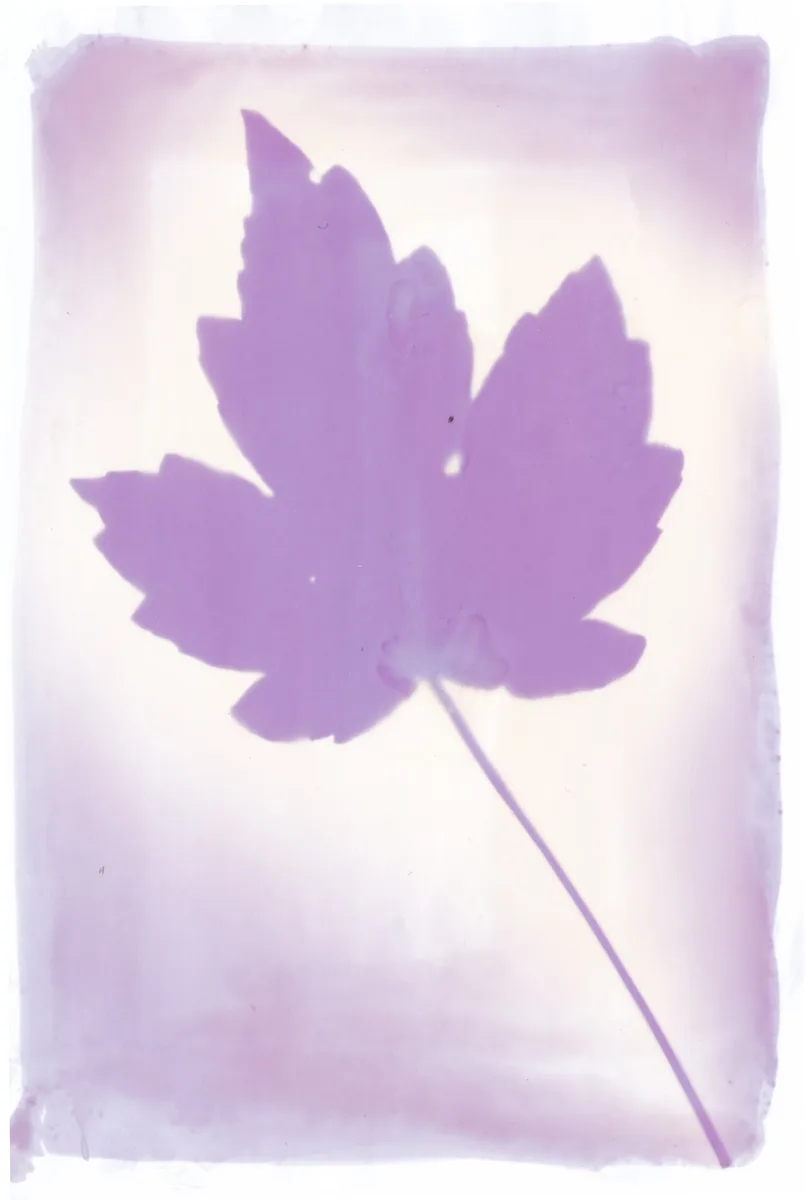
Pale purple leaf anthotype photogram. A pale purple silhouette of a leaf is visible against a faded background.Hutschi · CC BY-SA 4.0 · via Wikimedia CommonsView source ↗
Prompt
Transform this image into an Anthotype using a single pale botanical purple pigment on absorbent paper. Create sun-bleached highlights, low contrast, soft edges, uneven hand-coated staining, and faint plant-dye mottling, allowing the image to appear fragile and partially faded without deep blacks. Keep the original subject and composition.
You see a[soft, monochromatic image]in natural hues like pale pink, purple, or green. The picture often looks faded, [lacking sharp contrast]or deep blacks.
Principle
Sunlight slowly destroys the color of a[plant-based dye]coated on paper. The covered areas keep their original color, creating apositive image1.
Example
Sir John Herschel: Experimental anthotype of an engraving, 1842.
Try it out
Leave adark piece of construction paper partly covered in bright sunlight for aweek to see the uncovered dye fade.
Background
In 1842, Sir John Herschel experimented with using crushed flower petals and plant juices to make photographs. He coated paper with alcohol-extracted pigments from poppies, violets, or spinach. He then placed an object or positive transparency2over the dried paper. Leaving it in direct sunlight for days or weeks destroyed the unprotected pigment. This fading process left avisible image. However, the technique was entirely impractical. The images could not be chemically fixed3to stop the fading. Any further exposure to ambient light gradually erased the picture completely. Consequently, very few original anthotypes survive today.
Distinction
Unlike cyanotypes which use iron salts to create stable blue images, anthotypes use unstable plant dyes. Anthotypes cannot be fixed and remain forever sensitive to light.
Aftermath
This delicate technique highlights the fundamental challenge of early photography: making an image permanent.
Further examples · 11 images
02Purple leaf silhouette anthotype printA soft, purple silhouette of a lobed leaf appears on a lighter, sun-bleached paper background. This is a classic classic example of an anthotype made using plant materials.Hutschi · CC BY-SA 4.0 · Wikimedia Commons03Faded purple maple leaf anthotypeA monochromatic, faded purple image of a maple leaf shows the unexposed dye where the leaf blocked the sun. This perfectly demonstrates the anthotype technique's characteristics.Hutschi · CC BY-SA 4.0 · Wikimedia Commons04Pink circular slice anthotype photogramA pinkish circular shape, resembling a cross-section of a fruit or plant, remains colored while the surrounding area has faded. This is a clear demonstration of the anthotype process's positive imaging.Hutschi · CC BY-SA 4.0 · Wikimedia Commons05Reddish-brown anthotype print of a buildingA soft, monochromatic reddish-brown image of a building is shown with visible brush strokes from the emulsion coating. This demonstrates how a photographic transparency can be used to create a detailed anthotype print.Hutschi · CC BY-SA 4.0 · Wikimedia Commons06Yellow anthotype print of a buildingA yellow, low-contrast photographic print of a building shows the characteristic fading of photosensitive plant dyes. It is a genuine example of an anthotype made from a positive transparency.Hutschi · CC0 · Wikimedia Commons07Grey-blue leafy stem anthotypeA delicate, greyish-blue silhouette of a leafy stem is centered on a sun-bleached background. The soft edges and natural dye color perfectly illustrate the anthotype photogram technique.Hutschi · CC BY-SA 4.0 · Wikimedia Commons08Faded grey flower anthotype photogramTwo faded greyish flower silhouettes stand out against a lighter background where the dye has degraded. The lack of sharp contrast and natural hues confirm it is a genuine anthotype.Hutschi · CC BY-SA 4.0 · Wikimedia Commons09Grey-Blue Anthotype of a Leaf SprigThis image shows a faint grey-blue print of a sprig with leaves on a lighter background. It perfectly demonstrates the anthotype technique, where the covered area retained the original dye color against the sun-faded paper.Hutschi · CC BY-SA 4.0 · Wikimedia Commons10Pale Purple Anthotype of a Jagged LeafA pale blue-purple silhouette of a jagged leaf is visible on a lighter, washed-out background. This is a classic anthotype showing the preserved plant-based dye color where the leaf blocked the sunlight.Hutschi · CC BY-SA 4.0 · Wikimedia Commons11Soft Pink Anthotype Showing Leaf SilhouettesThis image displays a soft pinkish print showing the faint silhouettes of several leaves. It matches the anthotype process perfectly, utilizing a pink plant dye that faded in the sun-exposed areas.Hutschi · CC BY-SA 4.0 · Wikimedia Commons
Question
Why do anthotypes take days or weeks to expose?
Show possible answer +Hide answer −
Plant pigments are not highly sensitive to light like silver compounds. They require prolonged, intense UV exposure to break down the color molecules.