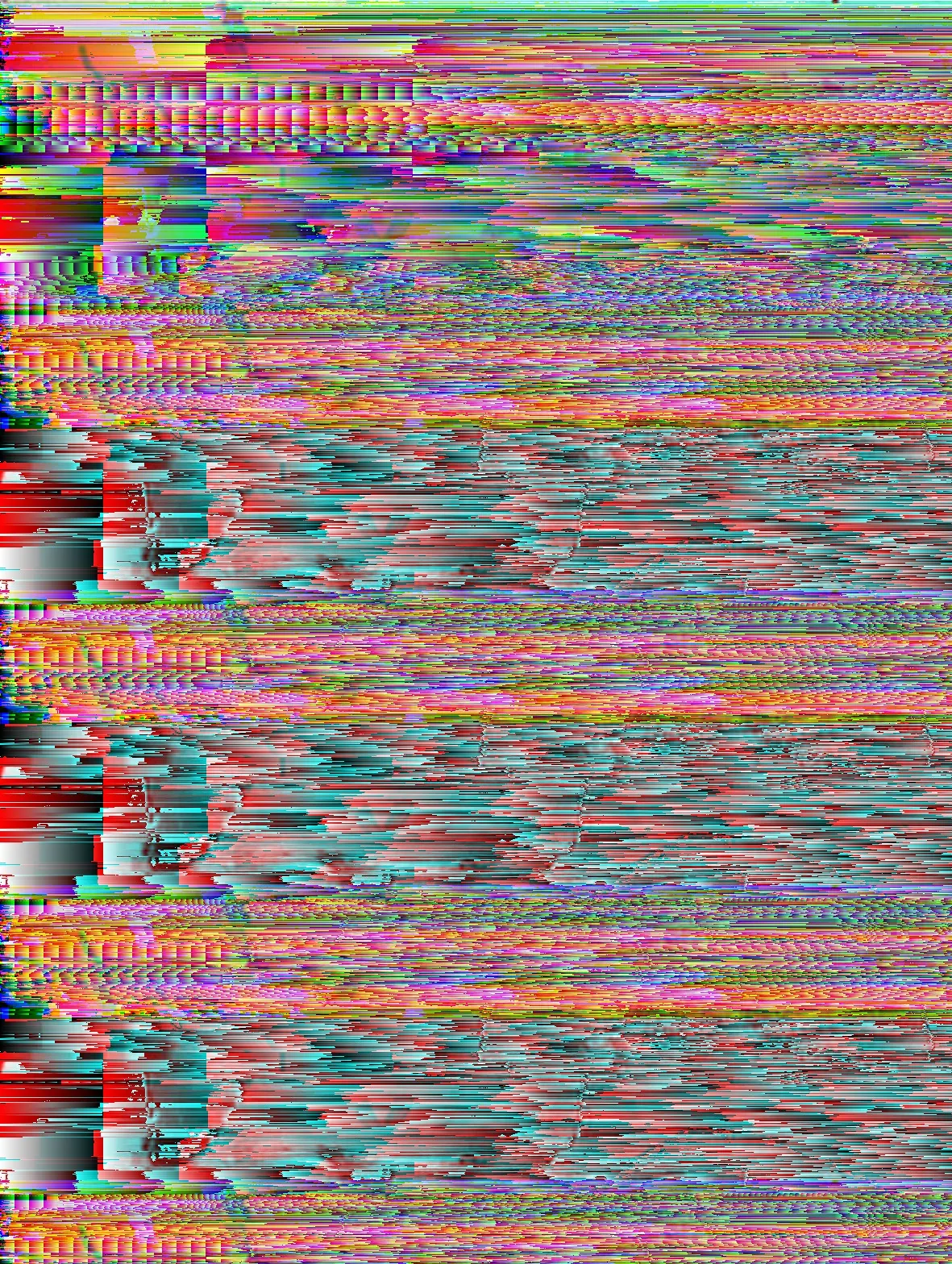
RGB split / chromatic glitch. Older predecessors. Customizable digital look of the 2010s.
Typeface · Monoton
Rosa Menkman: Glitch Art, 2011: digital color fringes and destroyed image structure.Rosa Menkman. CC BY 2.0View source ↗
Prompt
Apply an RGB Split effect by offsetting red, green, and blue channels into visible colored double contours. Add selective horizontal line displacement, small block errors, and brief-looking image jumps concentrated near high-contrast edges. Preserve a readable central image beneath the damaged digital signal aesthetic. Keep the original subject and composition.
[Red-cyan double contours], shifted lines and image jumps indicate adamaged digital signal.
Principle
[Color channels1are shifted]relative to each other. [Line offsets and block errors]simulate signal problems. Actual data manipulation can produce similar artifacts2.
Example
Rosa Menkman: AVernacular of File Formats (2010) examines digital artifacts.
Try it out
Shift the red channel of aportrait. Add line errors. Test how little distortion is needed for the desired effect.
Background
Older technical and artistic precursors; strongly present in the 2010s as acustomizable effect and plug-in look.
The red, green, and blue channels are shifted relative to each other. Additional line offsets, block errors, noise, or image dropouts create adistorted signal aesthetic. True databending and acontrolled filter can look similar.
Rosa Menkman, AVernacular of File Formats (2010), as an important reference for the study of digital artifacts; not as the alleged invention of the RGB split filter.
Regarding the image: Historical original / source image. The authentic glitch artwork shows colorful channel/line distortions. It is an example of glitch art; not every visible distortion is identical to asimple RGB split filter.
Distinction
Optical chromatic aberration arises from wavelength-dependent lens behavior. RGB splitting is afreely configurable digital channel shift; Datamosh uses temporal compression. There is no single inventor and no reliable first trend year. The classification describes astylistic trend, not the origin of the chromatic error.
Aftermath
Technical errors become arecognizable language for instability, networks, memory, and media friction.
Further examples · 9 images
02Self-portrait (2015-12-23 23.19.58 by Antonio Roberts)Digital self-portrait featuring horizontal line offsets and color channel displacement. The shifted red and cyan contours over the face create the characteristic 2010s glitch aesthetic through simulated signal errors.Antonio Roberts from Birmingham, Britain · CC BY-SA 2.0 · Wikimedia Commons03Self-portrait (2015-12-23 23.45.16 by Antonio Roberts)A portrait projected with digital artifacts, showing distinct shifts in the color channels. Horizontal bands of color and block errors are visible, demonstrating the intentional manipulation of RGB data for artistic effect.Antonio Roberts from Birmingham, Britain · CC BY-SA 2.0 · Wikimedia Commons04Self-portrait (2015-12-23 23.24.23 by Antonio Roberts)Profile portrait with heavy digital distortion. The image displays overlapping, misaligned color channels and fragmented line errors that simulate a corrupted digital file or damaged signal transmission.Antonio Roberts from Birmingham, Britain · CC BY-SA 2.0 · Wikimedia Commons05Self-portrait (2015-12-23 23.41.07 by Antonio Roberts)Frontal portrait displaying significant RGB splitting across the face. The misalignment of red and blue-green components creates vibrantly colored double contours, typical of digital glitch art techniques.Antonio Roberts from Birmingham, Britain · CC BY-SA 2.0 · Wikimedia Commons06Self-portrait (2015-12-23 23.29.35 by Antonio Roberts)Side view portrait utilizing digital artifacts and color channel shifts. The composition demonstrates how shifting color layers relative to each other creates a sense of digital signal instability and depth.Antonio Roberts from Birmingham, Britain · CC BY-SA 2.0 · Wikimedia Commons07Self-portrait (2015-12-23 23.40.29 by Antonio Roberts)Self-portrait featuring complex digital noise and RGB channel misalignment. The effect produces visible color fringes and horizontal line jumps, illustrating the aesthetics of file format vernacular and digital error.Antonio Roberts from Birmingham, Britain · CC BY-SA 2.0 · Wikimedia Commons08Self-portrait (2015-12-23 23.28.06 by Antonio Roberts)A portrait overlaid with geometric glitches and color separation. The red channel is visibly offset, creating colored borders that define the RGB split look popularized in the 2010s.Antonio Roberts from Birmingham, Britain · CC BY-SA 2.0 · Wikimedia Commons09Self-portrait (2015-12-23 23.29.20 by Antonio Roberts)Headshot with intentional digital distortion. The picture shows a clear separation of primary color channels and horizontal tearing, providing a good example of controlled digital signal manipulation.Antonio Roberts from Birmingham, Britain · CC BY-SA 2.0 · Wikimedia Commons