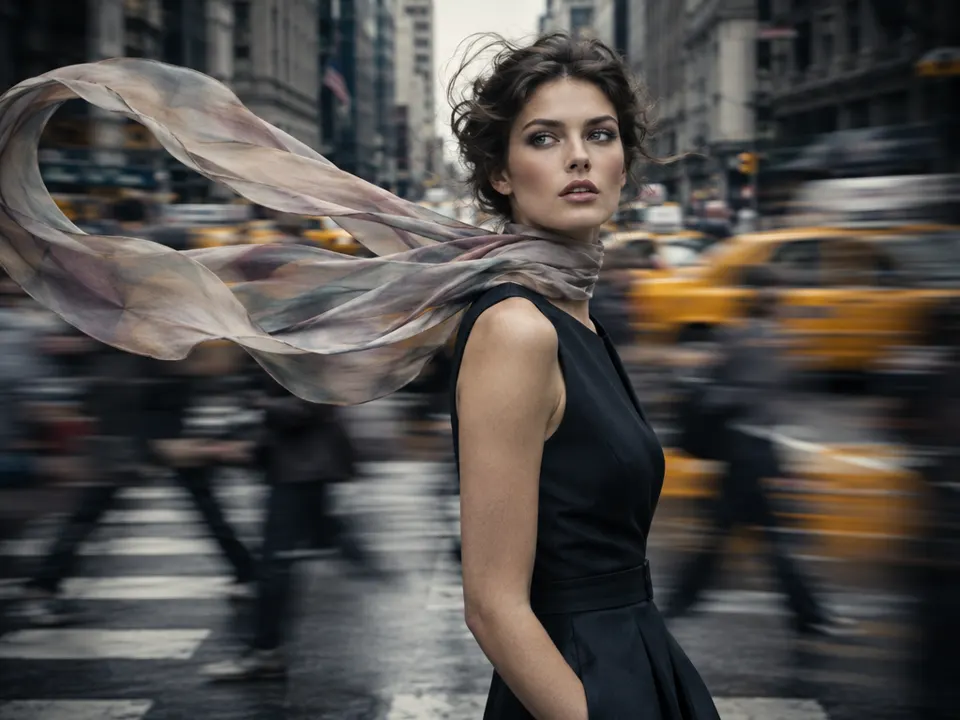
Cinemagraph
Beck and Burg coined the term in 2011. Selective loops are older.

Prompt
Apply a Cinemagraph aesthetic, making the scene appear completely frozen except for one small region of implied motion. Use delicate localized blur in existing smoke, water, or loose fabric, with seamless boundaries and otherwise tack-sharp surroundings. Preserve photographic lighting and avoid global movement streaks. Keep the original subject and composition.
Identify
The photo appears frozen. Only smoke, water, or clothing move endlessly.
Principle
A frozen image is overlaid on video. A mask1 releases selected movement. The transition is loop2ed seamlessly.
Example
Jamie Beck and Kevin Burg develop their Fashion Week practice in 2011.
Try it out
Film a static shot. Freeze a frame and mask a moving detail as a loop.
Background
Concept and known working practice of Jamie Beck and Kevin Burg from 2011 onwards.
A single still image is superimposed on a short video. A mask reveals only the moving part. The beginning and end are joined as seamlessly as possible.
Jamie Beck and Kevin Burg, the first so-called cinemagraphs, were created in 2011, among other things from their fashion and New York Fashion Week environment.
For illustration: Historical original frames, mounted side by side. Only the spoon and hand in the coffee area are moving, while the rest remains photographically still. Original frames 0 and 5 are shown side by side; no movement has been added later.
Distinction
GIF is a possible file format, cinemagraph a visual style. A standard video loop can move the entire image. Selective animation and loops are older concepts. Beck and Burg coined the term, not every form of partially moving image.
Aftermath
The photo acquired a subtle temporal dimension that worked particularly well for fashion, advertising, and social media loops.
Further examples · 7 images