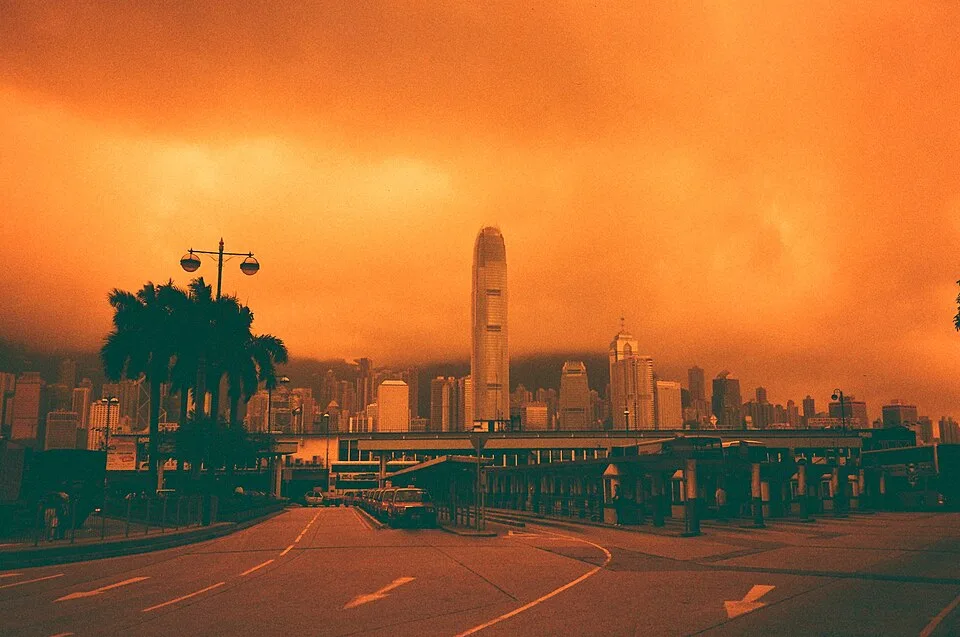
Waterfront Skyline Beneath an Orange Sky. A waterfront skyline and curving roadway lie beneath a dramatically orange clouded sky, with buildings and palms sinking into dark green shadows.cliffchen1973 from Kaohsiung, Taiwan · CC BY 2.0 · via Wikimedia CommonsView source ↗
Prompt
Apply a Redscale Film effect with dominant crimson shadows, burnt-orange midtones, and golden-yellow highlights. Suppress blue responses, shifting skies toward mustard or muted olive where present. Add organic film grain, slightly softened fine detail, and uneven warm color density without introducing digital glitches. Keep the original subject and composition.
Images show a[strong color shift]toward warm tones like red, orange, and yellow. Skies may appear green or dark yellow instead of blue.
Principle
The film is [loaded backwards]so light hits the back of the film first. It passes through the [red-sensitive layer]before reaching the green and blue layers.
Example
Lomography Society: Redscale XR film release, 2008.
Try it out
Look through apiece of dark orange cellophane to see how it filters and warms the colors of your surroundings.
Background
Redscale emerged as apopular technique during the early 2000s analog photography revival. Photographers manually spooled color negative film1backwards into empty canisters. Normally, light hits the blue-sensitive layer first, then green, then red. By reversing the film, light passes through the semi-opaque anti-halation layer2and the red-sensitive layer first. This starves the blue and green layers of light. The result is astriking, unpredictable warm color cast. Commercial film companies eventually manufactured pre-reversed redscale film to meet the growing demand from experimental photographers.
Distinction
Unlike sepia toning which applies auniform brown dye to monochrome prints, redscale alters how color film chemically records different wavelengths.
Aftermath
It demonstrates how altering the physical sequence of light exposure changes the entire chemical translation of ascene.
Further examples · 11 images
02Taxi and Bus in Orange StreetscapeA taxi and double-decker bus pass an arcaded building in a street scene saturated with orange, red, and yellow. The warm cast extends across pavement, architecture, and highlights while shadows turn green-black, strongly exemplifying the redscale effect.cliffchen1973 from Kaohsiung, Taiwan · CC BY 2.0 · Wikimedia Commons03Taxis Crossing an Orange RoadTwo taxis cross a sunlit road beside a double-decker bus and deeply shadowed trees. Orange pavement, yellow highlights, and nearly black green foliage reveal the pronounced color redistribution characteristic of redscale film.cliffchen1973 from Kaohsiung, Taiwan · CC BY 2.0 · Wikimedia Commons04Turning Taxi at an Amber IntersectionA red taxi turns through a busy commercial intersection framed by tall buildings and shop signs. The uniformly orange roadway and architecture, yellow-white highlights, and green-black shadows provide a clear demonstration of redscale color shifts.cliffchen1973 from Kaohsiung, Taiwan · CC BY 2.0 · Wikimedia Commons05Restaurant Street in Golden OrangePedestrians walk past a restaurant along a narrow street washed in golden yellow and orange. The warm transformation of normally neutral surfaces and the loss of natural blue tones clearly display the redscale effect.cliffchen1973 from Kaohsiung, Taiwan · CC BY 2.0 · Wikimedia Commons06Redscale City StreetPedestrians and vehicles fill a city street beneath spreading trees, with buildings rendered in fiery orange and shadows in deep green. The pervasive warm shift and suppression of blue clearly demonstrate the characteristic palette of redscale film.cliffchen1973 from Kaohsiung, Taiwan · CC BY 2.0 · Wikimedia Commons07Amber Harbor SkylineA waterfront skyline rises above an amber harbor beneath yellow-orange clouds. The transformation of sky, water, and buildings into a nearly continuous warm palette strongly exemplifies redscale rendering.cliffchen1973 from Kaohsiung, Taiwan · CC BY 2.0 · Wikimedia Commons08Ferry Beneath a Yellow SkyA ferry rests beside a waterfront skyline, its dark hull contrasting with orange water and luminous yellow clouds. The displaced sky color and pervasive orange cast are characteristic of redscale film.cliffchen1973 from Kaohsiung, Taiwan · CC BY 2.0 · Wikimedia Commons09Orange Sky Over an Open LandscapeAn elevated view overlooks a broad landscape and pedestrian approach beneath a saturated orange sky, with bluish flares along the lower edge. The orange daylight sky and warm terrain against green-black shadows clearly display the redscale effect.Veera.sj · CC0 · Wikimedia Commons10Monument Against an Orange SkyA towering standing statue rises between rows of poles against an intensely orange sky. The replacement of ordinary daylight blue with orange, paired with deep greenish shadows, clearly demonstrates redscale film coloration.Veera.sj · CC0 · Wikimedia Commons11Rounded Building in Mustard and RustA rounded building with decorative balconies rises against a muted brown sky, its facade rendered in mustard yellow and rusty orange. The pervasive warm shift and suppression of blue are characteristic of redscale film.Veera.sj · CC BY-SA 4.0 · Wikimedia Commons
Question
Why do some redscale photos look mostly yellow instead of deep red?
Show possible answer +Hide answer −
Overexposing the film pushes more light through to the green and blue layers. This shifts the overall image color from dark red toward bright yellow.