2000s, popularization in digital sports and automotive photography
Typeface · Squada One
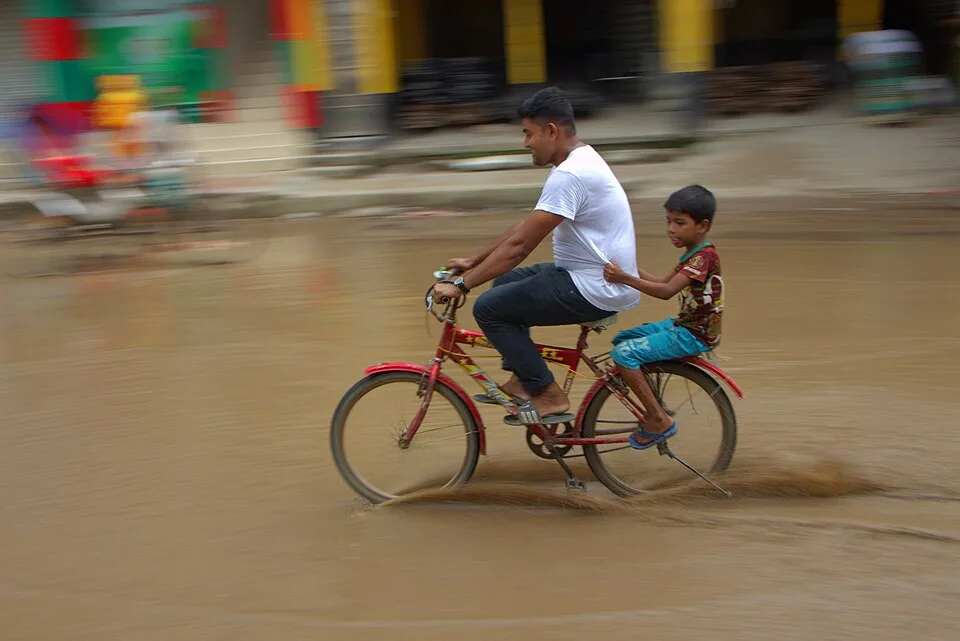
Bicycle Riders Crossing a Wet Street. A man pedals a red bicycle with a child seated behind him, crossing a wet street against streaked storefronts.Md.Mijanur rahman Mijan · CC BY-SA 4.0 · via Wikimedia CommonsView source ↗
Prompt
Transform this image into a Panning Shot, keeping the main subject mostly sharp against long horizontal background streaks. Stretch surrounding colors into directional bands, add restrained motion softness to moving extremities, and preserve clear focal contours. Maintain natural exposure and avoid radial zoom blur. Keep the original subject and composition.
You see amoving subject that [appears mostly sharp]and clearly defined. The background features [long, horizontal streaks]that convey astrong sense of high speed.
Principle
The photographer moves the camera to track amoving subject during a[slightly long exposure]. This keeps the subject fixed on the sensor1while the stationary background blurs.
Example
Unknown Photographer: Digital automotive panning shots at Le Mans, 2000s.
Try it out
Wave your hand in front of your face while tracking it with your eyes; notice how the background streaks while your hand remains clear.
Background
Panning is an optical technique that grew massively in the 2000s thanks to digital photography. Before digital cameras, panning was highly unpredictable. Photographers had to wait for film development to see if they successfully matched the subject's speed. In the 2000s, digital screens provided instant visual feedback. This allowed photographers to adjust their shutter speed2and tracking motion on the spot. Furthermore, the 2000s introduced optical image stabilization3in camera lenses. Some lenses featured aspecific panning mode that stabilized vertical shakes while allowing horizontal movement. This made sharp subjects against heavily blurred backgrounds much easier to achieve.
Distinction
In standard motion blur, the stationary camera captures asharp background and ablurred subject. Panning reverses this entirely by moving the camera along with the fast subject.
Aftermath
It teaches how relative motion between the camera, subject, and background dictates what appears sharp or blurred in aphotograph.
Further examples · 11 images
02Open-Wheel Racer Against Streaked TrackA blue and orange open-wheel racing car appears sharply defined against horizontal bands of blurred track and grass. Camera movement follows the car during the exposure, preserving its outline while stretching the stationary surroundings into speed streaks.Julian Herzog (Website) · CC BY 4.0 · Wikimedia Commons03Racing Cyclist Against Green HedgesA helmeted cyclist leans over a racing bicycle against horizontally streaked green hedges. The sharply rendered rider and frame contrast with the blurred background, revealing a camera pan matched to the cyclist's speed.Francis Franklin · CC BY-SA 4.0 · Wikimedia Commons04Motor-Paced Cycling on a Banked TrackA motor-paced cyclist follows closely behind a motorcycle on a banked track, with spectators blurred behind them. Both riders remain clearly defined as the background stretches horizontally, demonstrating a pan that follows their shared motion.Steffen Prößdorf · CC BY-SA 4.0 · Wikimedia Commons05Blue Racing Motorcycle Against Streaked SceneryA rider crouches over a blue racing motorcycle while trees and trackside barriers stretch into horizontal streaks. The clear rider and motorcycle against the strongly blurred surroundings demonstrate a tracking pan during an extended exposure.Steffen Prößdorf · CC BY-SA 4.0 · Wikimedia Commons06Orange Motorcycle Against Streaked GreeneryAn orange racing motorcycle and its crouched rider stand clearly against streaked trees and trackside grass. The sharply defined subject contrasts with the horizontally blurred surroundings, showing the camera tracking its motion during exposure.Steffen Prößdorf · CC BY-SA 4.0 · Wikimedia Commons07Blue Yamaha in a Panning ExposureA blue Yamaha racing motorcycle crosses the frame against horizontal bands of blurred trees, grass, and pavement. The rider and motorcycle remain clearly defined while the stationary scenery streaks past, demonstrating a panning exposure.Steffen Prößdorf · CC BY-SA 4.0 · Wikimedia Commons08Racing Car Beneath Streaked GrandstandsA red and black racing car remains crisp beneath grandstands stretched into horizontal streaks. Camera tracking preserves the car's bodywork and lettering while blurring the stationary spectators and barriers.Steffen Prößdorf · CC BY-SA 4.0 · Wikimedia Commons09Blue Racing Car Passing the CrowdA blue and red racing car appears sharply outlined against a laterally blurred crowd and circuit barriers. The contrast between the defined bodywork and horizontal background trails clearly demonstrates panning.Steffen Prößdorf · CC BY-SA 4.0 · Wikimedia Commons10Yellow Racing Coupe Against Horizontal StreaksA yellow and turquoise racing coupe passes beneath long horizontal streaks of fencing, grass, and trackside machinery. The car remains sharply recognizable while the stationary surroundings blur extensively, revealing the tracking movement of the camera.Steffen Prößdorf · CC BY-SA 4.0 · Wikimedia Commons11Motorcycle Cornering Against a Streaked BackgroundA rider leans a blue motorcycle into a turn against horizontally smeared barriers and grass. The comparatively sharp motorcycle and rider stand apart from the streaked background, demonstrating panning through the corner.Steffen Prößdorf · CC BY-SA 4.0 · Wikimedia Commons
Question
Why do some parts of a panned car, like the wheels, still appear heavily blurred?
Show possible answer +Hide answer −
The camera tracks the car's overall forward motion, keeping the main body sharp. However, the spinning wheels move in different directions relative to the sensor, causing them to blur.