H 238 / 3211990s

Reaction-Diffusion Patterns

1990s computer graphics; Alan Turing’s 1952 theory; Greg Turk’s 1991 texture synthesis
Typeface · Rubik Microbe

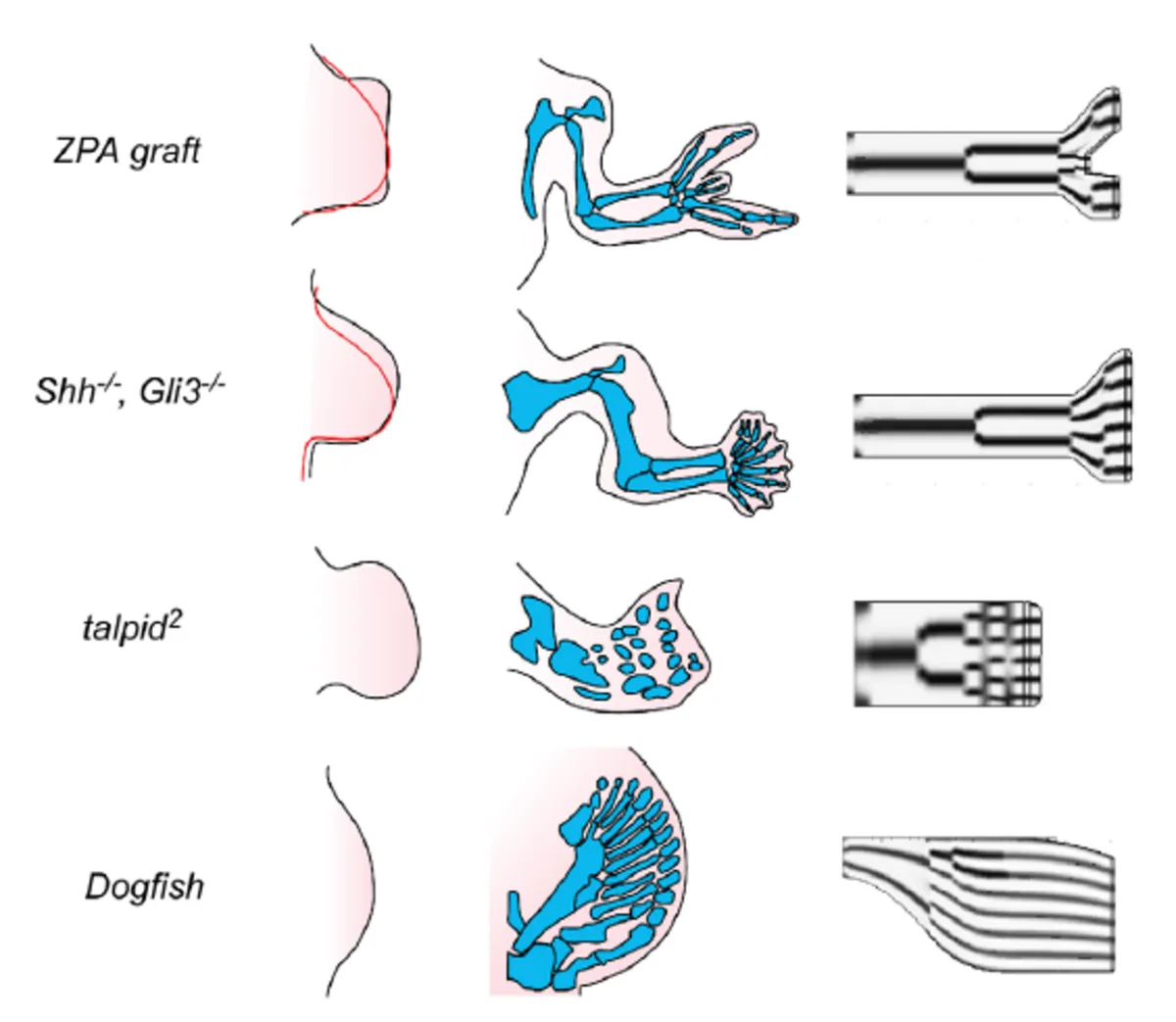
Pattern Formation in Limbs and Fins. Anatomical drawings of limbs and fins appear beside grayscale fields of branching stripes and rounded spots.
Pattern Formation in Limbs and Fins. Anatomical drawings of limbs and fins appear beside grayscale fields of branching stripes and rounded spots.Zhu, Jianfeng & Zhang, Yong-Tao & Alber, Mark & Newman, Stuart. · CC BY 4.0 · via Wikimedia CommonsView source ↗

Prompt

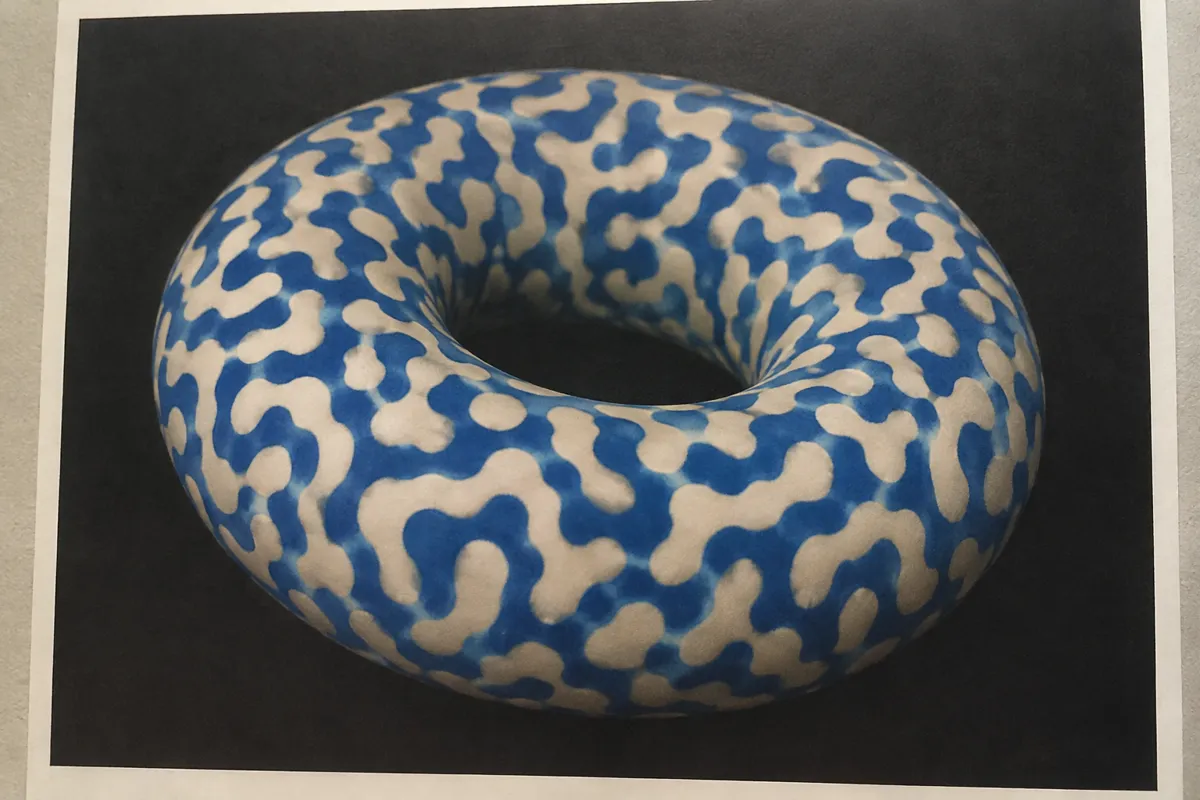
Apply Reaction-Diffusion Patterns across existing surfaces, creating rounded spots, winding stripes, and branching organic mazes with roughly uniform spacing. Use contrasting cream and charcoal tones, smooth irregular boundaries, and subtle surface-following shading so the markings resemble natural pigmentation rather than pasted geometric tiles. Keep the original subject and composition.

Identify

Rounded spots, winding stripes, and branching mazes repeat with roughly consistent spacing. Their organic boundaries suggest animal markings, coral, or microscopic colonies.

Principle

A simulation couples local reactions with diffusion1, which spreads substances or numerical concentrations across a surface. Under suitable conditions, these interactions amplify small disturbances into organized patterns.

Example

Greg Turk: Generating Textures on Arbitrary Surfaces Using Reaction-Diffusion, 1991.

Try it out

In a reaction-diffusion simulation, change one reaction rate and watch whether isolated spots merge into winding stripes.

Background

Alan Turing described a chemical basis for biological pattern formation in 1952. His model showed how reacting substances with different diffusion rates could destabilize an initially uniform mixture. Small disturbances could then grow into spatial patterns. In 1991, Greg Turk applied reaction-diffusion systems to computer texture synthesis2 on arbitrary surfaces. This helped connect mathematical biology with digital graphics during the 1990s. The visible image maps simulated concentrations3 to colors or shades. Spots and stripes emerge through repeated local calculations, rather than being individually drawn or copied from photographs.

Distinction

Unlike marbling, reaction-diffusion patterns need no flowing liquid to stretch pigment into swirls. Unlike ordinary noise textures, they emerge from interacting reaction and diffusion processes.

Aftermath

The technique shows how simple local rules can generate complex visual order without a central design.

Further examples · 7 images
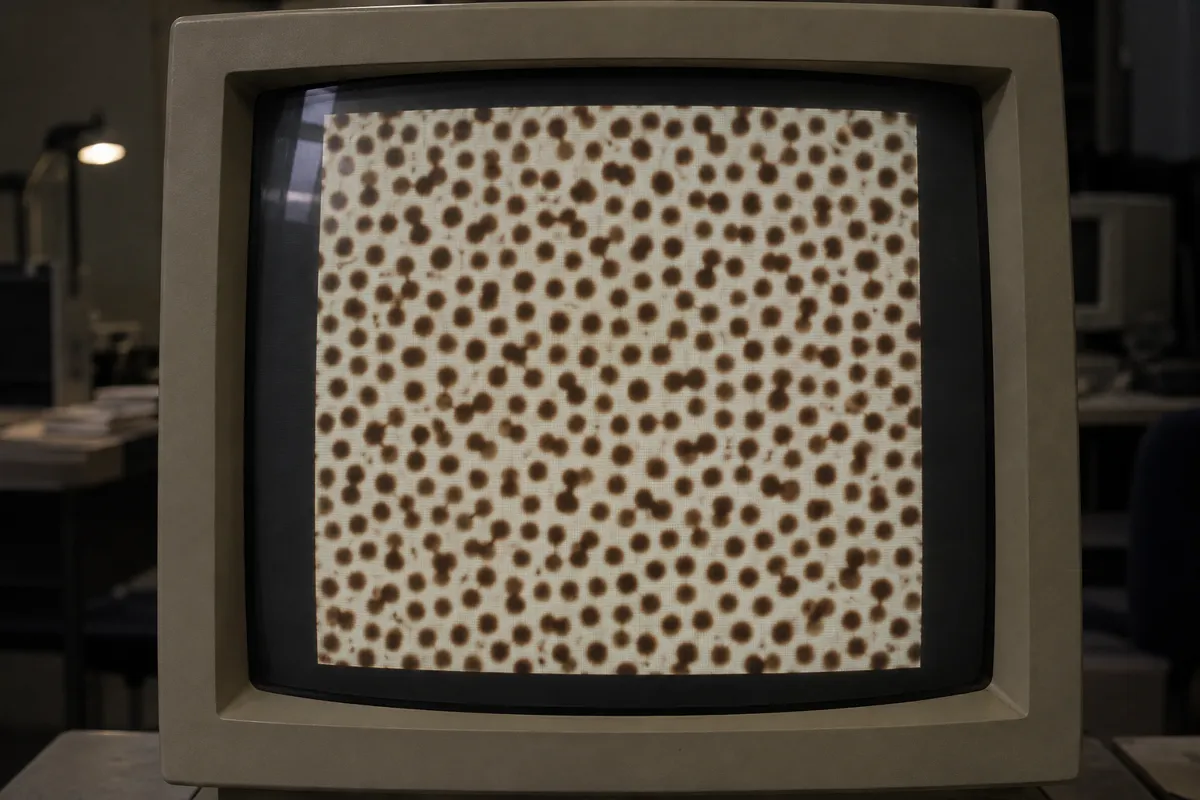
AI illustration: Turing spots displayed on a cathode-ray tube
02 AI illustration: Turing spots displayed on a cathode-ray tubeA vintage computer monitor displays a regular grid of dark circular spots emerging from a neutral background. This demonstrates how a uniform state can break into stable, periodic spots through the process of chemical or numerical diffusion.Illustration generated for the Atlas (AI)
AI illustration: Labyrinthine stripes on a three-dimensional sphere
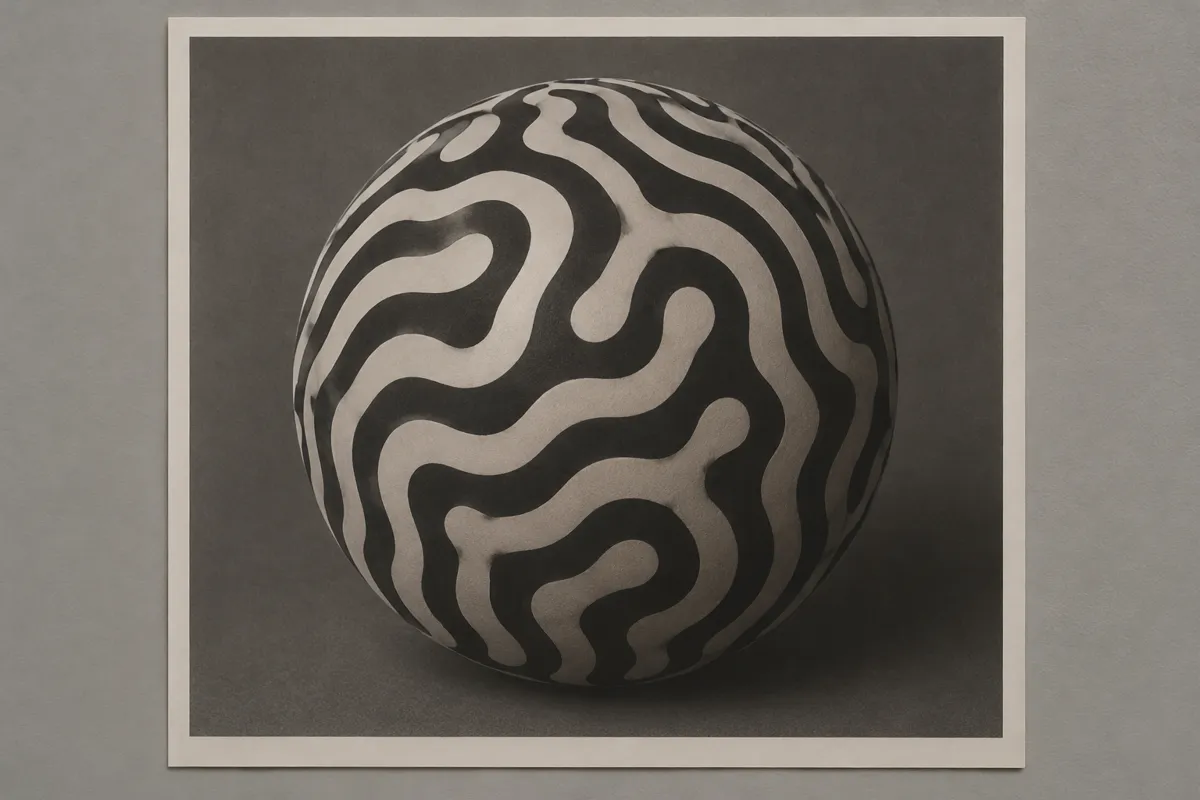
03 AI illustration: Labyrinthine stripes on a three-dimensional sphereA spherical surface is covered in winding, labyrinthine stripes with a consistent characteristic width. The pattern illustrates the emergent geometry created when two substances interact and spread across a non-planar topology.Illustration generated for the Atlas (AI)
AI illustration: Vermiculated maze pattern in warm tones
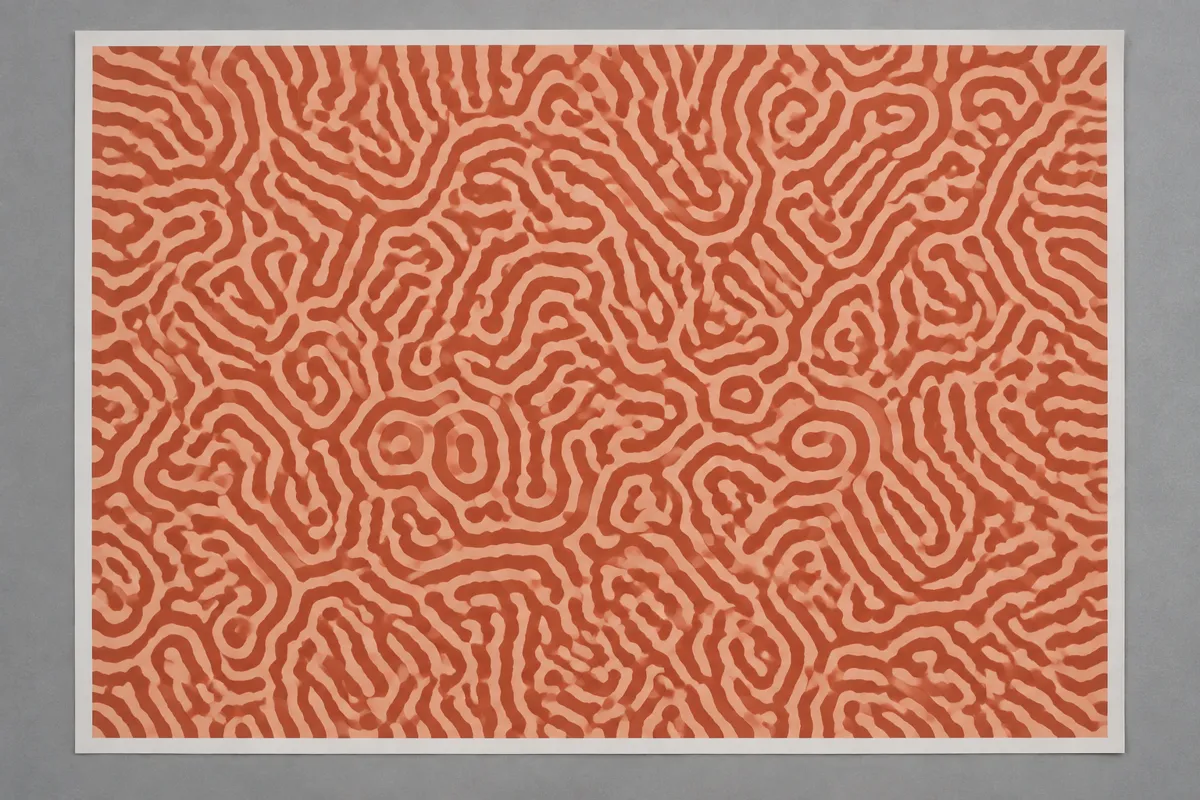
04 AI illustration: Vermiculated maze pattern in warm tonesA dense network of coral-like terracotta ridges twists across the canvas in an organic maze. This intricate structure is a result of local activation and long-range inhibition, common in biological pattern formation.Illustration generated for the Atlas (AI)
AI illustration: Biological marking simulation on a digital animal model
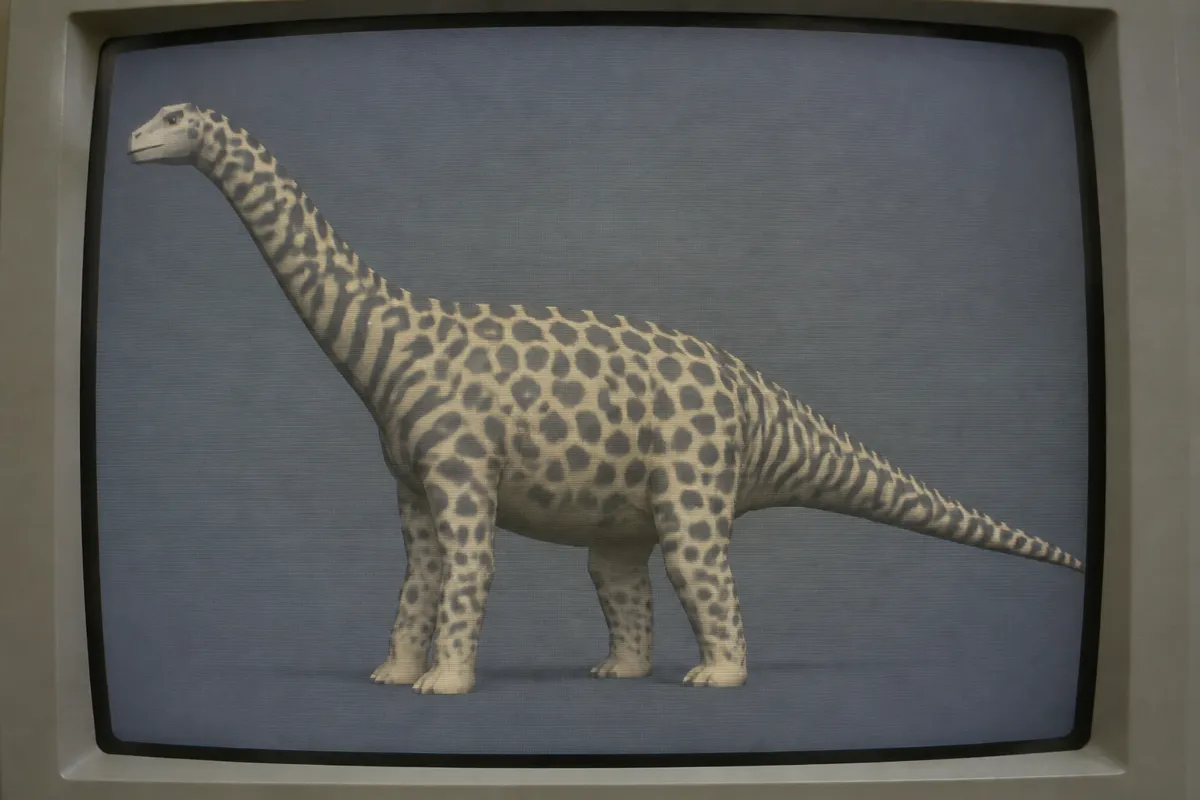
05 AI illustration: Biological marking simulation on a digital animal modelA computer-generated dinosaur model is shown with a hide featuring irregular spots and stripes. This application shows how these mathematical models are used in biology to explain the varied markings found on animal skin.Illustration generated for the Atlas (AI)
AI illustration: Sequential stages of pattern morphogenesis
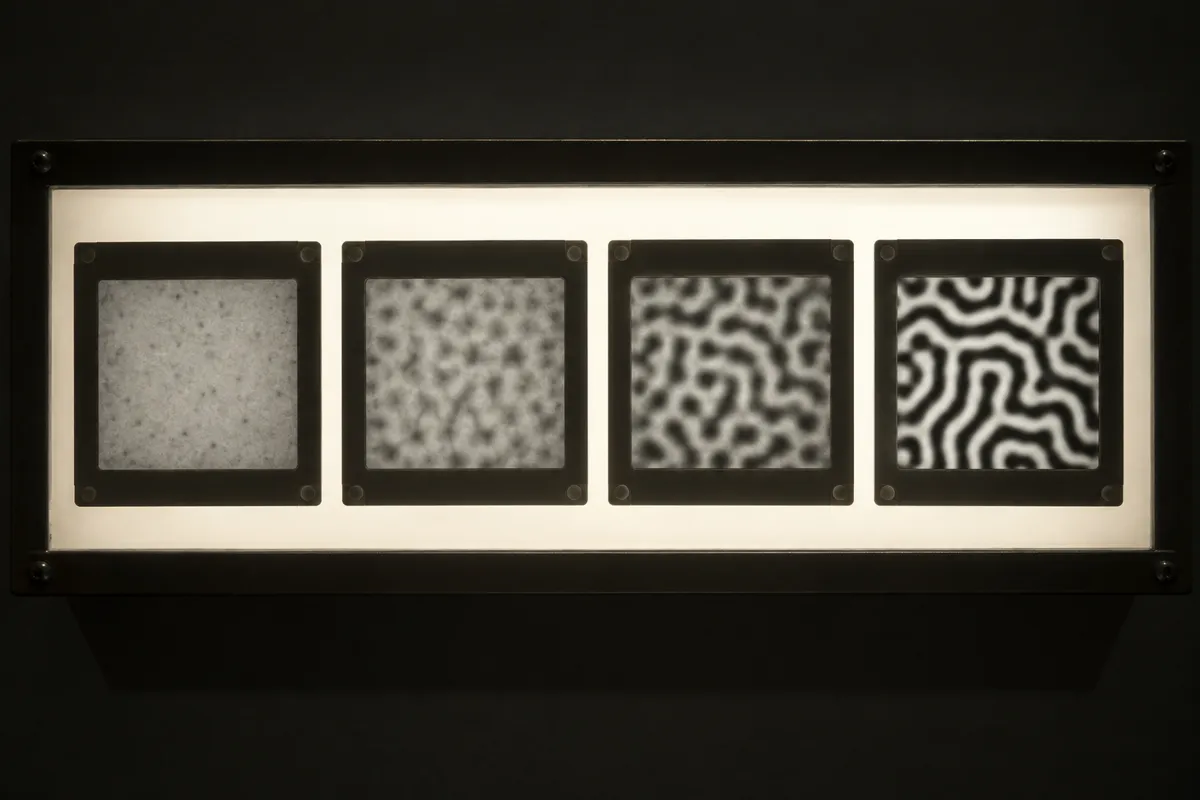
06 AI illustration: Sequential stages of pattern morphogenesisFour panels show the progression of a pattern from random noise to fully formed high-contrast stripes. This sequence highlights the developmental stages where small instabilities are amplified into a stable, self-organized state.Illustration generated for the Atlas (AI)
AI illustration: Reaction-diffusion system applied to a torus
07 AI illustration: Reaction-diffusion system applied to a torusA torus is decorated with a blue and white interlocking pattern of rounded, branching lobes. The continuous, repeating nature of the shapes over the curved surface exemplifies how these simulations adapt to different mathematical manifolds.Illustration generated for the Atlas (AI)

Question

Why does diffusion not always erase differences in these systems?

Show possible answer +

Diffusion alone tends to smooth concentration differences. Coupled reactions can instead amplify certain disturbances, allowing persistent patterns to develop.