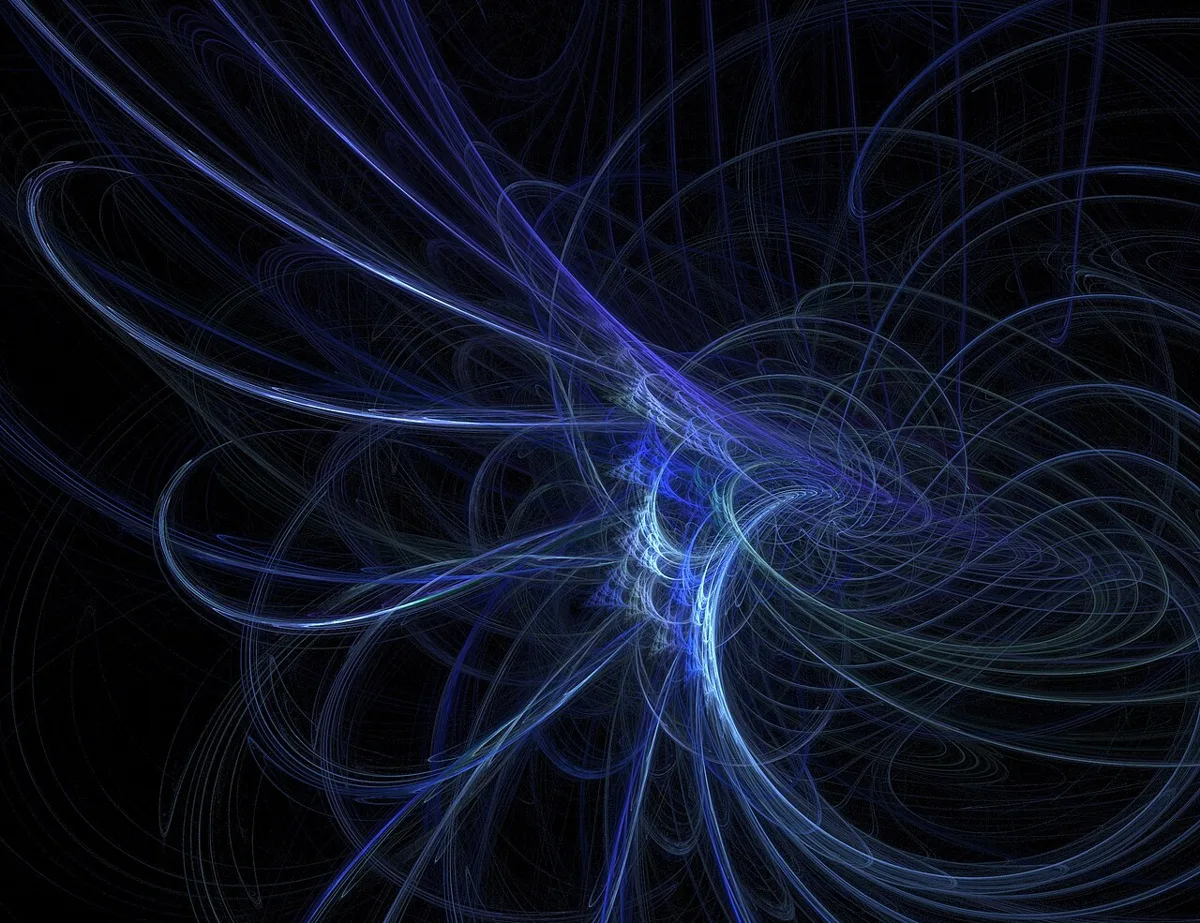
Blue Filament Vortex. Blue and violet filaments sweep through looping fans around a luminous central knot against black.“Jon Zander (Digon3)" · CC BY-SA 3.0 · via Wikimedia CommonsView source ↗
Prompt
Transform this image into Fractal Flames, tracing its recognizable forms with glowing filaments, translucent ribbons, branching fans, and tangled spirals against deep darkness. Repeat delicate structures at multiple scales, blend jewel-toned colors smoothly, and concentrate light into bright knots with airy luminous trails. Keep the original subject and composition.
[Glowing filaments]curl into [translucent ribbons], branching fans, and tangled spirals against dark backgrounds. Fine structures repeat at different scales, with smooth color transitions and bright knots.
Principle
Arandomly chosen sequence of nonlinear transformations1moves apoint repeatedly, building adensity map2of its visited positions. [Logarithmic brightness mapping]reveals faint structures alongside dense regions, while transformation histories guide color.
Example
Scott Draves: Electric Sheep, 1999.
Try it out
Magnify afractal flame image and trace one ribbon, noting where fine strands merge into brighter knots.
Background
Scott Draves developed fractal flames in 1992, extending iterated function systems3with nonlinear transformations and adistinctive rendering method. Instead of drawing continuous luminous curves, the algorithm records many successive point positions. Frequently visited areas accumulate more samples. Logarithmic brightness mapping compresses this density range, preserving faint wisps without letting dense regions dominate. Color follows the sequence of transformations rather than representing physical temperature. Draves later used these methods in Electric Sheep, launched in 1999. This distributed computing artwork generates animated flames, with viewer votes influencing their evolution.
Distinction
Unlike aMandelbrot image, afractal flame usually maps the density of sampled point visits rather than escape behavior. Its glow is computed, not photographed fire or simulated light scattering.
Aftermath
Fractal flames show how repeated mathematical rules and density rendering can produce intricate forms that resemble luminous natural structures.
Further examples · 11 images
02Golden Spire with Blue RibbonsA slender golden spire opens into tangled translucent ribbons with icy blue highlights. Fine branching strands and bright concentrations emerging from darkness exemplify the density-rendered structures of fractal flames.“Jon Zander (Digon3)" · CC BY-SA 3.0 · Wikimedia Commons03Floating Blue Ribbon ClusterPale blue ribbons fold into a floating cluster of angular fans and curling wisps. Repeated folds, translucent overlaps, and finely resolved luminous strands clearly exhibit fractal flame structure.“Jon Zander (Digon3)" · CC BY-SA 3.0 · Wikimedia Commons04Silver and Blue Flame RibbonsSilvery white and electric blue ribbons twist into sweeping fans against a deep black background. Multiscale filament detail, translucent layering, and luminous knots make the fractal flame effect unmistakable.Unknown author · CC BY-SA 3.0 · Wikimedia Commons05Nested Chambers in a Fractal VortexGreen, gold, and rose filaments surround nested oval chambers in a dark swirling composition. Intricate repetition within the chambers and luminous density gradients clearly display the fractal flame technique.Alexnardini · CC BY-SA 4.0 · Wikimedia Commons06Bronze and Teal Nested WhorlsTranslucent bronze and teal ribbons enclose nested whorls of fine, luminous filaments. Repeated spiral structures and layered densities against darkness clearly display the characteristic forms of fractal flames.Alexnardini · CC BY-SA 4.0 · Wikimedia Commons07Cyan Fans and Pink RibbonsCyan fans and delicate blue threads weave between flowing pink ribbons over a dark ground. Branching repetition, translucent overlaps, and smoothly graded luminosity distinguish this intricate fractal flame.Alexnardini · CC BY-SA 4.0 · Wikimedia Commons08Luminous Orb with Repeating RosettesA globe-like network of orange veils and green arcs carries circular rosettes at many sizes. These recurring ornaments and luminous density-built filaments form a clear example of fractal flame imagery.Alexnardini · CC BY-SA 4.0 · Wikimedia Commons09Looping Chains of Nested SpiralsBronze loops sweep around black openings, bordered by chains of smaller violet and green spirals. Fine filamentary construction and recursively nested curls reveal the intricate repeating geometry of a fractal flame.Alexnardini · CC BY-SA 4.0 · Wikimedia Commons10Crimson and White Filament PetalsFine white and crimson threads gather into translucent petal-like loops suspended against black. Bright knots, curling filaments, and smaller echoes within the larger forms strongly exemplify fractal flames.Alexnardini · CC BY-SA 4.0 · Wikimedia Commons11Golden Filament VortexGolden threads coil around a brilliant white knot while faint blue and red arcs cross the surrounding darkness. The intricate orbit-like filaments and wide range of visible densities are characteristic of fractal flame rendering.“Jon Zander (Digon3)" · CC BY-SA 3.0 · Wikimedia Commons
Question
Why can a fractal flame show both faint wisps and bright knots?
Show possible answer +Hide answer −
Logarithmic brightness mapping compresses differences in sample density. Sparse regions remain visible beside heavily visited regions.