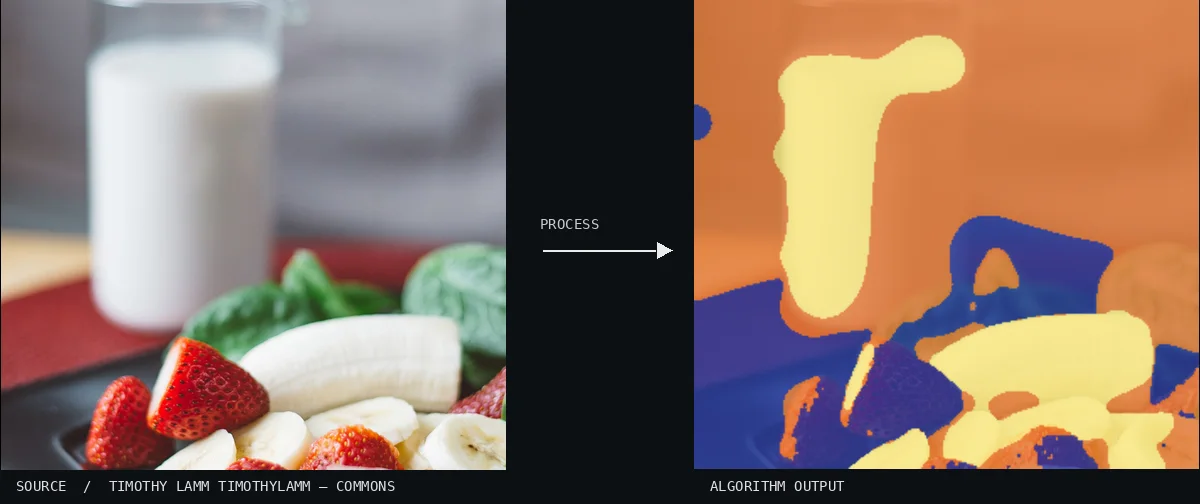
Atlas demonstration: the free source photo and the computed Random Walker Segmentation. A close-up view captures pieces of fruit arranged in a bowl. Each distinct slice and strawberry is isolated into uniform color blocks that terminate precisely at their physical edges.Image: Timothy Lamm timothylamm · CC0 (via Wikimedia Commons), processed for the AtlasView source ↗
Prompt
Apply a Random Walker Segmentation effect, separating the image into flat, distinctly colored labeled regions guided by foreground and background seed areas. Let crisp boundaries follow existing brightness and color changes, suppressing texture within each region without imposing a regular grid. Keep the original subject and composition.
The photo is divided into [labeled regions], with boundaries that tend to follow changes in brightness or color.
Principle
Starting from [labeled seeds1], the algorithm computes which seed label a[random walk2]from each pixel would most likely reach first. Steps favor similar neighboring pixels, so assigning the most probable label tends to place boundaries along image changes.
Try it out
Move the seeds and watch how boundaries shift around faint edges.
Classification
Calculated image processing result.
Further examples · 9 images
02Random Walker Segmentation, applied to “Flying fishes on the ground (Unsplash)”A large number of small fish are clustered together in a dense school. The algorithm effectively differentiates individual fish bodies from the surrounding water, creating a complex map of organic shapes.Erwan Hesry erwanhesry (photo); processed for the Atlas · CC0 · Wikimedia Commons03Random Walker Segmentation, applied to “Einstein's Instrument (Unsplash)”This image focuses on the ornate f-hole and bridge of a wooden string instrument. The resulting regions perfectly trace the elegant curves of the wood carving and the straight vertical lines of the strings.Johanna Vogt johanna_vogt (photo); processed for the Atlas · CC0 · Wikimedia Commons04Random Walker Segmentation, applied to “Ali Yahya 2017 (Unsplash)”A coffee cup sits on a saucer next to a reserved sign. The segmentation algorithm perfectly separates the solid objects from the background table and the highlights on the saucer.Ali Yahya ayahya09 (photo); processed for the Atlas · CC0 · Wikimedia Commons05Random Walker Segmentation, applied to “Glass balconies (Unsplash)”The sharp geometry of modern balconies is captured against a contrasting sky. The segmentation results in crisp, geometric borders that align precisely with the structural lines of the architecture.Mike Wilson mkwlsn (photo); processed for the Atlas · CC0 · Wikimedia Commons06Random Walker Segmentation, applied to “Fishing East Sooke Park (Unsplash)”A scenic view from a boat shows a fishing rod extending over the water toward distant hills. The segmentation captures the thin silhouette of the rod and the rough texture of the landscape across the horizon.Alan Bishop ravenwolfab (photo); processed for the Atlas · CC0 · Wikimedia Commons07Random Walker Segmentation, applied to “Holding hands with shadow (Unsplash)”Two people are shown holding hands while standing on a flat surface. The processing separates the figures and their joined hands into distinct color fields, though some textures on the clothing appear fragmented.Redd Angelo reddangelo16 (photo); processed for the Atlas · CC0 · Wikimedia Commons08Random Walker Segmentation, applied to “Vasquez Rocks, United States (Unsplash)”Sharp rock formations jut out from a sandy landscape under a clear sky. The edges of the jagged stones are traced with high contrast, separating the earth from the atmosphere through probability-based labeling.Ashwin Vaswani ashwinv11 (photo); processed for the Atlas · CC0 · Wikimedia Commons09Random Walker Segmentation, applied to “Zelenci 2014”A misty landscape shows a lone tree reflecting in a body of still water. The algorithm identifies the silhouette of the tree well, though the boundary between sky and mist becomes somewhat blurred.Aleš Krivec (photo); processed for the Atlas · CC0 · Wikimedia Commons