H 196 / 3211980s

Radiosity

Cornell: Modeling the Interaction of Light Between Diffuse Surfaces, 1984.

Typeface · Exo 2

Goral et al.: original Cornell box simulation, 1984.
Goral et al.: original Cornell box simulation, 1984.Cornell University Program of Computer Graphics; historical research illustration.View source ↗

Prompt

Apply a radiosity rendering effect, emphasizing matte surfaces illuminated by diffuse light bouncing throughout the scene. Let existing colored surfaces cast subtle matching tints onto nearby areas, with soft contact shadows, gently brightened recesses, and smooth indirect-light gradients rather than mirrorlike highlights. Keep the original subject and composition.

Identify

Colored walls color adjacent surfaces through indirect light.

Principle

Surfaces exchange diffusely reflected1 light energy with each other.

Example

Goral et al.: original Cornell Box2, 1984.

Try it out

Look for the color cast on a neighboring area that is actually white.

Background

In 1984, Cindy Goral, Kenneth Torrance, Donald Greenberg, and Bennett Battaile published their seminal Cornell paper on diffuse light exchange. The original Cornell Box contained no obscuring objects because the exchange factors were calculated analytically. Only later versions expanded the test model. Cornell compares calculated images with a physically measured space: The well-known box is thus also an experiment for verifying simulations.

Distinction

Radiosity refers to a specific method for diffuse light exchange. Not every image with indirect light was calculated using a radiosity solver.

Aftermath

Color is not just part of materials; it travels with indirect light.

Further examples · 7 images

Radiosity ac
02 Radiosity acA sequence of interior renders shows the progression from a mesh wireframe to a 20-pass simulation. As the number of passes increases, the indirect lighting gradually illuminates the room's corners and ceiling.Jlpons · Public domain · Wikimedia Commons
Radiosity-yes
03 Radiosity-yesThree colorful spheres sit on a white surface, casting red, yellow, and blue light onto the floor. This demonstrates color bleeding, where light energy is exchanged between surfaces based on their respective colors.The original uploader was Loebek at German Wikipedia. · CC BY-SA 3.0 · Wikimedia Commons
Classical radiosity comparison with path tracing, simple scene, interpolated
04 Classical radiosity comparison with path tracing, simple scene, interpolatedTwo vertical panels compare radiosity with path tracing using a sphere in a corner. The interpolated radiosity version produces smooth gradients of indirect light on the adjacent white walls.KaiaVintr · CC BY-SA 4.0 · Wikimedia Commons
Radiosity Comparison
05 Radiosity ComparisonSide-by-side renders compare direct illumination with a radiosity-based solution in a room with a red floor. The right side shows a pink tint on the white walls caused by light bouncing off the floor.Hugo Elias (myself) · CC BY-SA 3.0 · Wikimedia Commons
BMRT - Cornell box radiosity
06 BMRT - Cornell box radiosityThis Cornell Box variation features blue and red walls surrounding two rectangular blocks. The white back wall and blocks clearly display color bleeding from the flanking colored surfaces.Morn · CC0 · Wikimedia Commons
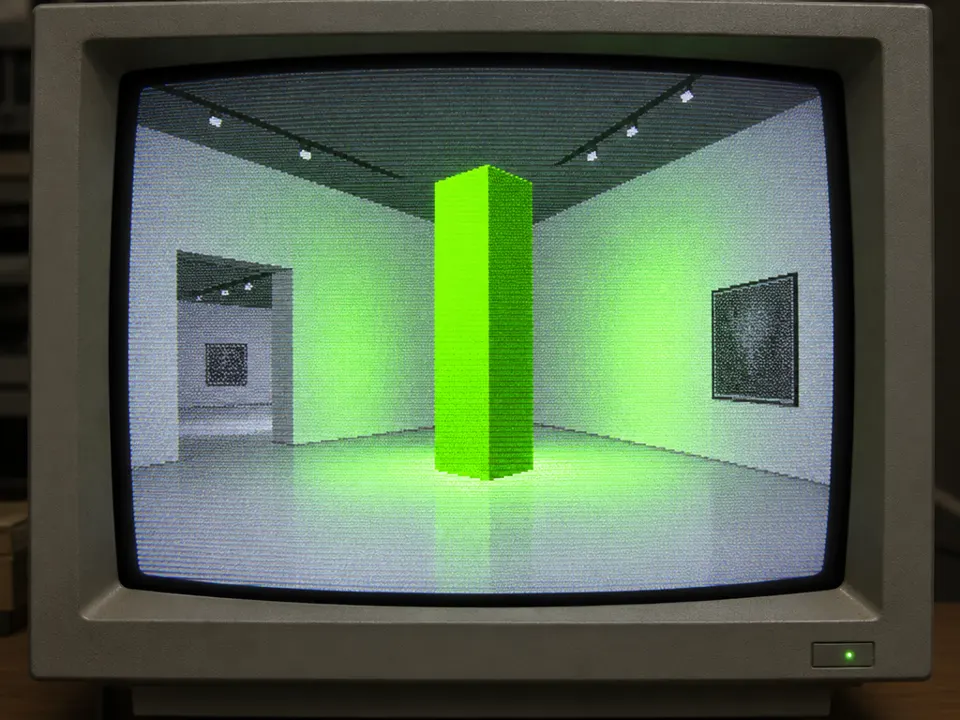
AI illustration: A green monolithic block emits light that spills onto the white walls and
07 AI illustration: A green monolithic block emits light that spills onto the white walls andA green monolithic block emits light that spills onto the white walls and floor. This diffuse color bleeding demonstrates light energy exchange between surfaces in a closed environment.Illustration generated for the Atlas (AI)

Question

Why can a white floor appear reddish near a red wall?

Show possible answer +

Red light is diffusely reflected by the wall and indirectly illuminates the floor. The floor material can still be white.

Sources