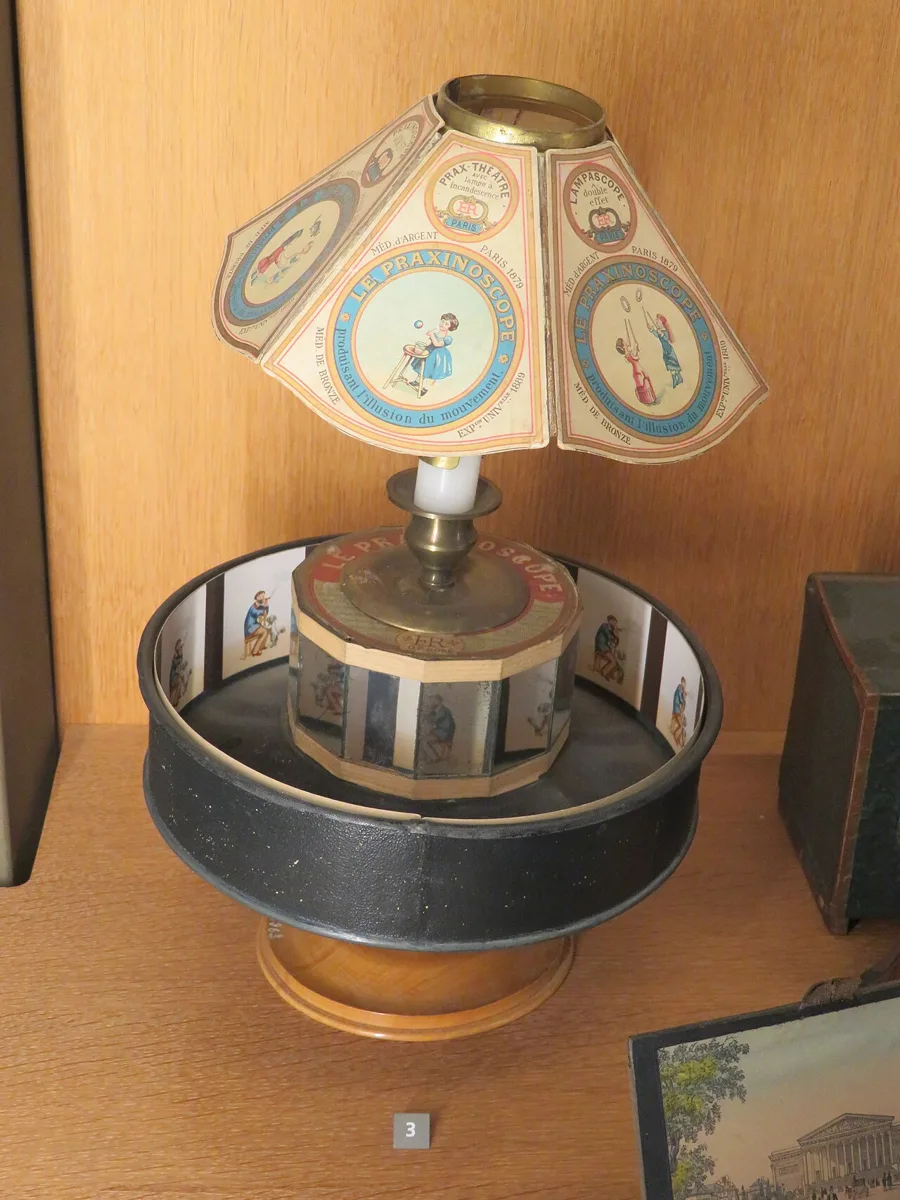
Illuminated Praxinoscope with Figure Strip. A lamp-equipped praxinoscope displays sequential figure drawings around an open drum and their reflections in a faceted central mirror assembly.Sukkoria · CC BY-SA 4.0 · via Wikimedia CommonsView source ↗
Prompt
Transform this image into a Praxinoscope display, translating the subject into brightly colored sequential drawings inside an open rotating drum. Show a central ring of mirrors reflecting a clear, steady-looking action phase, with neighboring phases on the surrounding strip, polished reflections, and no viewing slits. Keep the original subject and composition.
Asmall figure performs a[repeating action]inside aspinning drum. Its [reflected image]appears relatively steady, with bright colours and no viewing slits.
Principle
A[central ring of mirrors]turns with astrip of sequential drawings1inside the drum. Successive reflections2place the drawings in nearly the same position, allowing the viewer to perceive continuous movement.
Example
Émile Reynaud: Praxinoscope, 1877.
Try it out
Watch aworking praxinoscope, comparing the moving paper strip with its reflections; notice where the action becomes readable.
Background
Émile Reynaud introduced the praxinoscope in 1877 as an improvement on the zoetrope3. Apaper strip carried successive phases of an action around the drum’s inner wall. At the centre, aring of flat mirrors rotated with the drum, each mirror corresponding to one drawing. Viewers looked directly at the reflections rather than through narrow slots. This arrangement gave abrighter view and reduced the interruptions caused by slots. The short sequence repeated with every turn. Reynaud later developed more elaborate devices for presenting animated scenes.
Distinction
Azoetrope separates views through narrow slits in its rotating wall. Apraxinoscope instead uses central mirrors to present successive reflected images.
Aftermath
It shows how separate drawings can suggest movement when their successive views remain visually aligned.
Further examples · 11 images
02Horse and Rider in Praxinoscope MirrorsSuccessive silhouettes of a galloping horse and rider surround central mirrors that visibly reflect the figures. This close view clearly exposes the praxinoscope’s defining relationship between an image sequence and its mirrored presentation.Gerarus · CC BY 4.0 · Wikimedia Commons03Rotating Blocks and Steadier Mirror ImageYellow blocks blur around a rotating white platform while a more distinct yellow reflection appears at the base of the central mirrors. The contrast demonstrates the praxinoscope principle of presenting a relatively stable reflected image from moving subjects.Biswarup Ganguly · CC BY-SA 4.0 · Wikimedia Commons04Praxinoscope and Separate Animation StripA shaded praxinoscope contains colored figure drawings and central mirrors, while a separate loop of sequential drawings rests beside it. The exposed image strip and reflected figures clearly show the visual materials and optical arrangement used for praxinoscope animation.Ismoon (talk) 21:07, 28 March 2019 (UTC) · CC BY-SA 4.0 · Wikimedia Commons05Outdoor Praxinoscope with Horse SequenceAn outdoor drum surrounds a central ring of mirrors, with successive horse silhouettes lining its inner wall. The visible drawings and their reflections clearly demonstrate the slitless mirror arrangement used to produce praxinoscope animation.Globetrotter19 · CC BY-SA 3.0 · Wikimedia Commons06Historic Praxinoscope with Reflected FiguresA historic drum contains a strip of coloured figures facing a polygonal ring of mirrors. The figures visibly recur in the mirror faces, clearly displaying the reflective image sequence central to the praxinoscope.Pink Flojd · CC0 · Wikimedia Commons07Animal Drawings in a Mirrored DrumAn open drum at the left of a museum display contains animal drawings surrounding a central ring of mirrors. The visible drawings and their reflections demonstrate the praxinoscope’s arrangement for producing animation without viewing slits.Biswarup Ganguly · CC BY 3.0 · Wikimedia Commons08Yellow Block Praxinoscope DemonstrationYellow blocks encircle a polygonal mirror assembly on a white platform, with block reflections visible near the mirrors’ bases. This three-dimensional demonstration substitutes physical forms for drawings while retaining the praxinoscope’s central reflecting arrangement.Biswarup Ganguly · CC BY-SA 4.0 · Wikimedia Commons09Mirror Animation Exhibit with Yellow BlocksA red museum pedestal supports a ring of yellow blocks surrounding an upright faceted mirror assembly. The visible physical subjects and their reflections identify a three-dimensional demonstration of the praxinoscope mechanism, although the distant view limits detail.Biswarup Ganguly · CC BY-SA 4.0 · Wikimedia Commons10Engine-Driven PraxinoscopeA miniature engine and belt drive share a wooden base with a raised drum containing yellow illustrated panels and central mirrors. The exposed image strip and mirrored centre identify a mechanically driven example of praxinoscope animation.Birmingham Museums Trust · CC BY-SA 4.0 · Wikimedia Commons11Praxinoscope Theatre with Decorated LampshadeA decorated lampshade rises above a theatre-style drum whose exposed section shows small coloured figures and central mirror facets. Despite the foreground housing, the visible image strip and reflective assembly provide a clear example of the praxinoscope medium.Escarlati · CC BY-SA 2.5 · Wikimedia Commons
Question
Why does the praxinoscope usually give a brighter view than a slit-viewed zoetrope?
Show possible answer +Hide answer −
Its mirrors remain openly visible, whereas zoetrope slits block the viewer’s sight for much of each rotation.