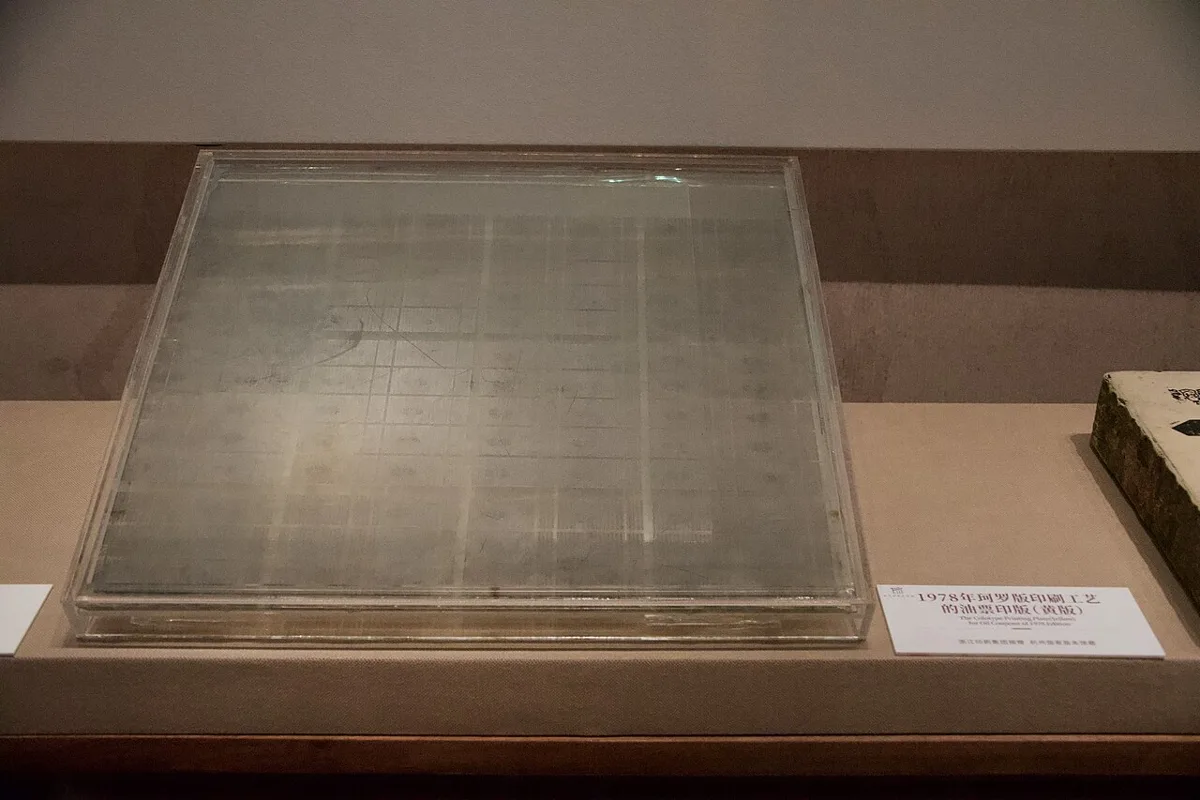
Collotype Glass Printing Plate Medium. A thick glass plate featuring a faint grid and an image matrix used for printing.User:CatOnMars · CC BY 4.0 · via Wikimedia CommonsView source ↗
Prompt
Apply a Collotype effect, converting the image into a finely detailed monochrome ink print with smooth tonal transitions, deep shadows, and delicate highlights. Introduce microscopic wormlike reticulation, subtle matte paper fibers, and softly absorbed ink edges without any regular halftone dots. Keep the original subject and composition.
You see aprinted image with smooth tonal transitions, deep shadows, and delicate highlights. Close inspection reveals a[microscopic, worm-like reticulated grain1]instead of standard printing dots.
Principle
Aglass plate is coated with [light-sensitive gelatin]and baked. Exposure hardens the gelatin, making it [absorb greasy ink]in proportion to the light received.
Example
Eadweard Muybridge: Animal Locomotion, 1887.
Try it out
Magnify ahigh-quality vintage postcard from the early 1900s to look for random, cracked-mud textures instead of organized dots.
Background
Alphonse Poitevin invented the basic process in 1855, but Joseph Albert perfected it in 1868. He replaced afragile stone base with aglass plate. The process relies on dichromated gelatin2. When exposed to light under anegative3, the gelatin hardens. Baking the plate creates microscopic wrinkles in the gelatin. During printing, the plate is dampened. Soft, unexposed areas absorb water and repel greasy ink. Hardened, exposed areas repel water and hold the ink. This allows for incredibly smooth, photographic gradients. Collotype became the premier method for reproducing fine art and high-quality postcards.
Distinction
Unlike halftone printing, which uses aregular grid of distinct dots, collotype uses arandom, continuous-tone wrinkle pattern.
Aftermath
It demonstrates how exploiting the physical limits of achemical binder can create reproductions of unmatched photographic fidelity.
Further examples · 11 images
02Muybridge Animal Locomotion Collotype PrintA sequential photographic print showing a deer running, featuring deep shadows and smooth continuous tones. This Muybridge plate is a classic example of a genuine collotype print, clearly demonstrating the delicate highlights characteristic of the technique.Eadweard Muybridge Flickr uploader BPL · Public domain · Wikimedia Commons03Running Deer Locomotion Collotype PlateA vintage print displaying multiple frames of a running deer against a numbered grid background. Printed using the collotype process, it perfectly shows the continuous photographic tones achievable without the use of standard halftone dots.Eadweard Muybridge Flickr uploader BPL · Public domain · Wikimedia Commons04Antelope Motion Study Collotype PrintA sequential motion study of an antelope captured in multiple photographic frames on a single page. As a widely published collotype print, it serves as a classic example of the technique's ability to reproduce rich, continuous-tone imagery.Eadweard Muybridge Flickr uploader BPL · Public domain · Wikimedia Commons05Jumping Deer Sequence Collotype PrintSixteen frames of a jumping deer arranged in a grid format on a vintage printed page. This is a classic demonstration of a collotype print, utilizing light-sensitive gelatin to produce smooth tonal ranges for high-fidelity scientific illustration.Eadweard Muybridge Flickr uploader BPL · Public domain · Wikimedia Commons06Deer Motion Sequence Collotype PlateMultiple photographic frames showing a deer in motion, printed with rich contrast and deep shadows on paper. It is a classic example of a genuine collotype, widely used in the 19th century for dot-free, continuous-tone photographic reproduction.Eadweard Muybridge Flickr uploader BPL · Public domain · Wikimedia Commons07Animal locomotion. Plate 696 (Boston Public Library)A printed page features a sequential photographic grid of an eland walking, complete with printed margins and text. This is a plate from Eadweard Muybridge's "Animal Locomotion," which is a famous, classic example of a print produced using the continuous-tone collotype process.Eadweard Muybridge Flickr uploader BPL · Public domain · Wikimedia Commons08Collotype Print of Deer RunningA printed page displays a grid of sequential photographs showing a small deer running. As a plate from Muybridge's 1887 publication, it serves as a renowned historical example of a print created through the collotype technique.Eadweard Muybridge Flickr uploader BPL · Public domain · Wikimedia Commons09Elk Sequential Motion Collotype PrintA printed page features sixteen sequential frames of a large elk or deer in motion. The image is a genuine collotype print from Muybridge's motion studies, demonstrating the printing process's ability to render smooth, photographic tonal transitions in ink.Eadweard Muybridge Flickr uploader BPL · Public domain · Wikimedia Commons10Jumping Deer Collotype Print PlateA sequential grid of a deer jumping over an obstacle is printed on a large page with a caption. This page is a classic example of a collotype print, famously used to publish Muybridge's photographs with high fidelity.Eadweard Muybridge Flickr uploader BPL · Public domain · Wikimedia Commons11Collotype Plate of Running Fallow DeerA printed plate displays sequential motion photographs of two fallow deer running. It is an authentic collotype print from Eadweard Muybridge's collection, representing a historically significant and definitive application of this specific printing process.Boston Public Library · CC BY 2.0 · Wikimedia Commons
Question
Why does a collotype print not have a visible dot pattern?
Show possible answer +Hide answer −
It uses the natural wrinkling of dried gelatin to hold ink, rather than an artificially generated screen of dots.