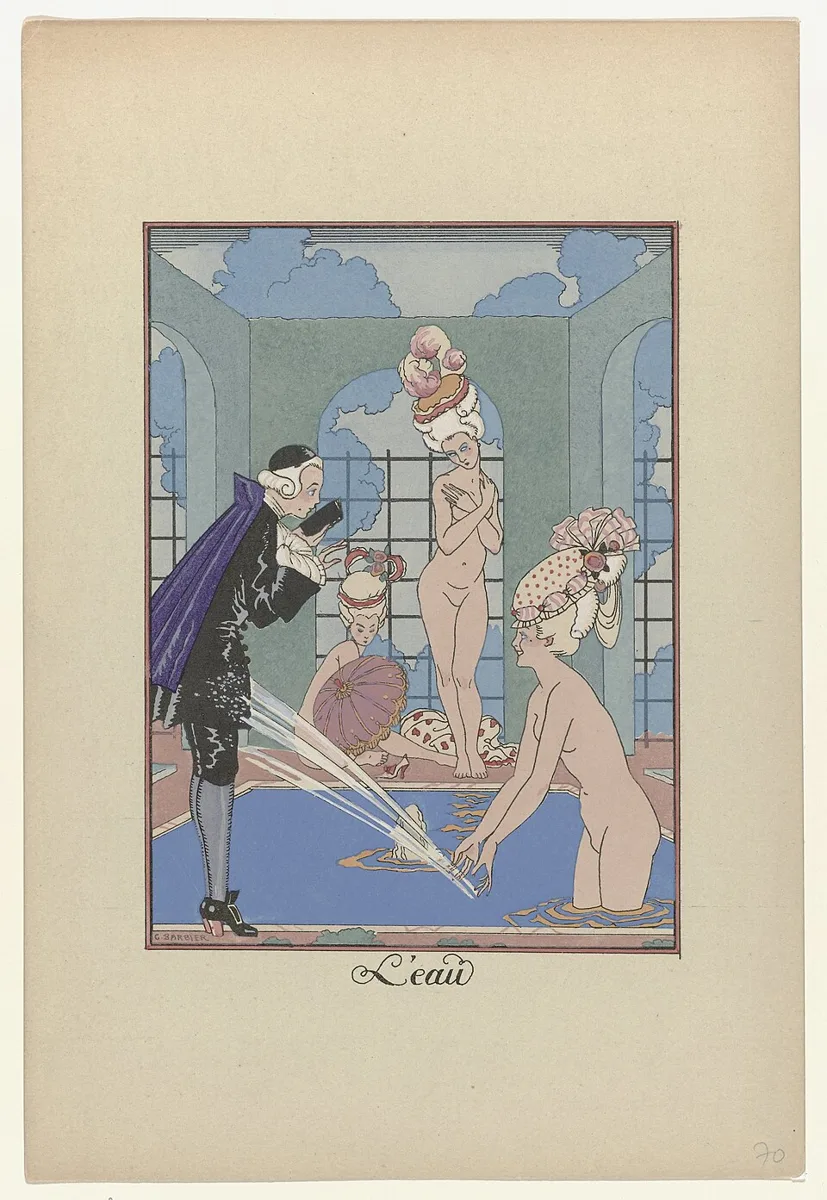
Art Deco Illustration With Hand-Brushed Colors. This theatrical illustration features sharply delineated areas of flat, opaque color over crisp line work.Rijksmuseum · CC0 · via Wikimedia CommonsView source ↗
Prompt
Apply the Pochoir Stencil Print effect with vivid gouache-like color blocks, sharply cut silhouettes, and thick matte pigment on textured paper. Use slight hand-brushed density variations, occasional stencil overlap, and crisp decorative simplification, avoiding halftone dots, photographic gradients, or glossy surfaces. Keep the original subject and composition.
You see vivid, [solid blocks of color]with sharp, distinct edges. Colors appear thick and matte, lacking the [dotted patterns]of commercial printing.
Principle
Artisans cut shapes out of thin metal or celluloid sheets. They [hand-brush watercolor or gouache1]through these cutouts onto printed paper.
Example
George Barbier: Gazette du Bon Ton illustrations, 1912.
Try it out
Look closely at an Art Deco fashion print to spot tiny overlaps where brushed colors slightly cross the stencil boundaries.
Background
Pochoir is ahighly refined stencil technique that reached its peak in Paris during the early twentieth century. Publishers used it to produce luxury fashion magazines and artist portfolios. Unlike mechanized color printing, pochoir relied entirely on skilled human hands. Workshops employed dozens of artisans, called coloristes2, who applied layers of gouache or watercolor layer by layer. Each color required aseparate, custom-cut stencil. This labor-intensive additive process3created incredibly vibrant, textured images that machines could not replicate. The resulting prints defined the elegant, geometric aesthetic of the Art Deco era.
Distinction
Pochoir uses hand-brushed paints through cutouts, leaving thick, irregular paint deposits. Chromolithography uses chemical stone printing, producing flat, mechanically smooth ink layers.
Aftermath
It shows how intensive manual craftsmanship briefly outshined industrial mass production in defining modern luxury.
Further examples · 11 images
02Stencil-Colored Romantic Period IllustrationA romantic period scene is rendered with distinctly separate, solid blocks of pastel and bold colors. The untextured, thick pigment bounded by printed lines is a classic result of manual stencil application.Rijksmuseum · CC0 · Wikimedia Commons03Fashion Plate Featuring Pochoir Stenciled ColorsThis fashion plate depicts a patterned coat utilizing solid, vibrant reds and blues without gradations. The lack of commercial printing dot patterns confirms the colors were brushed through precise metal or celluloid cutouts.Rijksmuseum · CC0 · Wikimedia Commons04Hand-Colored Fashion Print Of A CoatAn elegant fashion illustration displays flat, unmodulated tones of gray, black, and pale skin colors. The sharp edges and opaque nature of the pigments clearly demonstrate this meticulous hand-coloring method.Rijksmuseum · CC0 · Wikimedia Commons05Vividly Stenciled Illustration Of Woman And ChildA woman and child are depicted using vivid, isolated patches of green, red, and blue pigment. The thick, matte quality of the colors applied over the printed drawing is characteristic of this stencil technique.Free Public Domain Illustrations by rawpixel · CC BY 2.0 · Wikimedia Commons06Luxury Book Page With Stencil-Colored IllustrationA page of text is accompanied by an illustration of two figures colored with bold, solid pink and black patterns. The striking, flat colors seamlessly integrated with typography show the technique's use in high-end publishing.Unknown author · Public domain · Wikimedia Commons07Woman with Dog on Beach Pochoir PrintA fashion plate depicts a woman sitting by a stylized beach with a small dog, rendered in flat teal, pink, and tan. The rich, matte layers of watercolor bounded by sharp borders perfectly demonstrate the hand-stenciled pochoir printing method.Unknown author · Public domain · Wikimedia Commons08Elegant Couple in Evening Wear Pochoir PrintAn elegant couple stands near a decorative floral backdrop in this vintage fashion illustration. The solid, untextured blocks of green and grey showcase the distinct, hand-applied gouache technique typical of pochoir.George Barbier · CC0 · Wikimedia Commons09Restaurant Dining Scene Pochoir Fashion PrintDiners in formal attire are seated at a table beneath tall blue windows in a stylish restaurant setting. The flat, opaque areas of color seamlessly filling the outlined figures and architecture are characteristic of artisanal stencil printing.George Barbier · CC0 · Wikimedia Commons10Woman in Dark Riding Habit Pochoir IllustrationA woman in a dark tailored riding habit poses outdoors holding a riding crop. The uniform application of deep blue and yellow without mechanical halftones clearly illustrates the pochoir stencil process.Bernard Boutet de Monvel · Public domain · Wikimedia Commons11Woman in Blue Garden Dress Pochoir PrintA woman in a vibrant blue garden dress admires a floating rose in a stylized outdoor setting. The crisp edges and vivid, saturated hues of the dress and foliage are telltale signs of hand-brushed pochoir coloring.Charles Martin · Public domain · Wikimedia Commons
Question
Why did pochoir eventually fall out of favor?
Show possible answer +Hide answer −
The process was extremely slow and required highly skilled labor. As printing technologies improved, hand-stenciling simply became too expensive to sustain.