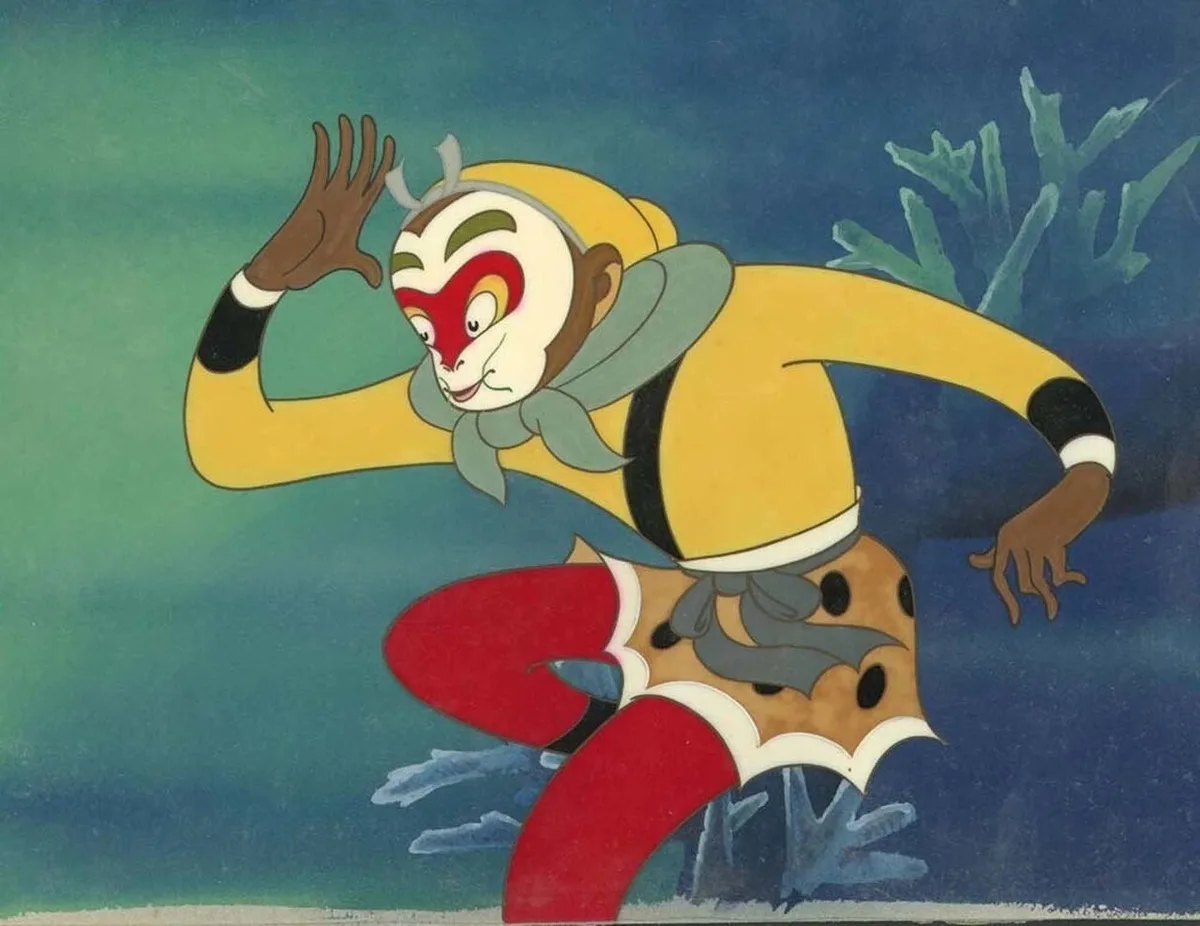
Hand-Painted Monkey King Animation Cel. A painted monkey character crouches over a textured, painted underwater background.Unknown · Public domain · via Wikimedia CommonsView source ↗
Prompt
Transform this image into a Cel Animation frame with clean ink outlines, opaque flat colors, and restrained two-tone shading on foreground subjects. Render the background as detailed painted scenery, adding subtle acetate sheen, tiny paint irregularities, and faint layer shadows between foreground and backdrop. Keep the original subject and composition.
You see [moving, painted characters]interacting seamlessly with static, detailed backgrounds. The moving figures often have distinct outlines and [flat colors].
Principle
Artists paint moving elements on [transparent celluloid1sheets]. They stack these sheets over asingle painted background to photograph them.
Example
Earl Hurd: Bobby Bumps, 1915.
Try it out
Pause an old animated cartoon and look closely at acharacter's painted edges. You might see afaint shadow where the clear plastic sits above the background.
Background
Before cel animation, early animators drew every single frame completely from scratch. This meant redrawing the exact same backgrounds thousands of times. In 1914, Earl Hurd patented anew method using transparent sheets made of celluloid. Artists could now draw only the moving characters on these clear sheets. They placed these transparent layers2over asingle painted background. Acamera then photographed the stacked setup one frame at atime. This saved massive amounts of labor and allowed for highly detailed backgrounds. It became the absolute standard process for 2D animation for nearly acentury.
Distinction
Unlike direct animation where artists scratch or paint directly onto the physical film strip, cel animation photographs layered drawings beneath acamera.
Aftermath
It teaches us that separating static and dynamic visual elements fundamentally optimizes complex visual production.
Further examples · 10 images
02Sun Wukong Fighting Nezha Cel AnimationA vibrant fight scene features painted characters with sharp outlines over a dark, textured background. The distinct separation between the flat-colored, moving figures and the detailed background is a hallmark of traditional cel animation.Unknown · Public domain · Wikimedia Commons03Winsor McCay Original Animation CelA black and white drawing of a sinking ship on a transparent sheet with two holes at the bottom. The registration holes prove this is a physical celluloid sheet (cel) used to perfectly align animation frames over backgrounds.Winsor McCay · Public domain · Wikimedia Commons04Ocean Waves Animation Cel by Winsor McCayAn inked drawing of ocean waves and a distant ship on a transparent sheet with registration holes. The physical transparent cel with peg holes at the bottom is the actual medium used to photograph cel animation.Winsor McCay · Public domain · Wikimedia Commons05Monkey King and Army Cel Animation FrameFlat-colored monkey characters and a large banner are positioned over a detailed landscape background. This demonstrates cel animation by layering hand-painted foreground elements on transparent sheets over a static watercolor background.Unknown · Public domain · Wikimedia Commons06Cel Animation Frame of Monkey King With PeachA colorful painted monkey character holding a pink peach is set against a painted blue background with leaves. The sharp, solid-color character outlines contrast with the soft background, clearly showing the layered cel technique.Unknown · Public domain · Wikimedia Commons07Epic Battle Scene Using Cel AnimationSeveral painted monkey characters engage in a battle with a multi-armed figure against a cloudy background. The technique is evident in the flat, opaque paint of the dynamic characters placed atop a static, painted background layer.Unknown · Public domain · Wikimedia Commons08Layered Cel Animation of the Monkey KingA large monkey character interacts with smaller monkeys and a giant peach over a soft-edged blue background. The clear separation of the flat, vibrant foreground characters from the painted backdrop perfectly illustrates traditional cel animation.Unknown · Public domain · Wikimedia Commons09Vintage cartoon frame showing layered characters and background.A still from an early cartoon shows flatly colored characters, including a large black elephant, positioned against a drawn background. The visual separation between the simple, outlined figures and the static background clearly illustrates the layering technique used in cel animation.Earl Hurd · Public domain · Wikimedia Commons10Early animation frame demonstrating cel layering over background.A dog and a turtle with distinct outlines and solid fills stand in front of a detailed, static drawing of a house. This perfectly demonstrates the cel animation process, where moving elements are painted on transparent sheets and photographed over a single background.Earl Hurd · Public domain · Wikimedia Commons
Question
Why do moving elements in early cartoons sometimes have slightly different colors than static ones?
Show possible answer +Hide answer −
The clear celluloid layers stacked above the background absorbed and blocked tiny amounts of light. This subtly shifted the visual appearance of the background underneath.