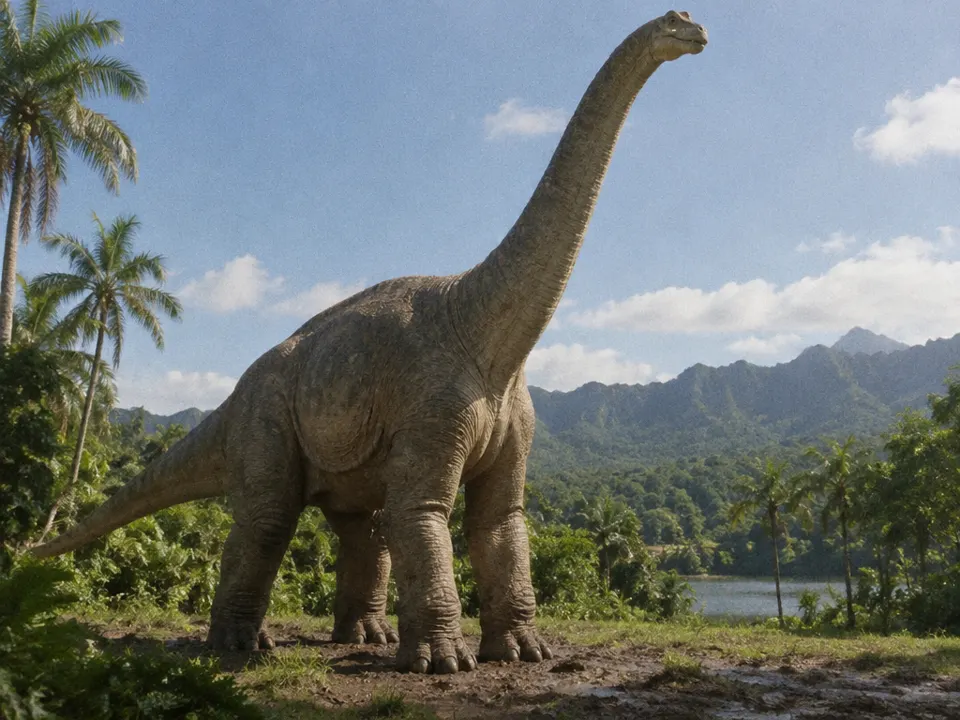
Transform this image into Photorealistic CGI with physically convincing materials, fine surface textures, natural reflections, and lighting matched precisely to the scene. Integrate modeled forms seamlessly using accurate perspective, soft contact shadows, realistic depth of field, and restrained motion blur where appropriate. Keep the original subject and composition.
[Digital creatures interact convincingly]with recorded people and real-world environments. Their origin remains invisible.
Principle
Animated 3D models are given [textures and lighting]. Compositing1adds appropriate [shadows, motion blur, perspective], and ground contact2.
Example
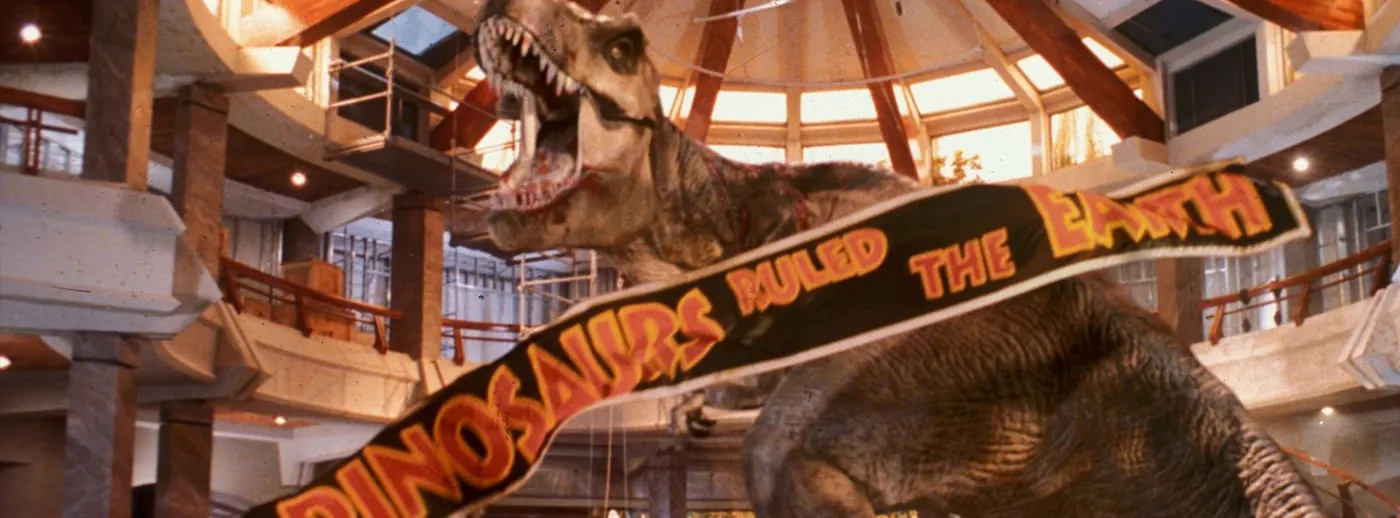
Jurassic Park (1993) combines ILM's digital dinosaurs with practical effects.
Try it out
Check aphoto montage for light direction, perspective, and ground contact. What deviations does it reveal?
Background
Breakthrough in the blockbuster: Jurassic Park (1993).
A3D model is given askeleton, animation, surface textures, and lighting. Rendering creates acamera image; compositing combines it with the real-world recording, including shadows, motion blur, and camera movement.
Jurassic Park (1993): ILM's CG dinosaurs combined with Stan Winston's practical dinosaurs; the film was deliberately ahybrid.
Regarding the image: Historical original / source image. Surface, light, shadows, and camera are adjusted to the filmed location. The film production also combined CGI and practical animatronics.
Distinction
Photorealism is the goal, CGI the toolkit. Non-realistic 3D animation is also CGI. CGI existed long before 1993. The decisive change was the convincing integration of moving digital animals into live-action, along with practical effects.
Aftermath
Ascene no longer needed to be fully executable by aphysical being or model. Image production could be planned using digital bodies.
Further examples · 7 images
02Renderman3A plaque documents the history of RenderMan. It cites essential photorealistic CGI techniques developed in the 1980s, including motion blur and penumbras, which enabled the digital creatures of Jurassic Park to blend with real environments.Awinch1001 · CC0 · Wikimedia Commons03Terragen renderA digital landscape rendered with Terragen software. It demonstrates atmospheric perspective and light interaction, key principles used in the 1990s to create realistic computer-generated environments and integrate digital elements into live-action photography.en:User:Fir0002 · CC BY-SA 3.0 · Wikimedia Commons04CGI Ukraine FlagA digital flag is integrated into a photographic sky environment. It demonstrates how 3D models are given textures and lighting to match a real-world background, though the result lacks the complexity of 1990s film compositing.Aerra Carnicom / Эра Карником · CC BY-SA 4.0 · Wikimedia Commons05Bollard as Ashtray, Pproduction stills, Alona Rodeh December 2022This digital rendering depicts bollards with complex light emission and surface textures. It demonstrates photorealistic CGI by simulating physics-based light behavior and material properties to mimic a real-world night scene.ARodeh · CC BY-SA 4.0 · Wikimedia Commons06Black Hole SideThe image shows a scientifically informed visualization of a black hole's accretion disk. It uses ray-tracing techniques to render complex gravitational lensing, illustrating how CGI creates photorealistic versions of phenomena that cannot be photographed.852278-MCS · CC BY-SA 4.0 · Wikimedia Commons07AI illustration: A large dinosaur is integrated into a real-world landscape with consistenA large dinosaur is integrated into a real-world landscape with consistent lighting and shadows. The skin textures and ground contact illustrate the seamless blend between digital assets and live-action environments.Illustration generated for the Atlas (AI)