Bullet Time
Bullet time. Pop breakthrough with The Matrix in 1999. Multi-camera precursors earlier.
Prompt
Apply a Bullet Time effect that suggests an orbiting camera around nearly frozen action. Keep the subject exceptionally sharp, suspend tiny airborne particles, and add restrained curved motion streaks only to distant surroundings, emphasizing depth separation and cinematic directional lighting. Keep the original subject and composition.
Identify
The action is almost stationary while the focus flies around the body.
Principle
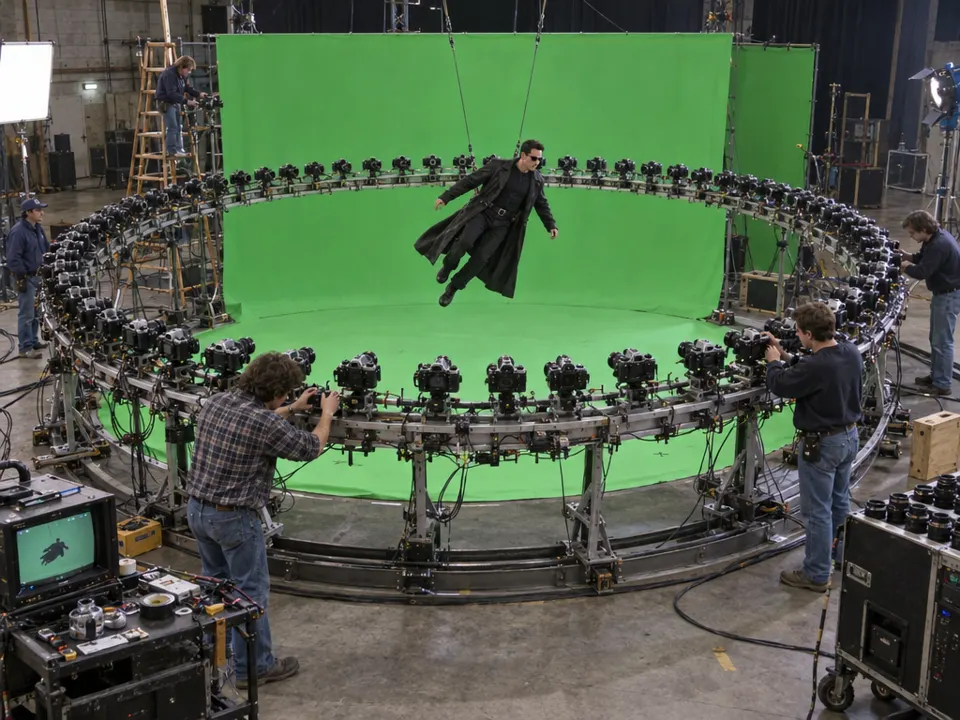
Spatially distributed cameras take photographs simultaneously or at different times. Combined, digitally smoothed views create the illusion of a camera movement.
Example
The Matrix (1999): John Gaeta's team uses up to 120 cameras.
Try it out
Arrange views of a frozen moment one after the other. Compare the change in perspective with ordinary slow motion.
Background
Pop cultural breakthrough: The Matrix (1999).
A series of spatially distributed cameras captures a moment simultaneously or with a time delay. The sequence of images jumps between viewpoints. Interpolation1 and digital backgrounds smooth the apparent camera movement around the slowed-down action.
The Matrix (1999), VFX team led by John Gaeta: Arrays2 with up to 120 cameras for the famous slow-motion sequences.
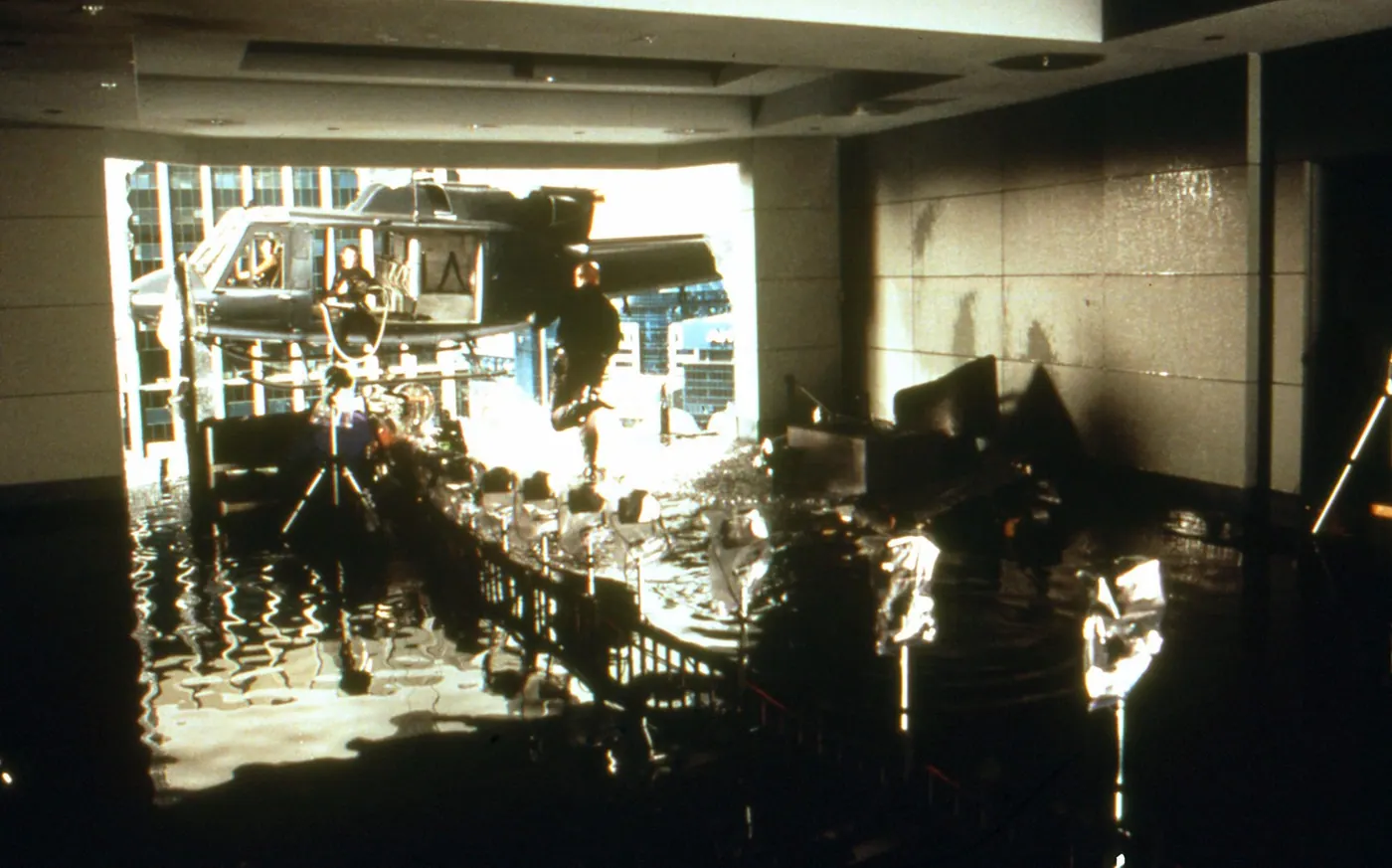
Regarding the image: Historical original / source image. Several cameras are positioned on the ground along the action sequence. This production shot shows the setup, not the finished, seemingly slow-motion footage with free camera movement.
Distinction
Super slow motion slows down time from a single camera perspective. Bullet time adds a deliberate change in spatial perspective. Multi-camera techniques and earlier experiments are older. The Matrix made this variant a widely recognizable film look.
Aftermath
Time and camera movement could be decoupled. An impossible perspective became a sign of superhuman perception.
Further examples · 6 images