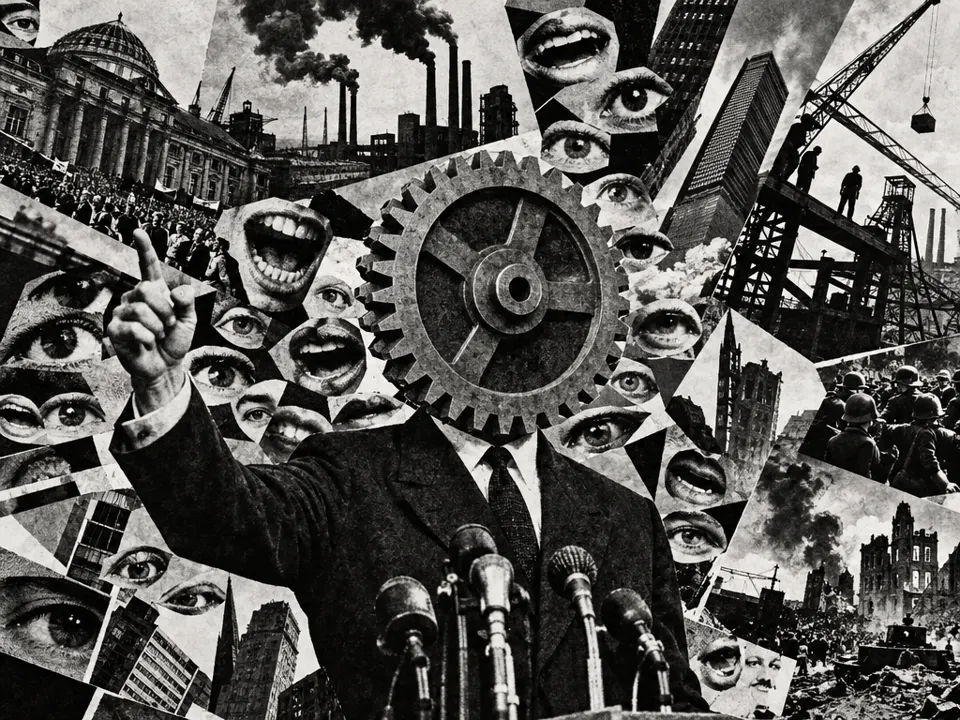
Transform this image into a Photomontage of visibly cut photographic fragments, mismatched scales, displaced detail duplicates, and scattered typographic scraps. Use hard scissor-cut edges, torn paper fibers, overlapping layers, inconsistent grayscale tones, and subtle paste shadows while retaining the overall arrangement. Keep the original subject and composition.
Photo fragments, foreign body parts, [impossible proportions]and typography visibly collide.
Principle
[Cut-out images and texts]are rescaled and reassembled. Their [new juxtaposition1changes the meaning].
Example
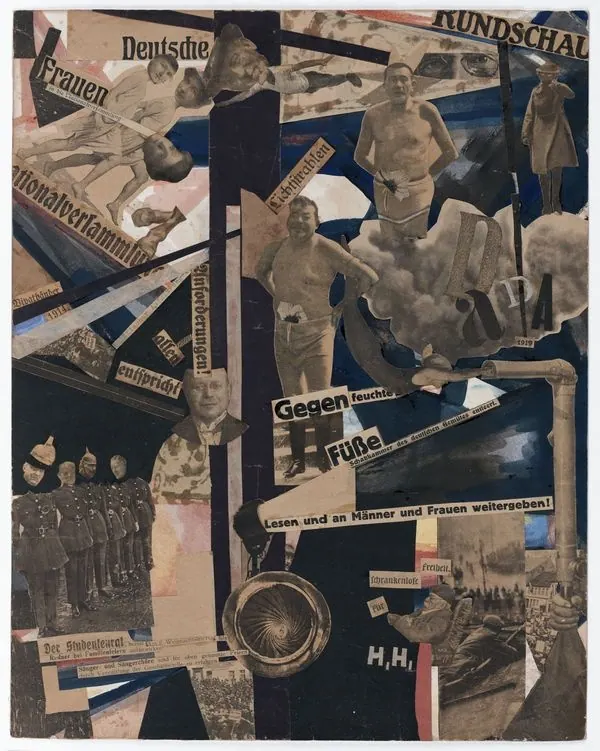
Hannah Höch: Dada2-Rundschau, 1919. Berlin Dada Fair, 1920.
Try it out
Create anew message from five press photos. Enlarge one fragment and observe how the effect changes.
Background
Composite photographs existed in the 19th century; Berlin Dada radicalized the method around 1918–1920. 1920s: Dada, illustrated press, and political graphics. The 1920s designation refers to the artistic breakthrough, not the invention of composite photography.
Recognize: Visible breaks, foreign body parts, impossible proportions, and typography.
Mechanism: Photo fragments and text are cut out, rescaled, and assembled into acontradictory visual world.
example: Hannah Höch: Dada-Rundschau, 1919; Schnitt mit dem Küchenmesser, 1919, beachtet auf der Dada-Messe 1920.
Practice: Create anew statement from five press photos; examine how the combination changes the meaning. Pay particular attention to size relationships: Atiny body under ahuge head immediately shifts the message of the image.
Photo fragments and text are cut out, rescaled, and assembled into acontradictory visual world.
Visible breaks, foreign body parts, impossible proportions and typography.
Create anew statement from five press images; examine how the combination changes the meaning.
The year 1920 refers to the artistic breakthrough, not the invention of composite photography.
Distinction
The assignment to 1920 refers to the artistic breakthrough, not the invention of composite photography.
Aftermath
Remix culture, zines, memes and digital cut-and-paste aesthetics.
Further examples · 7 images
02Die Plage (The Plague) by Harley Gaber, from an exhibit at Southwestern College, San Diego, CAThis work features cut-out portraits, typography from the Dada Almanac, and hand-drawn script. The disparate elements are reassembled into a non-linear composition, characteristic of the 1920s Berlin Dada photomontage style.Christina Ankofska · Attribution · Wikimedia Commons03Simultaneous portrait of Nelly-Pétro.This image shows a composite of different photographic fragments layered over a central figure. The visible edges and illogical spatial relationships demonstrate the radicalized cut-and-paste method used by avant-garde artists in the 1920s.Theo van Doesburg · Public domain · Wikimedia Commons04Grand opening of the first Dada exhibition, Berlin, 5 June 1920A contemporary photograph showing the first Dada exhibition in Berlin. Large-scale photomontages and posters are visible on the walls, documenting the movement's radical use of cut-out imagery and typography in an architectural context.Unknown authorUnknown author · Public domain · Wikimedia Commons05Beispiel einer FotomontageA woman's body is combined with butterfly wings to create a hybrid figure. This demonstrates the juxtaposition of disparate biological subjects and the alteration of meaning through the scaling and fusion of photographic fragments.Raimond Spekking (image of the woman)
Eric Pöhlsen (image of the butterfly and photomontage) · CC BY-SA 3.0 · Wikimedia Commons06Original photographic montage featuring various equipment used in shipboard communicationsShip hulls, radar equipment, and nautical details are layered in a non-linear composition. The overlapping fragments and varying scales create a dense visual field that departs from traditional perspective, following the Dadaist radicalization of the method.Department of Defense. American Forces Information Service. Defense Visual Information Center. 1994 · Public domain · Wikimedia Commons07AI illustration: A politician with a gear for a head is surrounded by fractured eyes and iA politician with a gear for a head is surrounded by fractured eyes and industrial imagery. The composition uses radical rescaling and jarring juxtapositions to create a new political message.Illustration generated for the Atlas (AI)