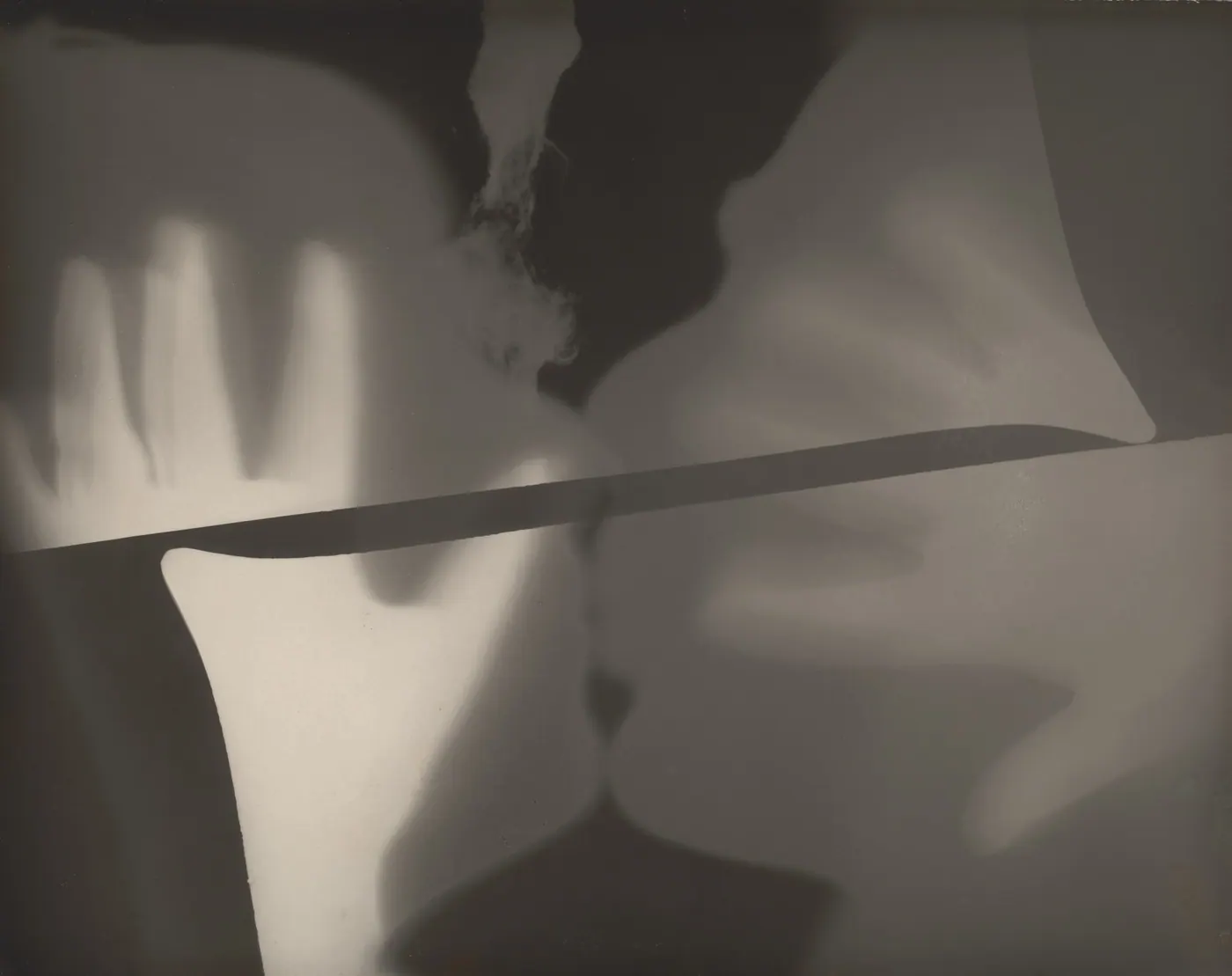
Transform this image into a Photogram, rendering the subject as luminous white silhouettes and translucent gray forms on deep black photographic paper. Combine sharp contact edges with soft hovering shadows, overlapping transparency, delicate surface textures, and slight development mottling. Remove conventional modeled lighting. Keep the original subject and composition.
Guess the objects. What different traces would aglass, asheet of paper, and an opaque metal object leave behind?
Background
Cameraless photographs date back to the early days of photography. 1921–1922: Man Ray's Rayographs transformed the process into an avant-garde language. Man Ray did not invent the photogram; Rayograph is his own name for his version.
Recognize: White silhouettes, transparent grey areas and dark background; often spatially enigmatic objects.
Mechanism: Objects are placed on light-sensitive paper and block the light completely or partially. After development, shadows and translucencies remain.
example: Man Ray: Rayograph, 1922.
Practice: First, guess the objects shown, then examine their transparency. Consider what trace aglass, asheet of paper, and ametal object would each leave if light shone on them from above.
Objects lie on light-sensitive paper and block the light completely or partially. After development, shadows and translucencies remain.
White silhouettes, transparent grey areas and dark background; often spatially enigmatic objects.
First guess the objects shown, then examine their transparency.
Man Ray did not invent the photogram; rayograph is his own name for his version.
Distinction
Man Ray did not invent the photogram; rayograph is his own name for his version.
Aftermath
Analogous counterpart to masks, negative forms and scanner experiments.
Further examples · 9 images
02Lemons photogramTranslucent blue circles with internal segment patterns are visible against a textured background. The image demonstrates a photogram through the varying light transmission of lemon slices placed directly on light-sensitive material.Uploaded by Cormaggio · CC BY-SA 1.0 · Wikimedia Commons03Cyanotype photogram on linen by Kate Cordsen. 2016 at Florence Griswold MuseumA large-scale wall installation shows overlapping dark and light blue geometric shards. It serves as a photogram example by recording the layered shadows and light blocks of physical shapes on linen.Qiling333 · CC BY-SA 4.0 · Wikimedia Commons04BergnerPhotogramLight-colored silhouettes of various fern fronds and leaves are arranged on a pale green field. This illustrates the photogram process by capturing the opaque shapes and fine edges of botanical specimens without a camera.Amelia Bergner · Public domain · Wikimedia Commons05Photogram by László Moholy-Nagy, (fgm 422), 1923A glowing, abstract white form appears against a dark sepia background with soft gradients. It exemplifies the photogram by using light to trace the contours and refractions of a three-dimensional object in 1923.Lazlo Moholy-Nagy · Public domain · Wikimedia Commons06D-PhotogramFour panels display translucent glasses, leaves, and organic pods with distinct highlights and shadows. These are effective photograms because they reveal the internal structures and transparency of objects through direct light exposure.Martanda · CC BY-SA 3.0 · Wikimedia Commons07Herbarium - FotogramDetailed white silhouettes of leaf-bearing stems are set against a stark black background. This work highlights the photogram technique by recording the intricate veins and textures of plants through direct contact.Foto: Jonn Leffmann · CC BY-SA 3.0 · Wikimedia Commons08Löwenzahn, LumenprintA glowing, ethereal white dandelion is visible on a flat greyish-blue surface. It is a clear photogram example as the flower head and stem blocked light to leave behind a pale negative impression.Hutschi · CC BY-SA 4.0 · Wikimedia Commons09Ray 811A lightbulb, pocket watch, and small objects appear as negative silhouettes against a black background. The varying translucency of the bulb and the metal chain demonstrates how different materials block light during the process.Hendrike · CC BY-SA 3.0 · Wikimedia Commons