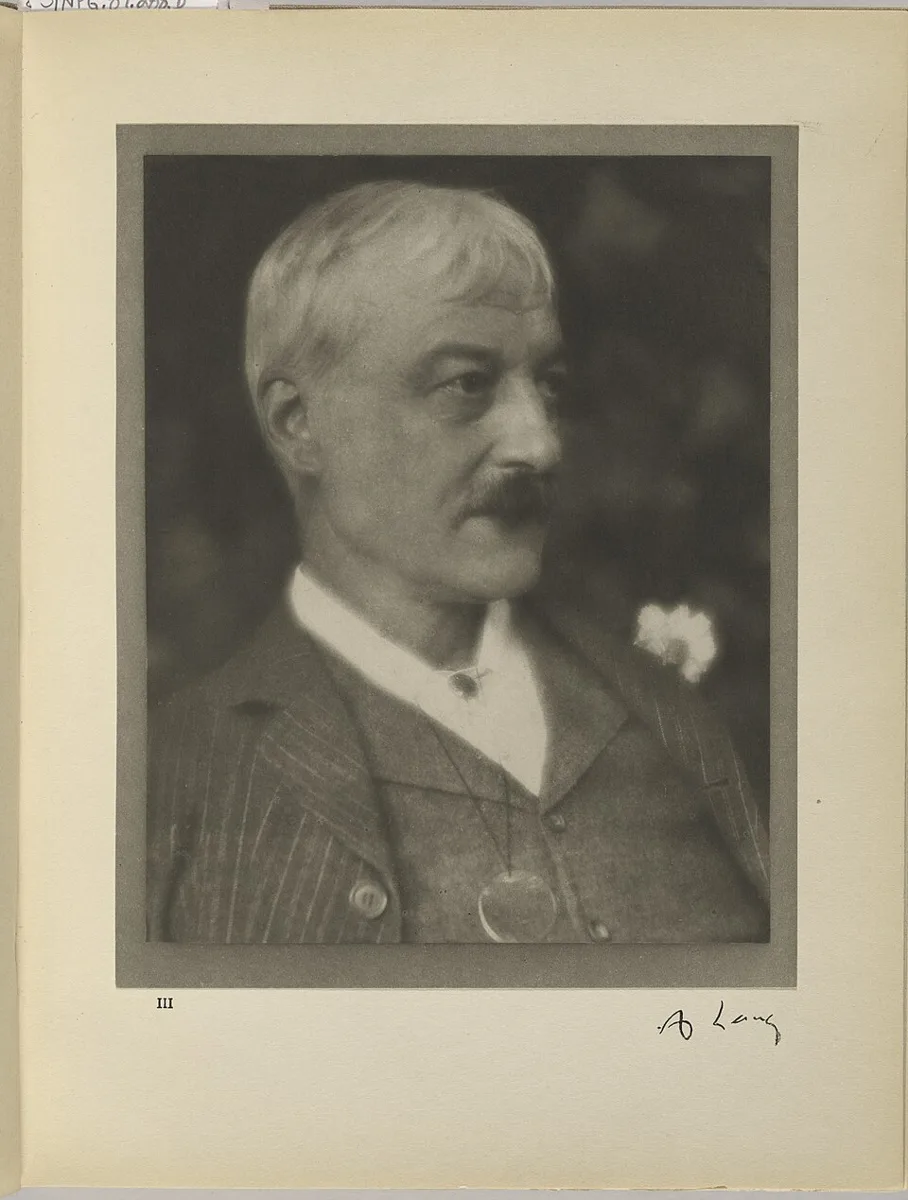
Photogravure Portrait of a Mustached Man. A mounted portrait shows a mustached man in a striped suit, his softly illuminated face emerging from a dark background.Alvin Langdon Coburn · CC0 · via Wikimedia CommonsView source ↗
Prompt
Apply a Photogravure effect with richly inked, velvety blacks, subtle continuous gray transitions, and delicate highlight detail. Add microscopic random aquatint grain rather than regular dots, warm textured paper, softly absorbed edges, and a faint recessed plate impression around the image. Keep the original subject and composition.
You see aphotographic image with continuous tones1, incredibly rich, [velvety blacks], and subtle grays. Under magnification, the image is made of arandom, [microscopic grain pattern]rather than regular dots.
Principle
Light exposure hardens agelatin layer on acopper plate, dictating how deeply acid bites into the metal. Ink settles into these [varying etched depths], transferring continuous tones to paper under heavy pressure.
Example
Peter Henry Emerson: Gathering Water Lilies, 1886.
Try it out
Look closely at an old printed photograph with astrong magnifying glass. If you see arandom dusting of pigment instead of arigid grid, it might be aphotogravure.
Background
Photogravure bridges early photography and fine art printing. In 1879, Karl Klietsch combined photography with traditional intaglio2printmaking. First, acopper plate is dusted with fine rosin powder3and heated, creating amicroscopic grain. Next, alight-sensitive gelatin tissue exposed to afilm positive is transferred to the plate. Acid etches the copper, biting deeper where the gelatin is thinnest. This creates tiny pits of varying depths across the metal. Aprinter rubs ink into the plate and wipes the surface clean. Finally, aheavy press forces damp paper into the pits to pull out the ink.
Distinction
Unlike standard halftone prints, which use grids of tiny dots to fake grays, photogravure varies physical depth. This results in true continuous tones rather than an optical illusion.
Aftermath
It demonstrates how early photographers used complex printmaking chemistry to elevate their images to accepted fine art.
Further examples · 11 images
02Bearded Man in PhotogravureA warm-toned portrait of a bearded man appears within a broad printed border on cream paper. Deep, textured blacks and delicate transitions across the forehead and beard display photogravure's expressive tonal range.Alvin Langdon Coburn · Public domain · Wikimedia Commons03A Maricopa MaidenA young woman looks directly outward from the folds of a blanket in the print titled A Maricopa Maiden. The warm photogravure combines luminous facial highlights with finely textured fabric and rich, softly graded shadows.Edward S. Curtis · Public domain · Wikimedia Commons04Hopi Woman in ProfileA Hopi woman appears in profile, with an elaborate coiled hairstyle and a hanging earring, in a sepia print on cream paper. Subtle modeling of the face and dense, textured shadows in the hair exemplify photogravure's continuous-tone rendering.Edward S. Curtis · Public domain · Wikimedia Commons05Double Portrait with a Flowered HatA long-haired man rests his hands on a chair behind a seated woman wearing a large flower-trimmed hat. The softly granular photogravure renders dark clothing in velvety tones while preserving delicate highlights in the faces and floral decorations.Clarence H. White · CC0 · Wikimedia Commons06Emerson’s Water-Lily Gathering PhotogravureA pale paper border surrounds a photograph of two figures gathering water lilies from a boat. Emerson’s photogravure image combines deep boat shadows, finely differentiated reeds, and luminous water in a particularly clear presentation of the process.Peter Henry Emerson · CC0 · Wikimedia Commons07Seated Figure Beside a ShelterA seated figure wrapped in a patterned covering appears beside a basket and a rough shelter in a richly brown photographic print. The image exemplifies the warm ink, dense shadows, and finely graduated textures of Edward Curtis’s photogravures.Edward S. Curtis · Public domain · Wikimedia Commons08Gathering Water LiliesTwo figures occupy a rowing boat among water lilies, with tall reeds extending across the distant bank. This photogravure balances pale water, delicate vegetation, and deep boat shadows through a finely graduated photographic tonal scale.Peter Henry Emerson (British, born Cuba, 1856 - 1936) (1856 - 1936) – photographer (Bri… · Public domain · Wikimedia Commons09Mesa Settlement in PhotogravureAn adobe settlement stretches across a rocky mesa above deeply fissured cliffs, with distant mountains beneath a pale sky. The warm-toned photogravure preserves intricate rock textures while carrying subtle atmospheric grays into the distance.Edward S. Curtis · Public domain · Wikimedia Commons10Water-Lily Gathering, Alternate ImpressionA second rendering of the boating scene shows one figure rowing while another reaches toward the lily-covered water. Fine tonal transitions in the reflections and dense shadows beneath the boat show photogravure's capacity to retain detail across contrasting values.Peter Henry Emerson · Public domain · Wikimedia Commons11Gathering Water Lilies in Soft TonesTwo figures sit in a rowing boat among water lilies and dense reeds, rendered in muted warm grays. This reproduction of Peter Henry Emerson’s water-lily gathering scene displays the delicate photographic tonal transitions associated with his photogravure prints.Peter Henry Emerson · CC0 · Wikimedia Commons
Question
Why do the darkest areas in a photogravure look so velvety and rich?
Show possible answer +Hide answer −
The acid etches the darkest areas the deepest into the copper plate. These deep pits hold massive amounts of ink, transferring athick, rich layer to the paper.