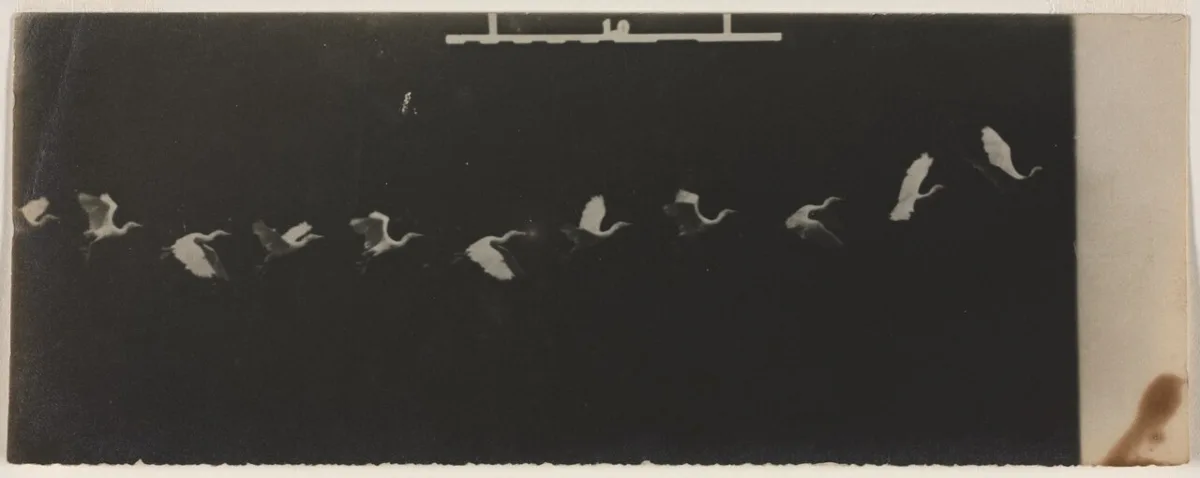
Chronophotograph of a white bird in flight.. A single photographic frame shows several overlapping phases of a white bird flying across a dark background.Étienne-Jules Marey · CC0 · via Wikimedia CommonsView source ↗
Prompt
Apply a Chronophotography effect, showing multiple overlapping phases of the subject's movement within one undivided frame. Use pale monochrome silhouettes, crisp stroboscopic contours, measured spacing, subtle photographic grain, and a dark stationary background that retains the original setting's structure. Keep the original subject and composition.
You see [multiple overlapping phases]of asingle moving subject captured within one single image frame. The subject appears as a[stroboscopic1sequence]against adark, stationary background.
Principle
Acamera lens is left open while a[slotted disk spins rapidly]in front of the photographic plate2. Each slot passes, briefly exposing the plate to the bright moving subject.
Example
Étienne-Jules Marey: Pelican in Flight, 1882.
Try it out
Wave your hand rapidly under astrobe light in adark room to see overlapping motion trails.
Background
Étienne-Jules Marey wanted to study human and animal movement scientifically. Earlier methods required multiple cameras to capture motion phases. Marey invented the photographic gun, and later afixed-plate chronophotographic camera. He dressed subjects in bright white clothes and placed them against deep black backgrounds. Arotating shutter disk spun in front of asingle glass photographic plate. The shutter rapidly blocked and unblocked the light. Because the background reflected no light, only the moving subject exposed the plate. The result was acontinuous overlapping graph of motion on one plate. This subtractive background technique ensured clear exposures.
Distinction
Unlike Eadweard Muybridge's separate sequential frames, Marey recorded all overlapping motion phases onto one single photographic plate.
Aftermath
It proves that complex, rapid motions can be decomposed and mapped onto asingle spatial plane.
Further examples · 10 images
02Chronophotograph of a man swinging a sledgehammer.A single image displays a man swinging a sledgehammer, resulting in overlapping, transparent phases of his body and the tool. It is a classic example of fixed-plate chronophotography, revealing the trajectory of a rapid movement against a black backdrop.Creator:Etienne-Jules MareyCreator:Charles Fremont · CC0 · Wikimedia Commons03Chronophotographic sequence of a man riding a bicycle.Multiple successive phases of a man riding a bicycle are recorded on one frame, with the wheels visibly overlapping. This clearly demonstrates the technique by capturing the subject's forward progression as a stroboscopic sequence against a dark background.Étienne Jules Marey · CC0 · Wikimedia Commons04Chronophotographic capture of a bird in flight.A sequence of a flying bird is shown with multiple overlapping wing positions captured within one continuous image frame. This is a genuine example of the visual effect, capturing the subject in a stroboscopic sequence against a stationary dark background.Étienne-Jules Marey · CC0 · Wikimedia Commons05Sequential flight phases of a bird on fixed plate.Several overlapping stages of a bird in downward flight are exposed onto a single horizontal image against a dark background. It perfectly illustrates chronophotography by capturing the fluid motion of a moving subject on a single open photographic plate.Creator:Etienne-Jules Marey · CC0 · Wikimedia Commons06Chronophotograph showing a fan-like motion of a rod.A person is shown rapidly moving a rod in an arc, leaving a fan-like trail of overlapping exposures in a single frame. This clearly shows the requested effect, where rapid successive exposures of a moving object create a visual sequence on a stationary plate.Étienne-Jules Marey · Public domain · Wikimedia Commons07Chronophotographic sequence of a man juggling clubs.Successive phases of a man juggling clubs are captured across a single wide frame with a continuous dark background. It is a prime example of the chronophotographic technique, recording the complex motion of the subject and props over time in one image.Étienne-Jules Marey · Public domain · Wikimedia Commons08Chronophotograph of an athlete performing a pole vault.A pole vaulter's jump is depicted through multiple overlapping exposures of his body ascending in a single image frame. This fits the criteria perfectly, showing the trajectory of the athlete's movement as a stroboscopic sequence against a dark structure.Étienne-Jules Marey · Public domain · Wikimedia Commons09Chronophotograph of an athlete tumblingA single athlete is shown in multiple sequential, overlapping poses of a jump or tumble across the same frame over a black background. It perfectly demonstrates the technique of chronophotography, where a slotted disk exposes the moving subject multiple times onto a single photographic plate.Étienne-Jules Marey · Public domain · Wikimedia Commons10Chronophotograph of a bird in flightA bird in flight is captured in multiple overlapping phases of a downward swoop across a single frame with a dark background. This is a classic chronophotograph that uses rapid stroboscopic exposures to study the mechanics of animal locomotion.Étienne-Jules Marey · Public domain · Wikimedia Commons
Question
Why did Marey use completely black backgrounds?
Show possible answer +Hide answer −
Ablack background reflects almost no light. This prevents the stationary background from overexposing the single plate during multiple shutter openings.