Photogrammetry
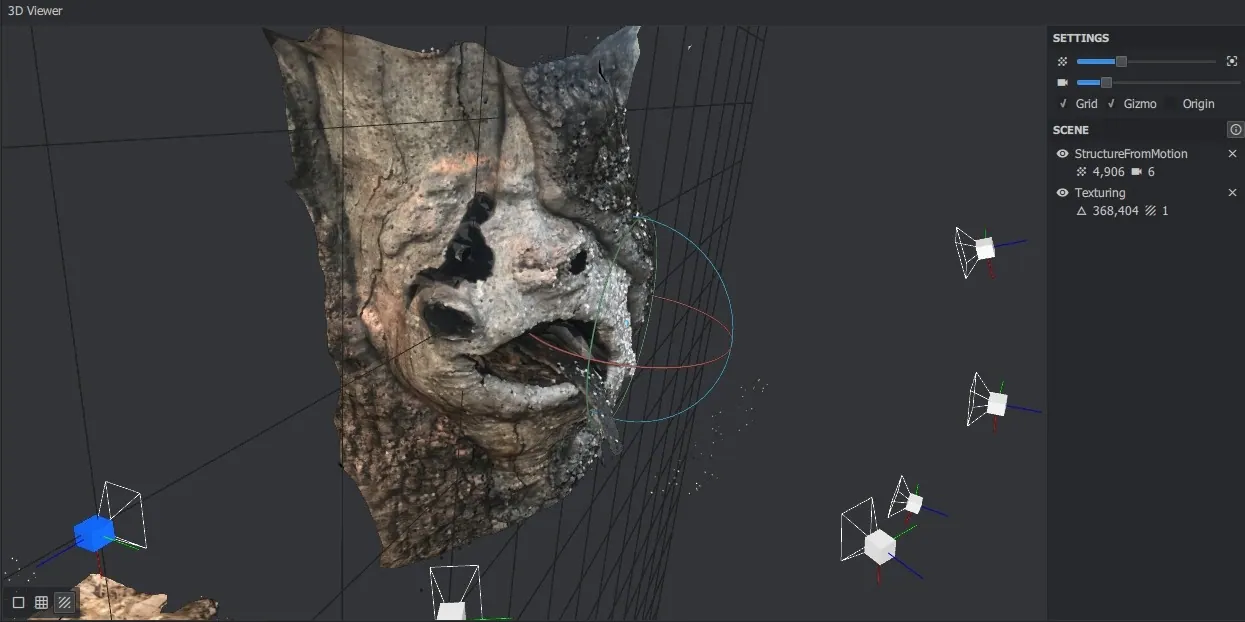
Photogrammetry / structure from motion. 2018: Meshroom facilitates the open photogrammetry workflow; older methods
Prompt
Apply a Photogrammetry effect, rendering the scene as a reconstructed three-dimensional scan covered in photographic textures. Introduce subtle triangulated surface irregularities, baked lighting, stretched textures near occlusions, and small rough mesh gaps along complex edges, while retaining realistic color and recognizable volume. Keep the original subject and composition.
Identify
Photographic textures over reconstructed three-dimensional surfaces.
Principle
Many overlapping photos provide camera positions1, depth, and a textured model2.
Example
AliceVision Meshroom, first released in 2018.
Try it out
Photograph a matte object from all sides with strong overlaps.
Background
Photogrammetry extracts geometry from photographs and has a long history predating digital creative tools. This slide anchors the more recent development to the first Meshroom release from August 2018. AliceVision describes its open pipeline of features, camera estimation, dense reconstruction, and texturing. The method requires recognizable image features across multiple shots. Glossy, transparent, or low-texture surfaces complicate this because views do not reliably match. Therefore, a matte, detailed object in even lighting is suitable for this exercise. The surface color is taken from the photographs; the shape is reconstructed computationally. Missing areas and torn edges can later be intentionally left visible as part of the scan aesthetic.
Distinction
Photogrammetry is a measurement and reconstruction method; the scan look is a possible aesthetic use.
Aftermath
A scan is not a neutral impression: the image cover, light and algorithm determine which parts are fully and stably reconstructed.
Further examples · 8 images


Question
Why is a shiny glass more difficult to scan than a matte stone?
Show possible answer +Hide answer −
Reflections and transparency change the visible features with the viewing angle; stable correspondences between photos are lacking.