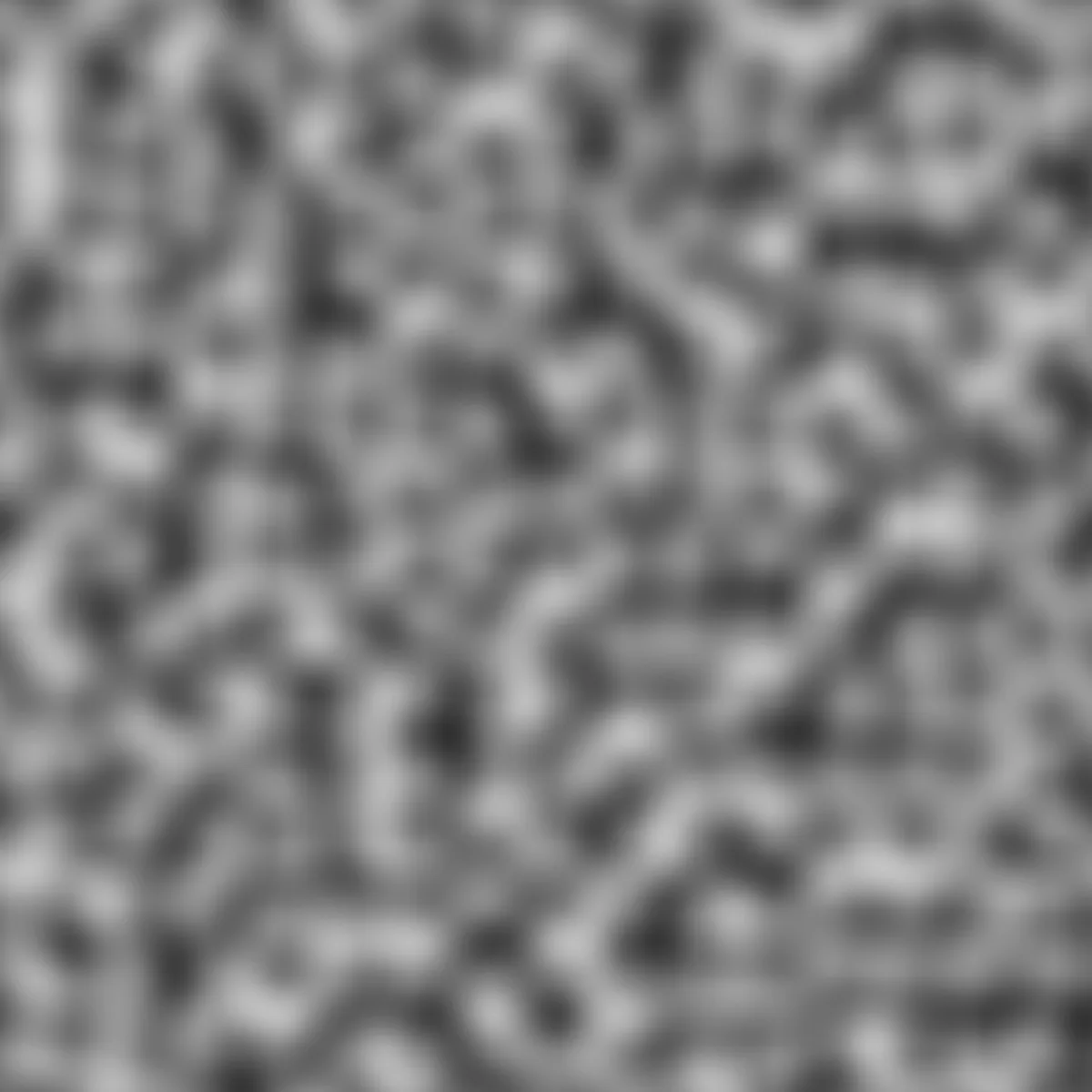
Grayscale Perlin Noise Field. Soft gray patches merge into an irregular field of rounded light and dark regions.Lord Belbury · CC0 · via Wikimedia CommonsView source ↗
Prompt
Apply a Perlin Noise effect using smooth, organic gradients that resemble drifting clouds, pale marble veins, and swirling water. Blend layered light and dark undulations into existing surfaces, with softly connected contours and no harsh static or isolated speckles. Keep the original subject and composition.
You see organic, flowing patterns that resemble clouds, marble, or swirling water. Unlike television static, it has [smooth transitions between light]and dark areas.
Principle
Acomputer algorithm1generates random values at specific points on agrid. It then [smoothly interpolates2between them]to create [continuous gradients].
Example
Ken Perlin: Tron (visual effects), 1982.
Try it out
Look closely at water ripples in an older video game. Try to spot the repeating, wavy gradients simulating nature.
Background
In the early 1980s, computer graphics looked very flat and artificial. Ken Perlin worked on the movie Tron and wanted realistic digital surfaces. He invented amathematical function to generate controlled randomness. This procedural texture3method layered different sizes of visual noise together. It created complex natural looks without requiring massive amounts of memory. Instead of hand-drawing every detail, computers could calculate textures on the fly. Perlin won an Academy Award for this technical breakthrough. It remains afoundational tool in modern animation and video games.
Distinction
White noise places entirely random pixels next to each other, creating harsh static. Perlin noise mathematically connects nearby points to form smooth waves.
Aftermath
It shows how mathematical formulas can capture the structured randomness found in the natural world.
Further examples · 8 images
02Perlin Noise Gradient LatticeRed directional arrows mark a blue lattice over a smoothly shaded green, white, and purple field. The diagram demonstrates how lattice gradients contribute to the continuous variations of Perlin noise.Matthewslf · CC BY-SA 4.0 · Wikimedia Commons03Perlin Noise with Zero ContourRounded red and blue patches spread across a dashed grid, separated by a winding green zero contour. This visualization explicitly demonstrates a two-dimensional Perlin noise field and its smooth transitions between positive and negative values.Morn · CC0 · Wikimedia Commons04Perlin Noise Contour FieldNested contour lines trace irregular peaks and hollows across a softly shaded red and blue field. The labeled two-dimensional Perlin noise visualization reveals continuous, spatially coherent variation at multiple intensity levels.Morn · CC0 · Wikimedia Commons05Procedural Texture Sample GridSixteen texture samples combine cloudy color fields, woodlike rings, watery turbulence, and geometric relief. Several organic panels clearly illustrate noise-based procedural texturing associated with Perlin noise, although the collection also includes other effects.Drummyfish · CC0 · Wikimedia Commons06Perlin noise dot productsRed directional arrows overlay a blue square lattice filled with softly shaded green, white, and purple regions. The diagram demonstrates the grid gradients and smoothly varying scalar field central to Perlin noise.Matthewslf · CC BY-SA 4.0 · Wikimedia Commons07Gradient Vectors and Interpolated NoiseA rectangular grid carries red gradient vectors over a continuous field of green and purple shading, accompanied by a numerical color scale. This exposes how local gradient directions produce the smooth fluctuations characteristic of Perlin noise.Matthewslf · CC BY-SA 4.0 · Wikimedia Commons08Procedural Terrain and Cloud LayersA computer-rendered landscape combines irregular green landforms, blue depressions, and wispy white cloud layers. Its layered, smoothly varying procedural textures provide a clear application of Perlin-like noise to terrain and atmosphere.Kevin Gill · CC BY 2.0 · Wikimedia Commons
Question
Why did early computers use algorithms to make textures instead of photographs?
Show possible answer +Hide answer −
Early computers had very little memory to store large image files. Calculating patterns mathematically saved vital storage space.