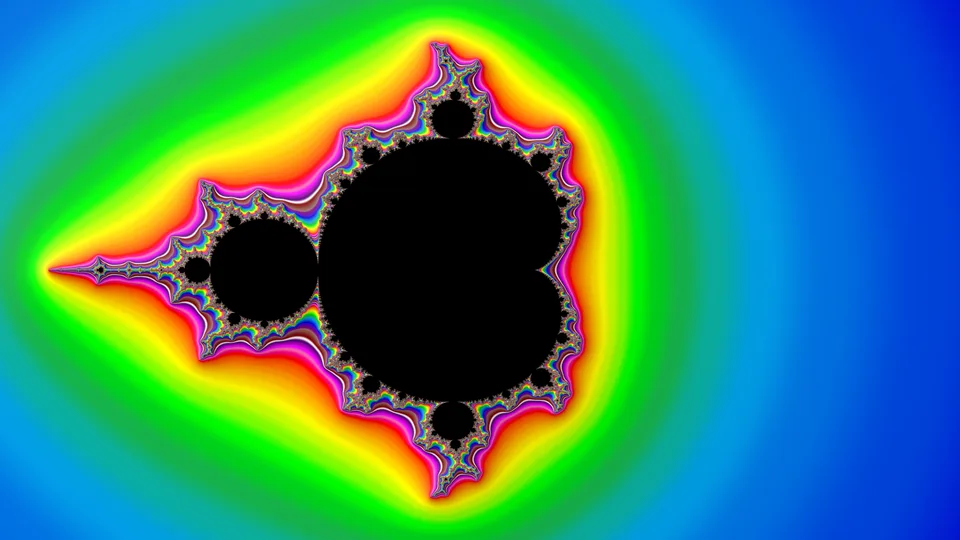
Mandelbrot Set With Rainbow Escape Bands. A large black cardioid joins a circular bulb, with smaller satellite bulbs and rainbow bands tracing the intricate perimeter.PantheraLeo1359531 · CC0 · via Wikimedia CommonsView source ↗
Prompt
Apply a Mandelbrot set treatment, mapping intricate escape-time patterns across existing forms. Use black cardioid-and-disk motifs, miniature repeating copies, branching filaments, tightly curled boundary spirals, and vivid nested color bands in cobalt, magenta, and gold, concentrating detail along recognizable silhouettes. Keep the original subject and composition.
You see acomplex, [swirling pattern]built around adistinctive beetle-like black shape1. As the image zooms in, [miniature copies of this shape]appear endlessly at smaller scales.
Principle
Acomputer repeatedly feeds the output of amathematical equation back into itself. Pixels get different colors based on how quickly their calculated numbers [grow toward infinity2].
Example
Heinz-Otto Peitgen and Peter Richter: The Beauty of Fractals, 1986.
Try it out
Search for aMandelbrot zoom video online, pick aspiral, and watch how similar shapes keep reappearing as it zooms.
Background
Benoit Mandelbrot defined this set in 1980 while working at IBM. He used powerful computers to calculate the boundaries of complex numbers3. Early printouts were rough, low-resolution black-and-white plots. Soon, mathematicians added vibrant colors to show how rapidly points outside the shape grew. This visual breakthrough made abstract mathematical concepts visible and widely popular. The 1986 book The Beauty of Fractals turned these computer-generated images into cultural icons. People suddenly saw infinite, organic-looking complexity emerging from incredibly simple rules.
Distinction
Unlike hand-drawn psychedelic art, aMandelbrot image contains strict mathematical self-similarity. Zooming into anormal drawing reveals blurry pixels, not infinitely sharp new structures.
Aftermath
It teaches us that incredibly complex, organic structures can arise from very simple, repetitive rules.
Further examples · 11 images
02Mandelbrot Miniature Amid Radiating WhorlsA small white Mandelbrot silhouette sits within concentric bands and elaborate blue-and-yellow whorls. This miniature copy surrounded by branching detail clearly demonstrates the nested structures revealed by Mandelbrot-set magnification.Aokoroko · CC0 · Wikimedia Commons03White Mandelbrot Miniature Within Colored ContoursA white, bulbous Mandelbrot miniature occupies the center of nested blue-and-yellow contours and jagged branching rings. The recognizable central form and intricate surrounding boundary clearly display the set's recurring structure under magnification.Aokoroko · CC0 · Wikimedia Commons04Mandelbrot Set With Luminous BoundaryA black cardioid joins a circular bulb, with smaller satellite bulbs and luminous branching edges against blue. This is the characteristic Mandelbrot-set outline, surrounded by colors representing the escape behavior of iterated values.Created by Wolfgang Beyer with the program Ultra Fractal 3. · CC BY-SA 3.0 · Wikimedia Commons05Mandelbrot Set as a Relief SurfaceThe familiar black Mandelbrot silhouette lies on a tilted blue surface, surrounded by a raised, jagged white rim. This relief visualization preserves the set's defining outline while expressing the surrounding numerical behavior through height and color.Duncan Champney DuncanMacC · CC BY-SA 4.0 · Wikimedia Commons06Mandelbrot Miniature Surrounded by Curling FilamentsA white Mandelbrot miniature appears inside a triangular enclosure of fine contours, surrounded by blue-and-yellow curls. Its recognizable bulb-and-cardioid form demonstrates the small copies embedded within the set's intricate magnified boundary.Aokoroko · CC0 · Wikimedia Commons07Mandelbrot Island Among Blue SpiralsBlue spiral arms radiate around a small white, beetle-shaped island against a yellow field. The central miniature Mandelbrot form and its intricate surrounding boundary provide a clear example of a magnified set detail.Aokoroko · CC0 · Wikimedia Commons08Miniature Mandelbrot With Radiating BranchesA white miniature Mandelbrot shape sits inside concentric bands, surrounded by dark branching arms and fine filaments. Its recognizable outline anchors this magnified view of the set's recursively detailed surroundings.Aokoroko · CC0 · Wikimedia Commons09White Mandelbrot Island in Spiral FiligreeA white beetle-shaped island is encircled by layered bands and blue spirals amid dense yellow branching textures. The recognizable miniature Mandelbrot outline makes this a clear magnified example despite the unconventional interior color.Aokoroko · CC0 · Wikimedia Commons10Sixfold Branching Mandelbrot DetailSix branching arms radiate from a finely ringed center against a deep blue field. Their recursively subdivided filaments and colored contours show the intricate boundary structures encountered in Mandelbrot-set zooms.Aokoroko · CC0 · Wikimedia Commons11Spirals Along the Mandelbrot BoundaryOrange and blue spirals curl between black regions edged with tiny bulbs and densely branching filaments. This magnified Mandelbrot boundary reveals the repeating spiral structures and escape-time coloring characteristic of the technique.Created by Wolfgang Beyer with the program Ultra Fractal 3. · CC BY-SA 3.0 · Wikimedia Commons
Question
Why are the images often so colorful?
Show possible answer +Hide answer −
The core Mandelbrot set is usually colored black. The bright colors outside the set show how fast other numbers run away toward infinity.