H 198 / 3211980s

Particle Systems

1982, William Reeves's Genesis Effect
Typeface · Rubik Glitch Pop

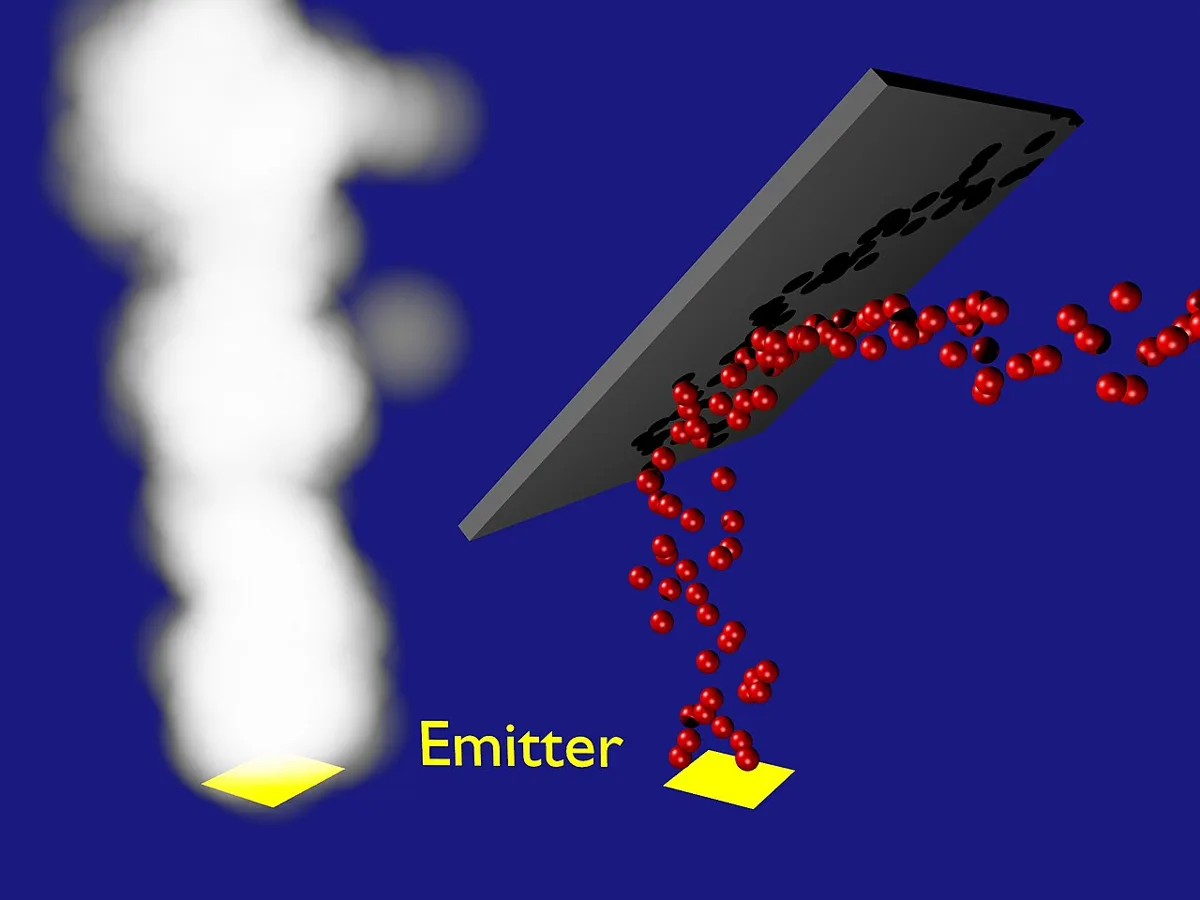
Particle Emitters and Collision Barrier. Two yellow emitters produce a soft white plume and a stream of red spheres that encounters an inclined barrier.
Particle Emitters and Collision Barrier. Two yellow emitters produce a soft white plume and a stream of red spheres that encounters an inclined barrier.Holger Weihe · CC BY-SA 3.0 · via Wikimedia CommonsView source ↗

Prompt

Apply a particle systems effect, reconstructing visible forms from dense swarms of tiny luminous points and softly translucent flecks. Use bright clustered cores, smoky irregular edges, scattered sparks, short directional trails, and varied particle sizes, with additive glow against darker existing areas. Keep the original subject and composition.

Identify

You see a swarm of tiny, glowing dots or shapes moving together to form fuzzy, chaotic shapes. They often look like fire, smoke, sparks, or magic spells.

Principle

A computer program spawns1 hundreds of independent digital points and applies basic physics rules to them. These points live, move, and die over a set lifespan.

Example

William Reeves (Industrial Light & Magic): Star Trek II: The Wrath of Khan, 1982.

Try it out

Drop a handful of sand in the wind and watch how individual grains move together to form a fluid dust cloud.

Background

Before the 1980s, computer graphics struggled to draw fuzzy or fluid things like fire. Traditional geometry relied on rigid polygons2, which looked fake and blocky. In 1982, William Reeves at Industrial Light & Magic invented particle systems to solve this. Instead of drawing a solid shape, his code generated thousands of tiny graphical points. Each point followed basic rules for speed, gravity, and color before fading away. He first used this for the "Genesis Effect" in Star Trek II. The result was a stunning wall of fire spreading across a planet. This technique revolutionized how computers simulate natural chaos3.

Distinction

Particle systems generate many independent points using math, unlike fluid simulations which calculate continuous flows on a 3D grid. Particle rendering is faster but less physically accurate.

Aftermath

It shows that complex natural phenomena can emerge from simple, repetitive mathematical rules.

Further examples · 7 images

Smoke Plume and Underlying Particles
02 Smoke Plume and Underlying ParticlesThree views show a curling plume as dense smoke, scattered particles, and directional marks emerging from a magenta source. The comparison explicitly connects the continuous-looking smoke to the individual elements and motion underlying a particle simulation.thWusa · CC BY-SA 3.0 · Wikimedia Commons
Multicolored Particle Cloud
03 Multicolored Particle CloudThousands of brightly colored dots cluster around a dense blue center and scatter toward the edges. The mass of discrete elements forming a diffuse cloud clearly illustrates the visual structure of a particle system.PantheraLeo1359531 · CC0 · Wikimedia Commons
Simulated Snowfall Over Digital Terrain
04 Simulated Snowfall Over Digital TerrainWhite specks and larger snowflake shapes fill the gray sky above a simple green digital landscape. The repeated, independently placed flakes clearly demonstrate particle-based snowfall using small points and snowflake sprites.Baron305 · Public domain · Wikimedia Commons
Mist and Droplet Particle Effects
05 Mist and Droplet Particle EffectsTwo square platforms support contrasting effects: a diffuse white mist on the left and a spray of translucent droplets on the right. These paired renderings demonstrate how particle systems can depict both soft vapor and individually modeled liquid drops.Tcpp · CC BY-SA 3.0 · Wikimedia Commons
Orange and Purple Particle Vortex
06 Orange and Purple Particle VortexA ragged circular vortex surrounds a white opening, grading from bright orange inside to deep purple outside. Numerous overlapping flecks and small geometric elements visibly build the turbulent ring as a particle-based effect.Luatrilogy · CC BY 4.0 · Wikimedia Commons
Glowing Particle Wake Beside a Sphere
07 Glowing Particle Wake Beside a SphereA green sphere sits beside a broad diagonal wake of bright, overlapping flecks in a pale blue simulation view. The granular, fading wake visibly demonstrates particles combining into a continuous-looking trail.YAGO rus · CC BY-SA 3.0 · Wikimedia Commons

Question

Why do particle systems give points a specific lifespan?

Show possible answer +

A lifespan deletes the point after a few seconds. This prevents the computer from freezing while trying to track too many overlapping particles.