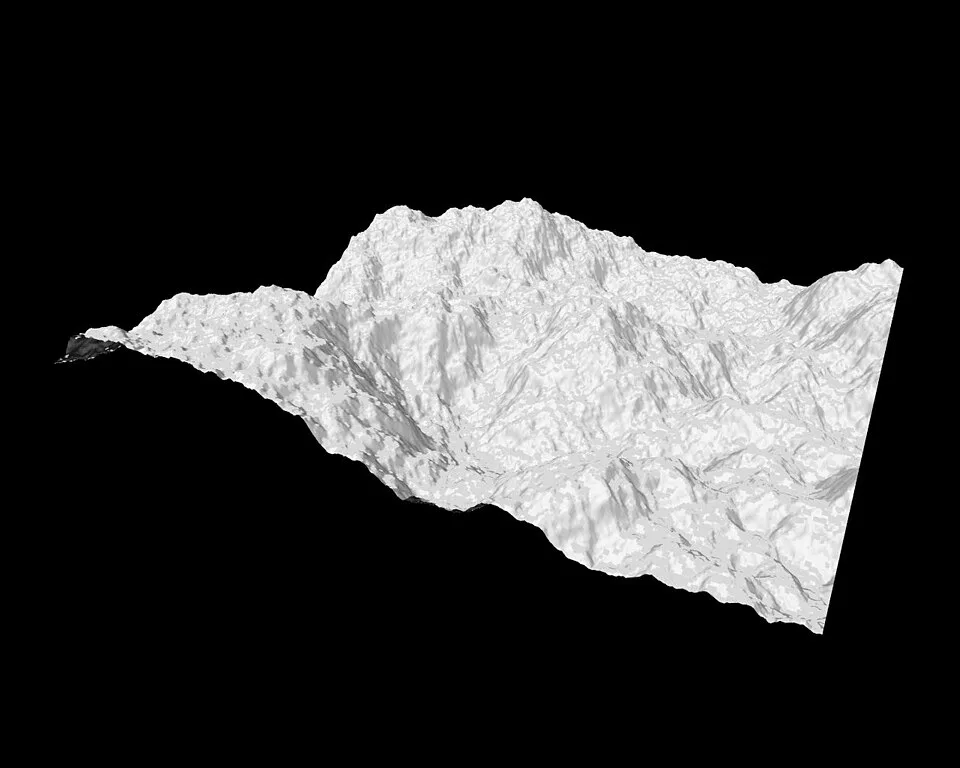
Isolated Fractal Mountain Surface. An isolated white terrain patch displays jagged peaks, branching gullies, and densely wrinkled slopes against black.Stevo-88 · Public domain · via Wikimedia CommonsView source ↗
Prompt
Apply a fractal landscape treatment, translating existing masses into rugged procedural terrain with recursively subdivided triangular facets, jagged ridgelines, branching valleys, and repeated roughness at multiple scales. Use earthy elevation colors, cool shadowed crevices, and directional light that reveals the angular relief. Keep the original subject and composition.
You see computer-generated mountains and valleys with [jagged, repeating details]. As the view zooms in, [smaller shapes look identical]to the larger shapes.
Principle
An algorithm1repeatedly [divides flat triangles]into smaller triangles. It offsets their center points randomly to create infinite, natural-looking roughness.
Example
Loren Carpenter: Vol Libre, 1980.
Try it out
Look closely at rugged mountains in avideo game. Notice how small rocks echo the shape of the whole peak.
Background
In the late 1970s, computer graphics struggled to create realistic nature. Smooth polygons looked artificial and plastic. Mathematician Benoit Mandelbrot published theories on fractals, describing shapes with self-similarity2across different scales. Loren Carpenter applied this math to 3D computer graphics. He wrote software that split large triangles into smaller ones, randomly shifting their heights. This simple recursive division3generated highly detailed, irregular mountains very quickly. Carpenter debuted an animated flight through these mountains at a 1980 conference. The stunning realism revolutionized visual effects, soon leading to the Genesis Effect in Star Trek II.
Distinction
Unlike hand-painted matte paintings, fractal landscapes are true 3D models that avirtual camera can physically fly through.
Aftermath
It teaches that complex natural structures can be built rapidly from very simple mathematical rules.
Further examples · 11 images
02Fractal Alpine Peaks and WaterwaysSnow-patterned mountain peaks rise around blue waterways in a visibly computer-rendered alpine scene. Large ridges break into progressively smaller rocky irregularities, strongly displaying the multiscale roughness of a fractal landscape.Stevo-88 · Public domain · Wikimedia Commons03Fractal Mountains Under Cloudy SkiesJagged computer-rendered mountains rise above a broad valley beneath a dramatic cloudy sky. Smaller ridges and irregular surface details repeat the roughness of the larger peaks, clearly displaying fractal terrain.Zhongde Liu from Germany · CC BY 2.0 · Wikimedia Commons04Fractal Hills Surrounding a LakeA rendered lake winds between rugged mountains and finely textured foreground hills. The nested irregularities across slopes and shorelines visibly demonstrate the multiscale roughness of fractal landscapes.Levyznin · Public domain · Wikimedia Commons05Rugged Fractal Mountain BasinPale, rugged slopes descend into a rendered mountain basin enclosed by steep cliffs. Large crags break into progressively smaller ridges and bumps, visibly expressing the recursive roughness of fractal terrain._william · CC BY-SA 2.0 · Wikimedia Commons06Multiscale Fractal Mountain ReliefBare gray mountain ranges fill the view with sharp peaks, branching gullies, and densely roughened slopes. The clearly exposed relief repeats jagged structures at multiple scales, providing an unmistakable demonstration of fractal terrain.Stinging Eyes · CC BY-SA 2.0 · Wikimedia Commons07Fractal Desert PlateauA rendered reddish plateau rises above a broad plain covered in intricate ridges beneath billowing clouds. Roughness distributed across both large landforms and smaller surface features gives a clear example of procedural fractal terrain.Jonathan Brandt from United States · CC0 · Wikimedia Commons08Procedural Canyon and Jagged CliffsSteep synthetic cliffs frame a broad canyon floor, with small pointed outcrops beneath a luminous sky. The cliffs repeat their jagged profiles in smaller crags and surface details, visibly illustrating fractal terrain construction.Stinging Eyes · CC BY-SA 2.0 · Wikimedia Commons09Procedural Snowy Mountain BasinA pale mountain wall overlooks reflective water, rocky islands, and distant pointed peaks. The synthetic landforms combine broad slopes with smaller irregular ridges and shoreline details characteristic of fractal terrain.Zhongde Liu from Germany · CC BY 2.0 · Wikimedia Commons10Fractal Ridges Reflected in a LakeBrown mountain ridges and a cloud-filled sky reflect across a calm lake in a computer-generated landscape. The surrounding terrain carries nested ridges and fine surface roughness that visibly support its fractal construction.Zhongde Liu from Germany · CC BY 2.0 · Wikimedia Commons11Rugged Fractal BasinA high viewpoint reveals a rugged basin enclosed by dark cliffs, with smaller mounds scattered across its textured floor. Repeated irregularity from the enclosing ridges down to fine ground features makes this a clear rendered fractal landscape.Zhongde Liu from Germany · CC BY 2.0 · Wikimedia Commons
Question
Why do fractal mountains look more realistic than early, smooth computer models?
Show possible answer +Hide answer −
Nature is physically rough and detailed at every scale. Fractals mimic this by adding smaller random variations infinitely.