2000s, popularization of heavy ND filters in digital photography
Typeface · Julius Sans One
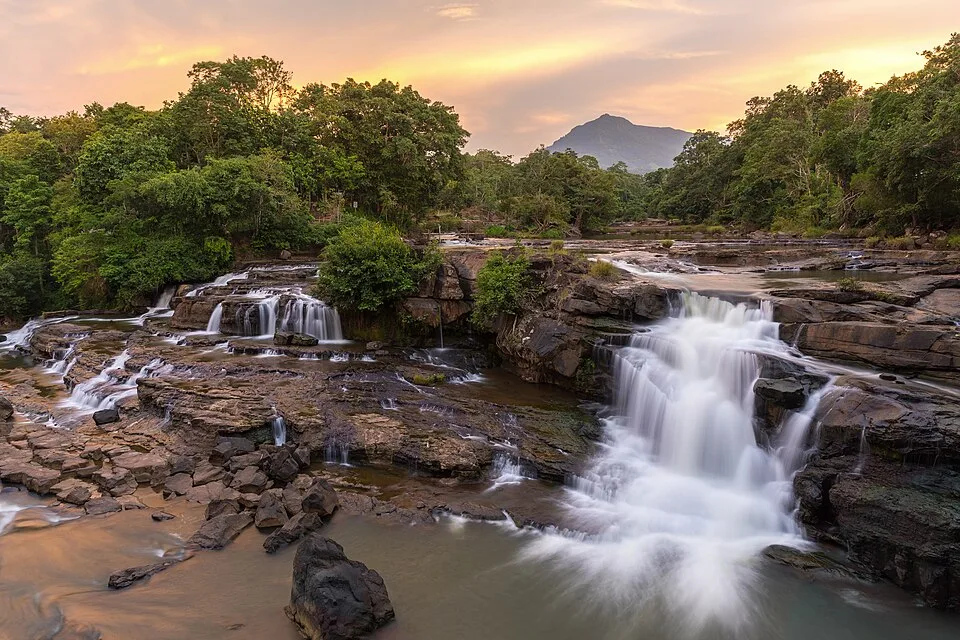
Silken Cascades Beneath an Evening Sky. White cascades flow over layered rock shelves beneath a wooded hillside and warm evening sky.Basile Morin · CC BY-SA 4.0 · via Wikimedia CommonsView source ↗
Prompt
Apply a Long Exposure Water effect to visible water, blending ripples and splashes into smooth, milky ribbons and mistlike pools. Retain gentle directional flow, subdued reflections, and luminous pale highlights while keeping stationary rocks, vegetation, architecture, and other solid forms sharply resolved. Keep the original subject and composition.
The water looks like [smooth, opaque fog]or flowing silk. Stationary objects like rocks and trees remain perfectly sharp.
Principle
The camera sensor [records light over seconds]or minutes. Moving water blurs across the frame, [averaging out]into auniform smoothness.
Example
Michael Kenna: 'Kussharo Lake Tree, Study 1', 2002.
Try it out
Stand near afast river. Squint your eyes to ignore individual splashes, observing the whole flow as one solid shape.
Background
Long exposure1water became amassive trend in digital photography during the 2000s. Early digital sensors were highly sensitive to light. This made long daytime exposures physically difficult. Photographers adopted strong Neutral Density (ND) filters2. These dark pieces of glass block most light from entering the lens. This forces the camera to keep its shutter3open much longer for aproper exposure. While the shutter remains open, still elements like stones stay sharp. Moving elements like ocean waves continuously change position. The sensor averages these moving reflections together. The result is aghostly, flattened texture that human eyes cannot naturally see.
Distinction
In intentional camera movement (ICM), the entire frame blurs because the photographer moves the camera. Here, the camera is locked on atripod, so only the moving subjects blur.
Aftermath
It reveals that cameras do not just capture instant moments, but can accumulate passing time into asingle static image.
Further examples · 11 images
02Silky Forest Stream Among Mossy BouldersA forest stream tumbles between moss-covered boulders into a shallow amber pool. Silky white falls and softened currents contrast with crisp stone textures, demonstrating the selective motion blur of long-exposure water.Dominic Nelson · CC BY-SA 4.0 · Wikimedia Commons03Mistlike Surf Around Coastal RocksScattered coastal rocks emerge from a pale, flowing sea in a monochrome shoreline view. The water becomes translucent streaks and foglike patches around sharply outlined stones, revealing motion averaged over a prolonged exposure.Adam Court · CC BY 2.0 · Wikimedia Commons04Woodland Falls Behind Fallen TrunksA woodland waterfall descends over a dark rock face behind several fallen trunks. Continuous silky ribbons and a softly blurred plunge pool contrast with detailed wood and moss, clearly showing long-exposure water.Frank Schulenburg · CC BY-SA 4.0 · Wikimedia Commons05Smoothed Harbor Beneath Streaking CloudsA paved waterfront overlooks smooth harbor water, industrial buildings, and sweeping streaks of cloud. The water has become an opaque, nearly textureless plane while posts and buildings remain crisp, demonstrating long-exposure smoothing alongside cloud motion.Neil Williamson from Broughty Ferry, Dundee, Scotland · CC BY-SA 2.0 · Wikimedia Commons06Luminous Waterfall Curtains in a ForestA broad forest waterfall hangs in luminous ribbons above rocks and a dark green pool. Silk-like falling water and misty impact zones contrast with sharply rendered boulders and foliage, unmistakably showing a long exposure.Jameswasswa · CC BY-SA 4.0 · Wikimedia Commons07Silken Surf Among Coastal RocksWhite surf sweeps in soft ribbons between sharply textured coastal rocks beneath a pale sky. The moving water forms silky trails while the rocks remain crisp, clearly revealing a long exposure.Antoine Lamielle · CC BY-SA 4.0 · Wikimedia Commons08Woodland Cascade Beneath a Fallen TrunkA woodland cascade pours beneath a fallen trunk, threading between moss-covered boulders into a milky pool. Long exposure transforms the falling water into smooth white curtains while preserving fine bark and stone textures.Dietmar Rabich · CC BY-SA 4.0 · Wikimedia Commons09Mistlike Water Along a Sunset ShoreFoglike water borders a sharply defined rocky shore beneath a pink and orange sunset. Wave motion has been averaged into a soft, nearly uniform surface by long exposure, contrasting with the angular stones.Benson Kua from Toronto, Canada · CC BY-SA 2.0 · Wikimedia Commons10Silky Waterfall Over Stepped CliffsA broad waterfall descends over stepped cliffs before plunging in a white curtain beside green slopes. The continuous silky strands of water contrast with sharply resolved rock faces, demonstrating motion recorded over an extended exposure.Diego Delso · CC BY-SA 4.0 · Wikimedia Commons11Sunlit Cascades Through Dark RocksSunlight illuminates a cascading stream that tumbles through dark rocks and lush vegetation. The water stretches into smooth ribbons and creamy pools while the surrounding stones remain defined, clearly showing long-exposure blur.Navneet Sharma · CC BY-SA 4.0 · Wikimedia Commons
Question
Why do photographers need dark filters for this effect in daylight?
Show possible answer +Hide answer −
Without afilter, along daytime exposure would let in too much light. This overexposure would turn the entire image completely white.