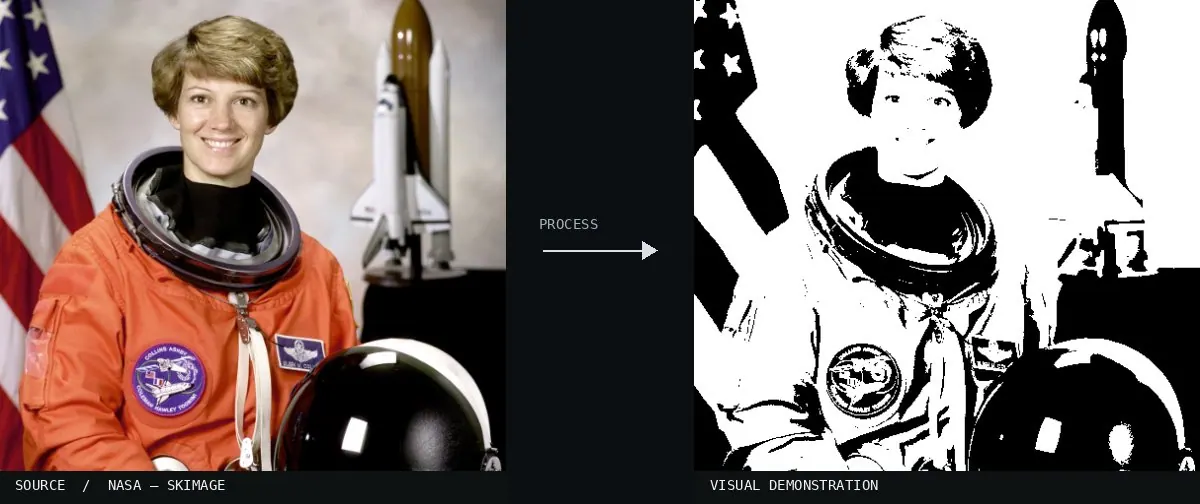
Real-world algorithm demonstration, applied to a NASA portrait.Image: NASA / Eileen Collins · scikit-image (public domain)View source ↗
Prompt
Apply Otsu Binarization, separating the entire photograph into solid black and solid white using one global brightness threshold. Create bold connected masses, hard contours, and simplified details, allowing shaded regions to merge naturally. Eliminate color, intermediate gray, gradients, and decorative dithering. Keep the original subject and composition.
A[single global1black and white]cross-section image.
Principle
Otsu2[maximizes the separation]between [two brightness classes].
Try it out
Compare with the local threshold.
Classification
Calculated image processing result.
Further examples · 8 images
02Thresholding exampleA side-by-side comparison shows an SD card before and after global thresholding. The resulting binary image demonstrates the conversion of a grayscale source into purely black and white pixels based on intensity.Bruce Shorty at Czech Wikipedia · Public domain · Wikimedia Commons03Example of adaptive thresholdingThe center panel displays a global thresholding result of a sudoku grid. It illustrates how a single intensity value fails to account for uneven lighting, a common way to evaluate Otsu's method against adaptive alternatives.ElkoSoltius · Apache License 2.0 · Wikimedia Commons04Angelica pollen grain image binarizationA side-by-side comparison of a pollen grain in color and its binarized version. The result shows a global threshold applied to the brightness values to separate the specimen from its lighter background.Ханжина Наталья Евгеньевна · CC BY-SA 4.0 · Wikimedia Commons05Otsu's Method VisualizationA histogram shows pixel intensity distribution and the calculated inter-class variance. The red line identifies the optimal threshold where variance is maximized, which is the core mechanism of the algorithm.Lucas(CA) · CC BY-SA 4.0 · Wikimedia Commons06Otsu Binarization, applied to “Waddenzee achter de zeedijk bij Paesens-Moddergat. 17-09-2024. (d.j.b) 06”A fence and shoreline at Paesens-Moddergat are reduced to high-contrast black and white pixels. The global threshold separates the dark wooden posts from the bright sky and water.Dominicus Johannes Bergsma. (photo); processed for the Atlas · CC BY-SA 4.0 · Wikimedia Commons07Otsu Binarization, applied to “Anfiteatro de Pula, Croacia, 2017-04-16, DD 35”A collection of ancient amphorae is rendered as a binary image. The algorithm separates the lit surfaces of the pottery from the deep shadows and dark crevices between them.Diego Delso (photo); processed for the Atlas · CC BY-SA 4.0 · Wikimedia Commons08Otsu Binarization, applied to “Don Quijote de La Mancha, Teresa Carreño Teather”Dancers on a theater stage are isolated against a dark background. The binarization process converts the spotlighted performers into white shapes while the unlit surroundings become pure black.Wilfredor (photo); processed for the Atlas · CC0 · Wikimedia Commons