M 017 / 18301 Edge & Featuresalgorithm output

Adaptive Thresholding

Adaptive Threshold. edge & feature detection
Typeface · Courier Prime

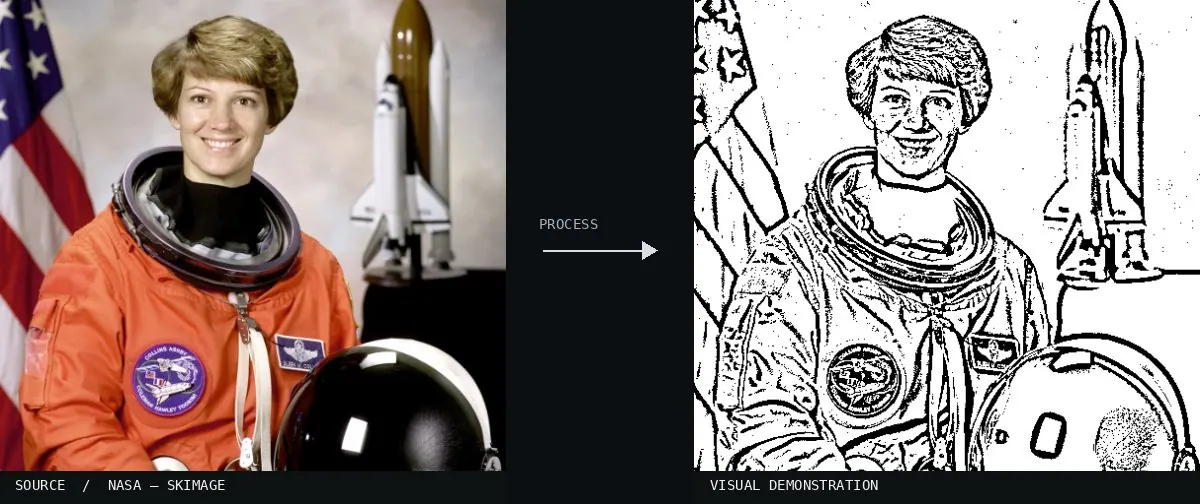
Real-world algorithm demonstration, applied to a NASA portrait.
Real-world algorithm demonstration, applied to a NASA portrait.Image: NASA / Eileen Collins · scikit-image (public domain)View source ↗

Prompt

Apply Adaptive Thresholding, converting the photograph into pure black and white using locally adjusted brightness divisions. Retain small details across both shaded and brightly lit areas, with crisp irregular boundaries, stippled textures, and no gray tones. Avoid broad lighting gradients overwhelming detail. Keep the original subject and composition.

Identify

Black and white surfaces despite changing lighting.

Principle

A local limit value1 is calculated from the neighborhood2.

Try it out

Test light and dark areas.

Classification

Calculated image processing result.

Further examples · 8 images

Binarizing neuron image
02 Binarizing neuron imageA sequence showing a microscopic neuron image being segmented. The third panel shows adaptive thresholding applied to extract foreground structures from a complex, unevenly lit background.Akarpe · CC BY-SA 3.0 · Wikimedia Commons
Adaptive Thresholding, applied to “Banaue Philippines Ifugao-Tribesman-01”
03 Adaptive Thresholding, applied to “Banaue Philippines Ifugao-Tribesman-01”The tribesman and hillside are rendered in binary black and white. Local thresholding preserves facial detail and background textures despite varying illumination across the complex scene.CEphoto, Uwe Aranas (photo); processed for the Atlas · CC BY-SA 3.0 · Wikimedia Commons
Adaptive Thresholding, applied to “Frost-covered lifebuoy, Lake Siskiyou”
04 Adaptive Thresholding, applied to “Frost-covered lifebuoy, Lake Siskiyou”A lifebuoy hangs on a weathered wooden post. The algorithm adapts to local brightness, maintaining the outline of the white ring against the light background and textures on the dark wood.Radomianin (photo); processed for the Atlas · CC BY-SA 4.0 · Wikimedia Commons
Adaptive Thresholding, applied to “Cranes made by Origami paper”
05 Adaptive Thresholding, applied to “Cranes made by Origami paper”Two origami cranes are visible against a white void. Adaptive thresholding distinguishes the patterned paper from shadows, ensuring the folded edges and surface designs remain legible in high contrast.Laitche (photo); processed for the Atlas · Public domain · Wikimedia Commons
Adaptive Thresholding, applied to “Partal pavilion bassin detail 1 edit”
06 Adaptive Thresholding, applied to “Partal pavilion bassin detail 1 edit”This image shows a pavilion with arches reflected in water. The local neighborhood calculation allows the intricate stonework and the darker water reflections to retain structural detail simultaneously.Jebulon (photo); processed for the Atlas · CC0 · Wikimedia Commons
Adaptive Thresholding, applied to “L'Umbracle, Valencia, Spain - Jan 2007”
07 Adaptive Thresholding, applied to “L'Umbracle, Valencia, Spain - Jan 2007”The arched structure of L'Umbracle creates complex light and shadow. The effect successfully extracts the thin architectural ribs and palm tree silhouettes by adjusting to regional lighting differences.Diliff (photo); processed for the Atlas · CC BY-SA 3.0 · Wikimedia Commons
Adaptive Thresholding, applied to “2015 Ribblehead Viaduct 1”
08 Adaptive Thresholding, applied to “2015 Ribblehead Viaduct 1”The Ribblehead Viaduct sits within a vast landscape. Detailed arches and terrain textures are preserved through local limit values, preventing large dark or light regions from washing out.Kreuzschnabel (photo); processed for the Atlas · CC BY-SA 3.0 · Wikimedia Commons