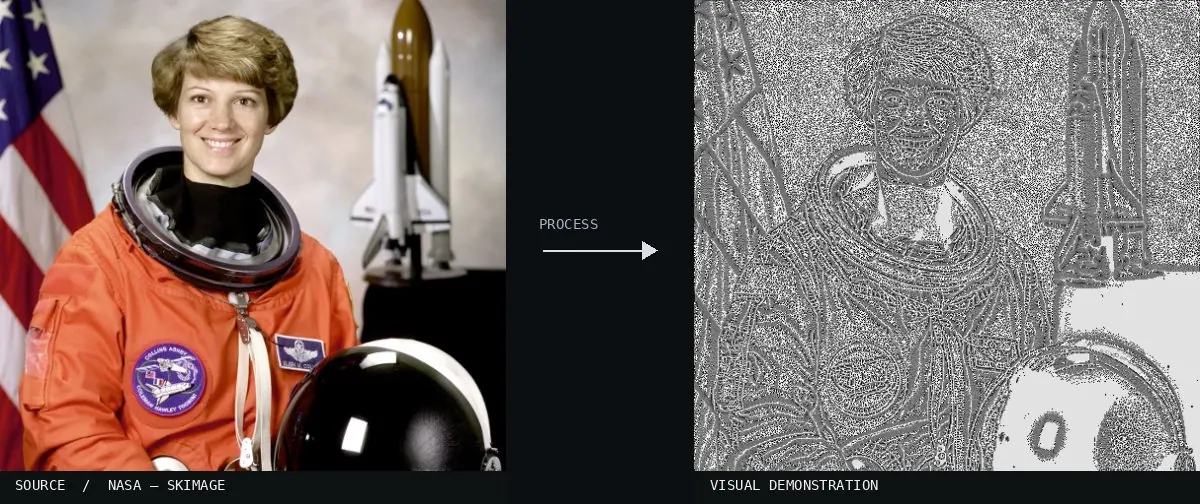
Real-world algorithm demonstration, applied to a NASA portrait.Image: NASA / Eileen Collins · scikit-image (public domain)View source ↗
Prompt
Apply Local Binary Pattern, replacing photographic shading with dense grayscale texture codes formed by tiny neighboring-pixel comparisons. Create an embossed, granular mosaic of micro-patterns, emphasizing pores, fabric, and surface transitions while flattening broad illumination. Avoid realistic relief lighting or smooth tonal modeling. Keep the original subject and composition.
[Neighboring pixels are binary-coded2][relative to the center].
Try it out
Compare smooth skin and fabric.
Classification
Calculated image processing result.
Further examples · 8 images
02Local Binary Pattern, applied to “Katholische Pfarrkirche St. Julitta und Quiricus, Andiast (d.j.b.) 20”A church cross and clouds are reduced to grainy, binary-coded textures. The effect emphasizes edge contrasts, turning the sky and metallic surface into a dense field of embossed patterns.Dominicus Johannes Bergsma (photo); processed for the Atlas · CC BY-SA 4.0 · Wikimedia Commons03Local Binary Pattern, applied to “Gilded Vectors of Disease - Horizontal”This grid of disease-vector illustrations shows high-frequency texture information. The local binary pattern conversion renders the insects and their frames as complex, topographic-like micro-features.Colin (photo); processed for the Atlas · CC BY-SA 4.0 · Wikimedia Commons04Local Binary Pattern, applied to “Zernez, Unterengadin, Graubünden. 20-09-2023. (actm.) 67”A stone building with a well exhibits uniform texture coding across the masonry. Smooth areas like the window panes are clearly distinguished from the rough, pixelated surfaces of the stone.Agnes Monkelbaan (photo); processed for the Atlas · CC BY-SA 4.0 · Wikimedia Commons05Local Binary Pattern, applied to “360° Grad Oberzalimalpe, Panorama”The mountain panorama displays a distinct shift from the sparse coding of the sky to the dense textures of the hills. The terrain appears as a calculated, embossed map of brightness gradients.Feel free to use my photos, but please mention me as the author and if you want send me a message. (photo); processed for the Atlas · CC BY-SA 3.0 at · Wikimedia Commons06Local Binary Pattern, applied to “Initiation ritual of boys in Malawi”The ritual participants' straw costumes create sharp, repetitive binary patterns. Skin and background foliage are likewise converted into a unified, grainy texture based on local pixel intensity.Steve Evans from Citizen of the World (photo); processed for the Atlas · CC BY 2.0 · Wikimedia Commons07Local Binary Pattern, applied to “Rolnicy nad Jeziorem Inle w Mjanmie, 20160806 8493”Two farmers in a field are integrated into a continuous texture of grain stalks. The processing emphasizes the vertical and diagonal lines of the crop as distinct local binary values.Jakub Hałun (photo); processed for the Atlas · CC BY-SA 4.0 · Wikimedia Commons08Local Binary Pattern, applied to “Full-page portrait of Luke in gold frame on purple background (NYPL b12455533)”This portrait of Luke displays the effect as an intricate, relief-like structure. The fine details of the gold frame and fabric folds are translated into a complex network of binary-coded edges.Scan by NYPL (photo); processed for the Atlas · Public domain · Wikimedia Commons