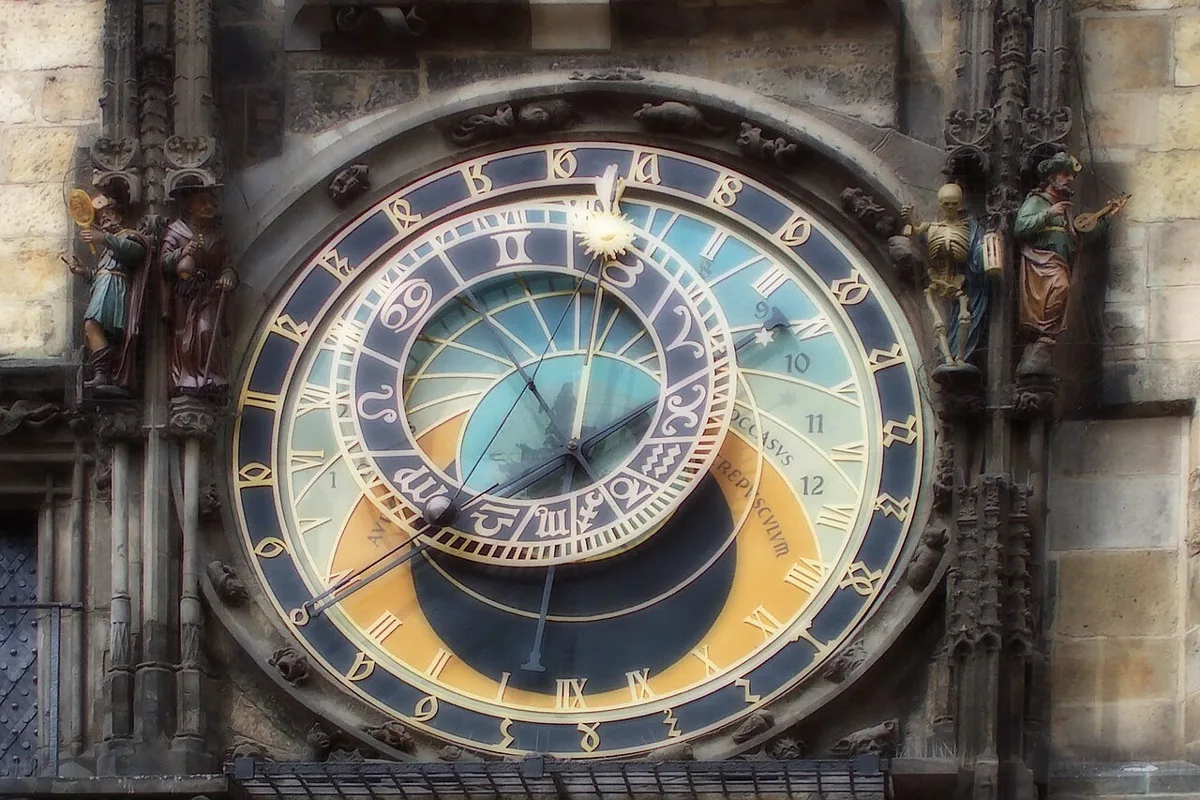
Astronomical Clock with Soft Highlight Glow. An ornate astronomical clock displays softly glowing gold markings and pastel dial segments against dark carved stone.Herr Kriss · CC BY-SA 3.0 · via Wikimedia CommonsView source ↗
Prompt
Apply the Orton Effect by combining crisp underlying detail with a softly defocused luminous overlay. Make highlights bloom gently, enrich colors, and deepen shadows while retaining clear dark contours. Create a dreamy photographic atmosphere without flattening textures or blurring every feature equally. Keep the original subject and composition.
You see an image that is both [sharp and blurry]at the same time. Bright areas [glow softly]while dark details remain clear.
Principle
Asharp, overexposed1slide is physically layered over ablurry, overexposed slide of the exact same scene. The [combined densities]create normal contrast.
Example
Michael Orton: Trees, Beacon Hill Park, mid-1980s.
Try it out
Duplicate adigital photo on your phone. Blur the top copy, make it semi-transparent, and increase the brightness of both layers.
Background
In the 1980s, Canadian photographer Michael Orton sought to mimic watercolor paintings using acamera. He used slide film2, which becomes lighter when overexposed. He took two photos of the same subject on atripod. The first exposure was perfectly focused but heavily overexposed. The second exposure was out of focus and also overexposed. At alight table, he sandwiched these two slides together in asingle mount3. Because slide film creates apositive image, stacking two light images makes aproperly exposed final picture. This analog process produced adistinct dreamy glow.
Distinction
Unlike simply taking an out-of-focus photograph, the Orton Effect retains sharp core details underneath the glow. It combines distinct clarity with ethereal blur.
Aftermath
It demonstrates how stacking multiple imperfect exposures can combine to create aproperly exposed, textured final image.
Further examples · 7 images
02Glowing Amber Violin BackAn amber violin back rests on patterned fabric, with broad luminous reflections crossing its visible wood grain. The glowing highlights spread over retained grain and dark contours, strongly demonstrating the Orton effect.Kaensu · CC BY-SA 2.0 · Wikimedia Commons03Autumn Leaves with Golden GlowYellow and orange fallen leaves cover vivid green grass, with visible veins, curled edges, and deep intervening shadows. A diffuse golden glow overlays these retained details, clearly demonstrating the Orton effect's simultaneous sharpness and softness.Benjamin D. Esham (bdesham) · CC BY-SA 4.0 · Wikimedia Commons04Softly Glowing Tree Beside Blue WaterA slender shoreline tree rises above exposed roots, blue water, and a small white boat. Soft halos around foliage and bright shoreline areas coexist with readable trunk and branch detail, providing a clear Orton-style appearance.Carsten Tolkmit from Kiel, Germany · CC BY-SA 2.0 · Wikimedia Commons05AI illustration: Luminous Birch Forest with Overlaid Soft FocusA sunlit birch forest is reflected in a calm pond, exhibiting a luminous, ethereal glow across the highlights. The scene demonstrates the characteristic sandwiching of sharp and blurred exposures to create a dreamlike, painterly aesthetic.Illustration generated for the Atlas (AI)06AI illustration: Coastal Landscape with Soft-Focus Highlight BloomA weathered rowboat rests on a rocky shore beneath a shimmering sunset that radiates a soft halo. This composition utilizes overlapping densities to maintain sharp textures in the foreground while bathing the light in a hazy bloom.Illustration generated for the Atlas (AI)07AI illustration: Garden Floral Study Exhibiting Dual Sharpness and BlurBright red poppies and white daisies stand against a stone wall, their petals appearing both finely detailed and softly diffused. The image captures the unique glow produced by layering an in-focus slide with a blurred counterpart.Illustration generated for the Atlas (AI)
Question
Why must both original slides be overexposed to create this physical effect?
Show possible answer +Hide answer −
Slide film produces apositive image where extra light makes the film physically lighter. Stacking two normally exposed slides would make the result entirely too dark.