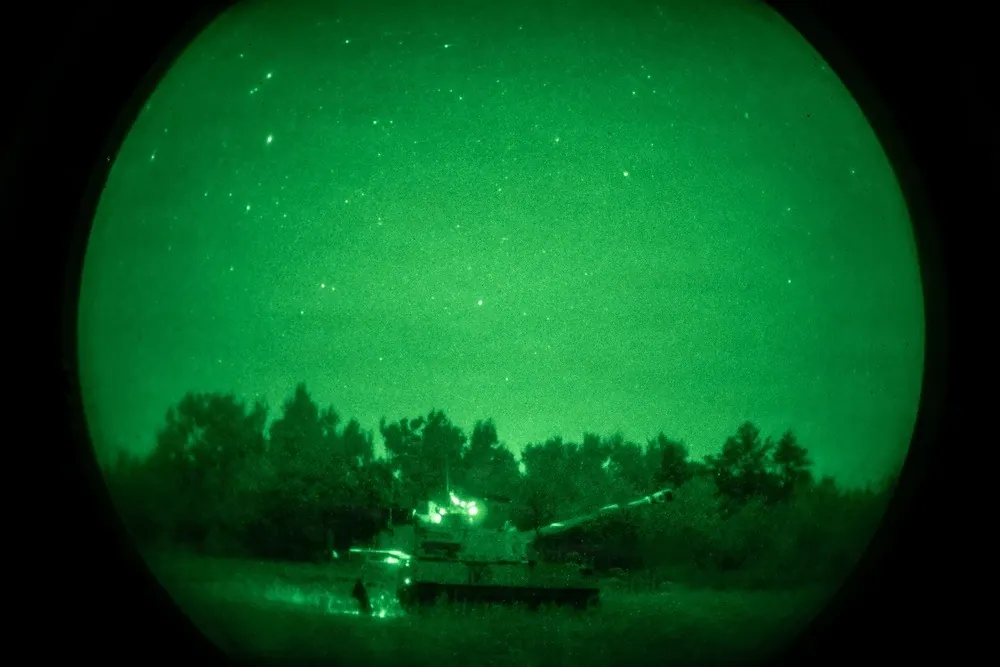
Night vision / image intensifier look. 1990s: military visual culture; technology significantly older
Typeface · Share Tech Mono
Night vision with Astroscope: Northern Strike exercise, August 6, 2026.Sgt. 1st Class Aaron Shuemake / West Virginia National Guard. Public domain.View source ↗
Prompt
Apply a Night Vision effect with monochrome phosphor green, murky dark green shadows, bright lime highlights, coarse sensor grain, and scattered luminous noise. Compress tonal contrast, bloom intense light sources, soften fine details, and add subtle edge vignetting for an amplified low-light appearance. Keep the original subject and composition.
Night vision recordings and subsequent surveillance aesthetics.
Try it out
Compare the green hue alone with added grain and overexposure.
Background
The classic green night vision impression originates from image intensifiers with acorresponding phosphor screen. It is not anatural color of darkness. The 1990s serve as areference point for military perception and application; NASA documented human perception issues with such devices in 1991. The technology is older and has evolved. The US Army announced the switch from green to white phosphor tubes in 2019. Some modern devices combine image intensification with thermal information; this combination does not eliminate the fundamental difference. Agreen filter merely simulates the surface. The exercise therefore tests which additional characteristics, such as noise, resolution limits, and bright overexposure, actually contribute to the sensor impression.
Distinction
Night vision through light amplification and thermal heat vision are different sensor principles.
Aftermath
For music visuals, adeliberately stylized look is often sufficient. With documentary images, it must remain clear whether genuine sensor data or post-processing is used.
Further examples · 11 images
02PEO ANAVS-6 NVGA person is shown wearing ANAVS-6 night vision goggles in a cockpit setting. The image demonstrates the characteristic monochromatic green phosphor glow and low-light amplification common in 1990s military technology.Photo Courtesy of PEO Soldier. Original uploader was Koalorka at en.wikipedia · Public domain · Wikimedia Commons03Brazilian Paratrooper fires weapon in night operations at JRTC 21-04A paratrooper is captured firing a weapon through a circular night vision aperture. The shot illustrates heavy grain and bright muzzle flash noise against a dark, green-tinted background.Capt. Joseph Warren, US Army · Public domain · Wikimedia Commons04Tactical Mobility-Night Vision GoggleA standalone tactical mobility night vision goggle unit is displayed against a black background. It serves as a physical example of the hardware used to produce intensified visual effects.Esercito de terra · CC BY 2.5 · Wikimedia Commons05Brazilian Paratroopers ready weapon around corner during night operations at JRTC 21-04Paratroopers are seen aiming weapons around a corner during night operations. The image shows significant overexposure and bright noise in the lower right, typical of intensified light sources.Capt. Joseph Warren, US Army · Public domain · Wikimedia Commons06Theon - Hensoldt Optronics - Mikron Night Vision BundeswehrThis image features a Mikron night vision device manufactured by Theon and Hensoldt Optronics. It represents the specialized optical hardware required for military-grade nocturnal surveillance and perception.Fabrice Ram · CC BY-SA 4.0 · Wikimedia Commons07Team of Brazilian Paratroopers ready weapons during night operations at JRTC 21-04A team of paratroopers is positioned against a wall during a training exercise. The high-contrast green hue and grainy texture provide a clear example of the traditional phosphor screen aesthetic.Capt. Joseph Warren, US Army · Public domain · Wikimedia Commons08Fire simulation at FOB Bastion 130109-A-KM292-014A group of soldiers is visible in high-contrast monochrome green. The image shows significant scintillation or electronic noise, which is characteristic of high-gain light amplification tubes used in night vision.Spc. Matthew Hulett · Public domain · Wikimedia Commons09Fire simulation at FOB Bastion 130109-A-KM292-013Soldiers are treating a simulated casualty in a dark environment. The bright areas around light sources show blooming and overexposure, typical of image intensifier technology reacting to concentrated photons.Spc. Matthew Hulett · Public domain · Wikimedia Commons10Fire simulation at FOB Bastion 130109-A-KM292-002This image depicts two soldiers walking across open terrain. The low contrast and uniform green hue illustrate the flat perspective often associated with historical generation light intensifiers.Spc. Matthew Hulett · Public domain · Wikimedia Commons11Fire simulation at FOB Bastion 130109-A-KM292-015A close-up of a soldier wearing night vision goggles. The glowing light on the helmet indicates active electronic components, while the overall image displays the green phosphor aesthetic.Spc. Matthew Hulett · Public domain · Wikimedia Commons
Question
Can a green filter recover information from a completely black photo?
Show possible answer +Hide answer −
No. Without recorded image information, changing the color does not create any new visibility; real sensors must first detect the light.