1910, Georges Claude’s neon demonstration at the Paris Motor Show
Typeface · Warnes
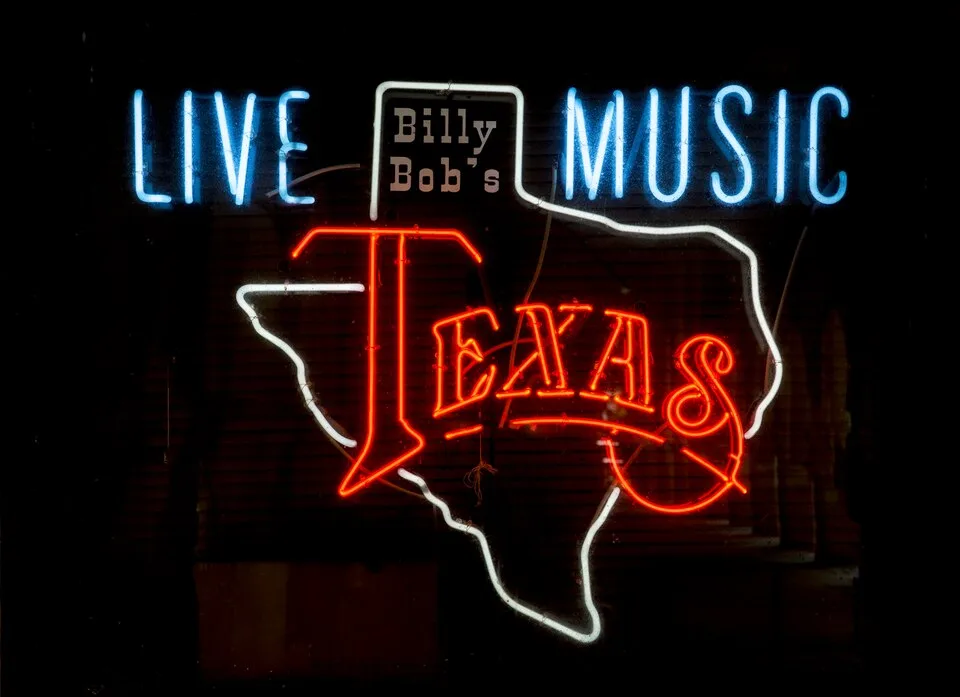
Texas Live Music Neon Sign. Blue live music lettering crowns red Texas lettering within a white outline of the state.Carol M. Highsmith · Public domain · via Wikimedia CommonsView source ↗
Prompt
Transform this image into a Neon Sign Glow treatment, tracing the subject’s defining contours with luminous glass tubes in hot pink, electric blue, and orange-red. Use rounded bends, consistent stroke thickness, bright cores, soft colored halos, and faint reflections against dark surroundings. Keep the original subject and composition.
[Bright tubular letters]or outlines stand against dark surroundings, often with a[soft halo]. The luminous strokes have rounded bends and nearly uniform thickness.
Principle
An [electric discharge1]excites atoms in low-pressure gas inside glass tubes, producing light as they release energy. Scattering in the eye or camera can spread this light into asoft halo beyond the tube.
Example
Georges Claude: Neon-tube demonstration at the Paris Motor Show, 1910.
Try it out
Photograph aworking neon sign at several exposure settings; compare the tube’s visible shape with the apparent width of its halo.
Background
Georges Claude demonstrated neon lighting at the Paris Motor Show in 1910. Commercial signs followed during the 1910s, turning bent glass tubes into illuminated lettering. Electrodes2drive an electric discharge through gas sealed at low pressure. Neon itself produces orange-red light; other gases and fluorescent coatings provide other colors in signs commonly called neon. The tube emits light directly, rather than reflecting illumination from elsewhere. Its surrounding halo is not gas escaping into the air. Scattering, reflections, and photographic halation3can enlarge the apparent glow.
Distinction
Unlike incandescent bulb lettering, neon can trace long, continuous strokes without rows of separate light points. LED imitations can resemble neon but use semiconductor emitters rather than agas discharge.
Aftermath
Neon shows how anarrow light source can appear larger through scattering and the way an image records brightness.
Further examples · 11 images
02Posada Motel Neon at NightBlue script, vertical red motel lettering, and a glowing directional arrow mark a dark street entrance. The luminous curves and soft colored halos show neon tubing used for both lettering and outlines.Carol M. Highsmith · Public domain · Wikimedia Commons03Chicken and Chinese Lettering in NeonA restaurant window displays a red chicken outline on a white platter between green Chinese characters. Continuous glowing tubes trace rounded contours and lettering, with visible halos even amid reflections and interior light.Williamf1006 · CC0 · Wikimedia Commons04Big Easy Daiquiris Neon LetteringA large Big Easy Daiquiris sign glows above additional multicolored signs along a nighttime sidewalk. Exposed tubular lettering, rounded bends, and colored halos make the neon technique readily visible.Carol M. Highsmith · Public domain · Wikimedia Commons05Close View of Glowing Neon TubesA close view reveals bright yellow-orange glass tubing bent into letters and held away from a red backing by small supports. Nearly uniform luminous strokes, rounded bends, and intense surrounding glow expose the physical structure and optical appearance of neon signage.Thomas An. · CC BY 2.0 · Wikimedia Commons06Neon Characters with Green BorderOrange-red Chinese characters glow within a green tubular border beside a dark building facade. Bright, evenly drawn strokes and soft surrounding halos clearly display neon sign glow.ThisParticularGreg · CC BY-SA 2.0 · Wikimedia Commons07Earl Carroll Theatre Neon PortraitA luminous line portrait and illuminated lettering mark the Earl Carroll Theatre in this nighttime photograph. The curved tubular portrait carries a conspicuous soft halo against the dark facade, demonstrating neon sign glow even in monochrome.Russell Lee · Public domain · Wikimedia Commons08Blue Ribbon Glow Above Railway TracksA luminous Blue Ribbon beer sign rises above dark railway tracks and a nighttime skyline. Its glowing lettering and outlined ornament spread a soft halo into the surrounding darkness, though the distant view obscures individual tubes.Jack Delano · Public domain · Wikimedia Commons09Blue Ribbon Sign in the NightA large Blue Ribbon beer sign shines over curving rails and silhouetted buildings. Bright colored lettering and outlines bloom against the night sky, clearly displaying the glow of an illuminated sign despite the viewing distance.Jack Delano · Public domain · Wikimedia Commons10Leopold’s Ice Cream Neon ScriptPink-red script spelling Leopold’s Ice Cream crowns a busy storefront at dusk. Rounded luminous tubes trace the letters with bright cores and soft colored halos, clearly showing neon sign glow.Carol M. Highsmith · Public domain · Wikimedia Commons11Nightclub Neon Along a Wet StreetColored nightclub signs line a dark street, their light reflected across wet pavement between parked cars. Several signs display luminous linear lettering against dark backgrounds, showing neon sign glow within a wider streetscape.The Library of Congress · Public domain · Wikimedia Commons
Question
Does every sign commonly called neon contain neon gas?
Show possible answer +Hide answer −
No. Neon produces orange-red light, while other gases and fluorescent coatings create many other sign colors.