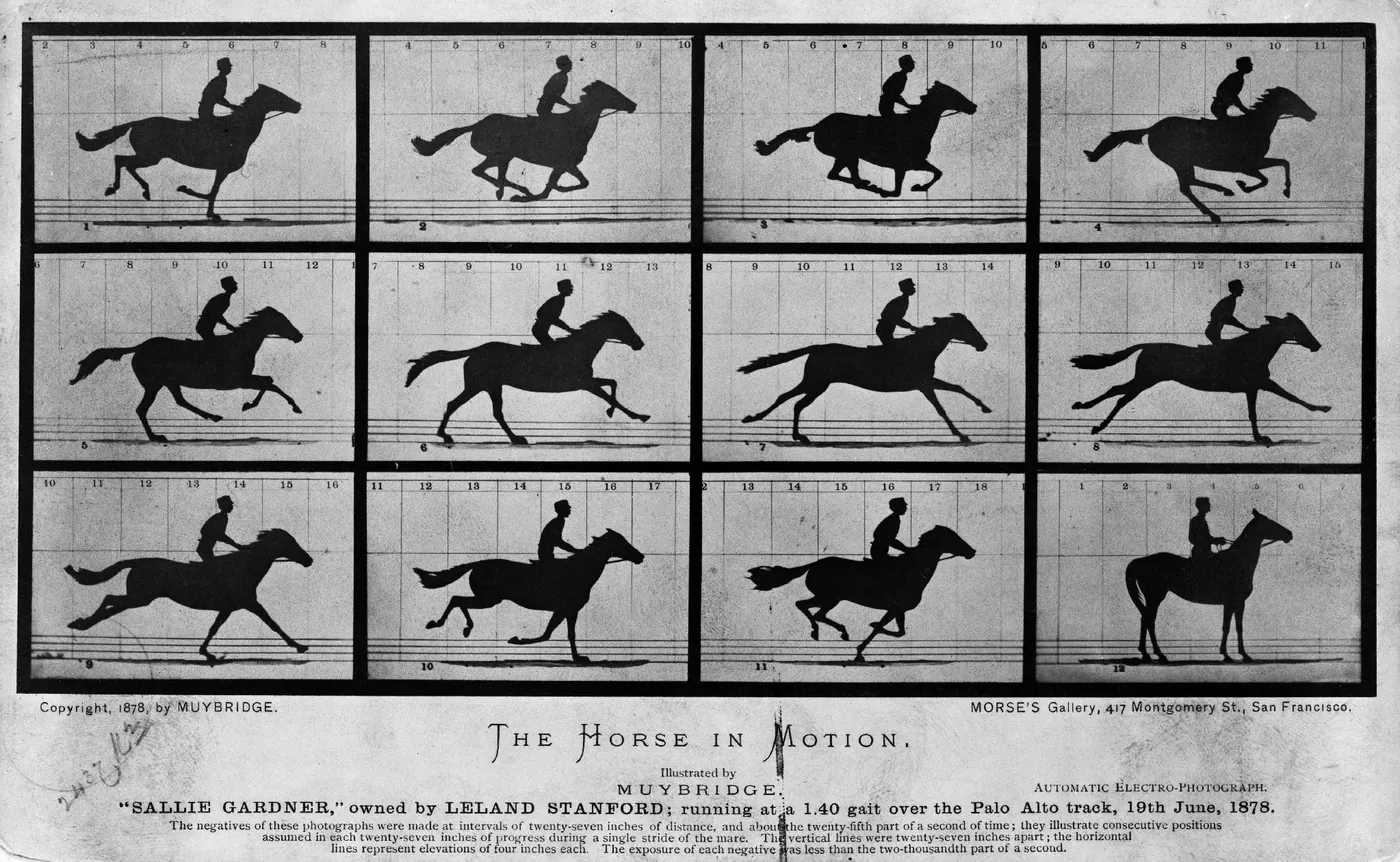
Eadweard Muybridge: The Horse in Motion, Sallie Gardner, 1878.
Temporal effect: still image or image sequence.Eadweard Muybridge / Library of Congress via Wikimedia Commons. Public Domain/Commons PDM.View source ↗
Prompt
Transform this image into a Motion Sequence study arranged as an orderly grid of consecutive photographic frames. Repeat the subject with small, plausible changes in movement, maintaining consistent camera position, lighting, scale, monochrome tones, fine grain, and narrow pale gutters. Keep the original subject and composition within each frame.
Photograph ajump as aseries. Place the phases side by side and then play them back as ashort sequence of images.
Background
Muybridge's successful motion studies of 1878; preceded by earlier experiments. Science, art, and precursors of cinema at the end of the 19th century. Detailed mechanism: Multiple cameras or rapidly successive shots break down asequence of movements into phases. Time, like space, can be manipulated. This is not stop-motion puppet animation.
Distinction
Time can be shaped like space. This is not stop-motion puppet animation.
Aftermath
Contact sheets, multi-shot sports images, motion studies and loop animations.
Further examples · 9 images
02Jean-Martin Charcot Hysteria chronophotography 2A grid of nine black-and-white photographs captures a subject's changing posture and expression in bed. This sequence uses chronophotography to break down a physical episode into distinct, observable temporal phases for scientific analysis.Jean-Martin Charcot · Public domain · Wikimedia Commons03Jean-Martin Charcot Hysteria chronophotographyThe image displays a series of photographs arranged in a grid, documenting subtle head and neck movements. It illustrates the late 19th-century technique of capturing successive motion phases for clinical study.Jean-Martin Charcot · Public domain · Wikimedia Commons04Révolver de janssenThis illustration shows Pierre Janssen's photographic revolver, a device designed to capture a sequence of images on a rotating disk. It is a fundamental apparatus in the history of motion study and early cinematography.Auguste Tilly · Public domain · Wikimedia Commons05C0423142-800px-wmThis diagram displays Étienne-Jules Marey's chronophotographic gun, which used a rotating plate to capture multiple images per second. The device represents the transition from still photography to capturing fluid motion sequences.Louis Poyet · Public domain · Wikimedia Commons06Photophone de DemenyThe diagram shows Demenÿ’s Photophone, which utilized a disc of images to create the illusion of motion. It exemplifies the early technology used to playback captured motion sequences to recreate life-like movement.Marey, Étienne-Jules (1830-1904), dans son ouvrage "Le Mouvement", publié par Gallica : https://gallica.bnf.fr/ark:/1214 · Public domain · Wikimedia Commons07Eadweard Muybridge - Athletes. Walking High Leap (sepia)A sepia-toned grid displays a man performing a high leap. The nine frames show consecutive phases of the jump, illustrating the breakdown of movement through rapidly successive photography.Eadweard Muybridge (1830–1904) · Public domain · Wikimedia Commons08Animal locomotion LOC 13625045044A grid of twenty frames shows a deer walking in profile. It demonstrates the technique of using multiple shots to record the mechanical gait of an animal.The Library of Congress · No restrictions · Wikimedia Commons09Muybridge Abe Edgington Series 1878Eight frames show a horse and carriage in motion. The chronological numbering and slight changes in leg positions illustrate the early chronophotographic method.Eadweard Muybridge. · Public domain · Wikimedia Commons