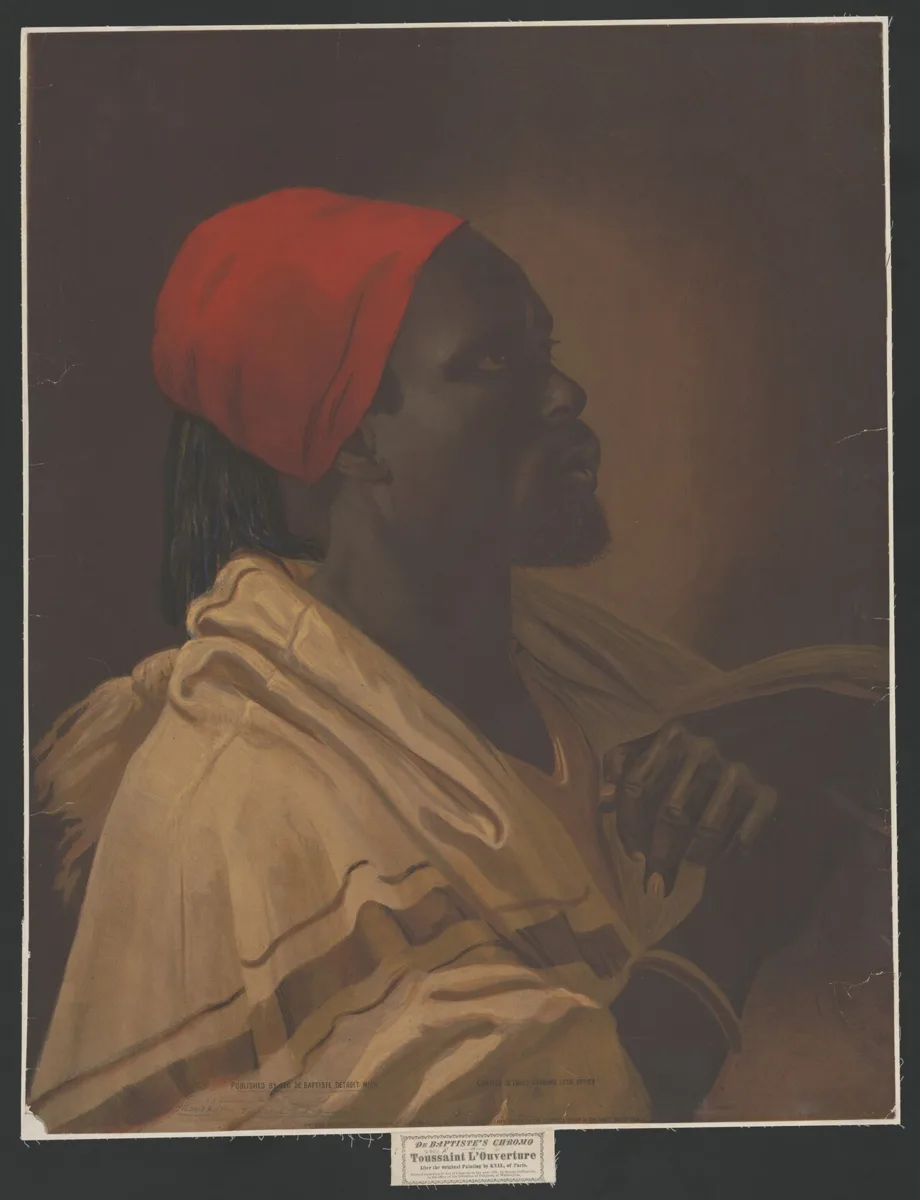
Chromolithograph Portrait of Toussaint L'Ouverture. A detailed portrait with rich, overlapping colors and smooth gradients that lack a mechanical halftone grid.DeBaptiste, George, 1815-1875, publisher; DeBaptiste, George, 1815-1875, copyright clai… · Public domain · via Wikimedia CommonsView source ↗
Prompt
Apply a Chromolithography effect with rich, opaque reds, blues, yellows, and greens printed in overlapping layers. Add irregular crayon stippling, subtly misregistered color edges, dense ink coverage, and warm paper texture. Preserve clear outlines and use layered pigment rather than photographic gradients. Keep the original subject and composition.
You see [rich, vibrant, opaque colours]that often overlap. Up close, you see irregular dots called stippling1rather than amechanical grid.
Principle
Oil and water do not mix. Printers draw [separate colour layers]onto flat limestone using greasy crayons, which [attract oily ink].
Example
Louis Prang: Yellowstone National Park portfolio, 1876.
Try it out
Look closely at avintage poster or cigar box label with amagnifying glass to spot the irregular, crayon-like colour dots.
Background
Chromolithography revolutionized visual culture in the late nineteenth century. Before this, colour prints were mostly hand-painted and very expensive. This chemical process made mass colour printing possible. An artist analyzed an original painting and broke it down into different colour layers. They drew each layer onto aseparate heavy limestone block2using agreasy substance. The stone was wet with water, which repelled the greasy ink. Only the drawn areas held the coloured ink. Pressing paper against multiple aligned stones built up afull-colour image. Some elaborate prints required up to twenty different stones to achieve realistic shading.
Distinction
Halftone printing uses astrict, uniform grid of mechanical dots to mix colours. Chromolithography uses overlapping solid colours and irregular stippling.
Aftermath
It democratized art by bringing affordable, high-quality colour images into everyday homes and advertising.
Further examples · 11 images
02Chromolithographic Print of a Civil War BattleThis dense battle scene features vibrant, opaque colors layered over one another. It is a classic example of chromolithography, likely using numerous stones to achieve the complex hues.L. Prang & Co. · Public domain · Wikimedia Commons03Chromolithograph Depicting a Winter Ice Skating SceneA winter skating scene displaying vivid, discrete color areas and subtle shading indicative of hand-drawn stippling. It is an excellent example of commercial chromolithography from the 19th century.L. Prang & Co.; Sandham, Henry, 1842-1910, artist · Public domain · Wikimedia Commons04Chromolithographic Illustration of a Tobogganing HillThis snowy landscape shows soft color transitions and rich, opaque layers of ink applied without a rigid dot matrix. The print clearly demonstrates the multi-stone chromolithographic technique.L. Prang & Co.; Sandham, Henry, 1842-1910, artist · Public domain · Wikimedia Commons05Chromolithograph of a Nighttime Naval Battle SceneA dramatic night scene where deep, saturated inks create intense contrasts of fire and smoke. The opaque, overlapping colors make this a prime demonstration of the chromolithographic medium.L. Prang & Co. · Public domain · Wikimedia Commons06Chromolithograph Depicting a Dramatic Cavalry ChargeThis vivid cavalry illustration exhibits rich reds, blues, and earth tones layered seamlessly together. It serves as a classic example of chromolithography's ability to replicate the look of oil paintings.L. Prang & Co.; Thulstrup, Thure de, 1848-1930, artist · Public domain · Wikimedia Commons07Chromolithographic Print of the Battle of ChattanoogaA scenic battlefield view composed of complex, overlapping layers of opaque ink rather than a CMYK grid. This visibly demonstrates the detailed, multi-layered process of genuine chromolithography.L. Prang & Co. · Public domain · Wikimedia Commons08Chromolithograph Showing the Battle of AntietamThis bustling battle illustration is rendered with vibrant colors and subtle stippled textures visible in the smoke and uniforms. It perfectly showcases the rich, painterly effect of traditional chromolithography.Thure de Thulstrup / Adam Cuerden · Public domain · Wikimedia Commons09Kurz & Allison Battle Scene ChromolithographA chaotic Civil War battle scene is depicted using flat, vivid hues of blue, red, and brown. It perfectly represents late 19th-century commercial chromolithography, known for its bold, overlapping opaque inks.Thure de Thulstrup / Adam Cuerden · Public domain · Wikimedia Commons10Vibrant Victorian Trade Card ChromolithographA vintage advertising card displays a girl's portrait framed by intensely bright, opaque green leaves and berries. This is a classic example of the vibrant, stippled layering that defines commercial chromolithography.Lautz Brothers & Co. · Public domain · Wikimedia Commons11Uncut Sheet of Futuristic Chromolithograph CardsAn uncut sheet of trading cards illustrates futuristic visions using highly contrasting, vivid colors. It clearly shows the mass-produced, richly inked application of the chromolithographic printing process.Ji-Elle · CC BY-SA 4.0 · Wikimedia Commons
Question
Why did one chromolithograph sometimes require twenty different limestone blocks?
Show possible answer +Hide answer −
Each block could only print one specific colour of ink. To mimic oil paintings, printers layered many different colours together.