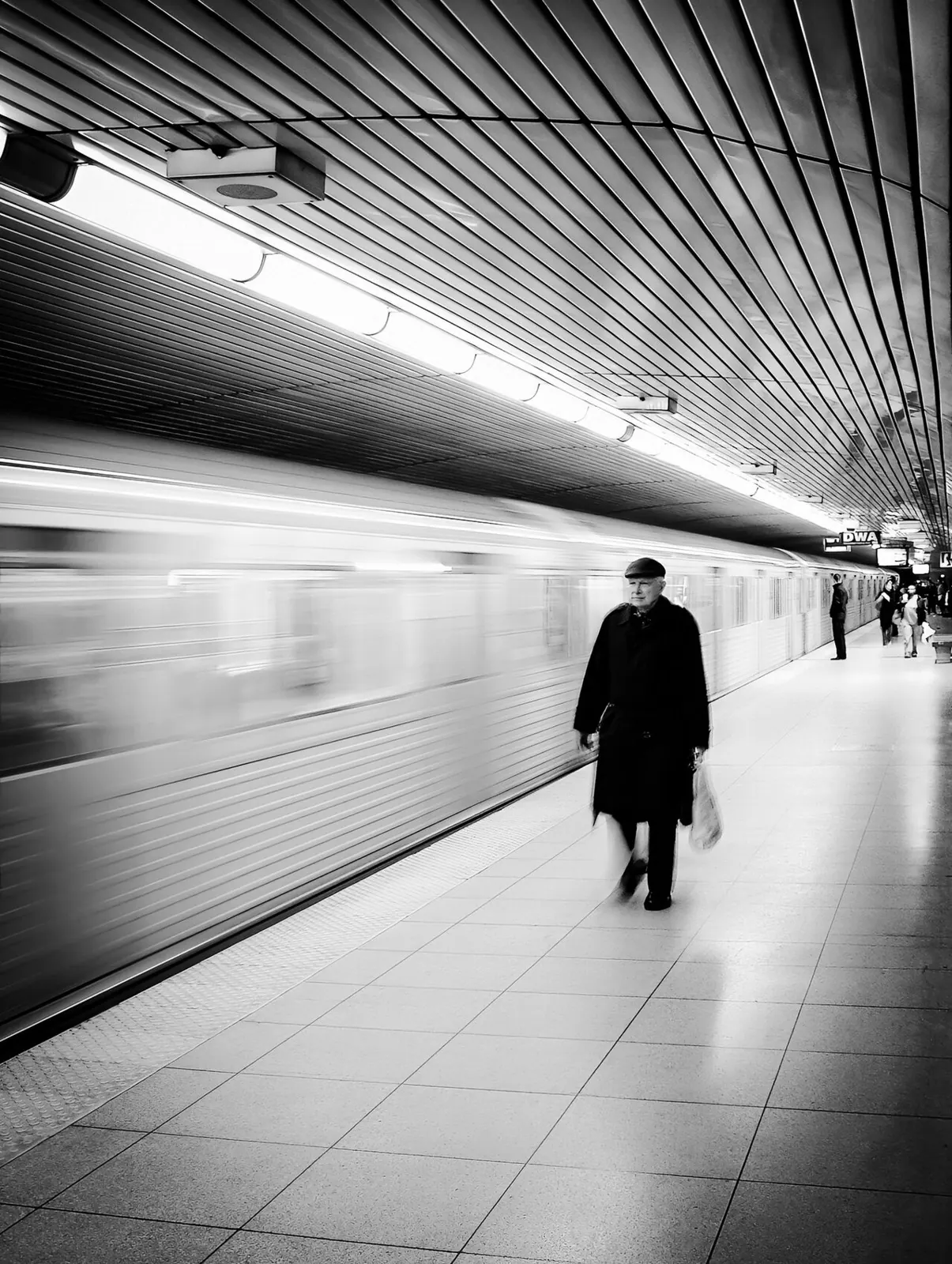
Motion blur. 1911: Futuristic photodynamics as a historical reference
Typeface · Barlow Condensed
Radomianin: Train at Dundas Station, Toronto, 2008. Movement against a sharper background.Radomianin / CC BY-SA 4.0; Wikimedia CommonsView source ↗
Prompt
Apply Motion Blur with continuous directional streaks following the scene's implied movement. Stretch highlights into luminous trails, soften moving contours, and retain sharper stationary surfaces to establish contrast. Use translucent smearing rather than discrete repeated copies, with realistic exposure blending and preserved color relationships. Keep the original subject and composition.
Anton Giulio and Arturo Bragaglia used long exposures of motion for their futuristic experiments. Instead of isolated phases of movement, they aimed to create aflowing impression of time. This distinguishes their photographic concept from systematic serial photography. Today, the same fundamental photographic logic applies to sports, dance, and street photography. The shutter speed, together with the direction and speed of movement, determines how far the trail extends in the image.
Distinction
Motion blur is not the same as incorrect focus. Camera movement blurs the entire scene; amoving person, on the other hand, can appear blurred against asharp background. The everyday example shown is not ahistorical Bragaglia photograph.
Aftermath
Aphotograph can show duration instead of just afrozen moment.
Further examples · 9 images
02Dülmen, Viktorkirmes auf dem Overbergplatz -- 2014 -- 3738A carnival ride rotates under a dark blue sky. The long exposure transforms the swinging seats into circular, glowing trails of light and color.Dietmar Rabich · CC BY-SA 4.0 · Wikimedia Commons03Folkloric Tanoura dance performed by manA Tanoura dancer performs a spinning movement in a dark setting. The rotating colorful skirt creates a broad, multi-colored disc due to the extended shutter speed.Mohamed Khalil90 · CC BY-SA 4.0 · Wikimedia Commons042018-05-04 (114) WESTbahn 4110 with motion blur at Bahnhof Ybbs an der DonauA blue and white WESTbahn train travels past a station platform. The subject appears translucent and elongated, illustrating how movement is distributed across image areas during exposure.GT1976 · CC BY-SA 4.0 · Wikimedia Commons05Zug LangzeitbelichtungLight trails from a passing train extend across a dark landscape. The long exposure reduces the physical train to bright, directed streaks of light against a static background.Thomas Wolf (Der Wolf im Wald) · CC BY-SA 2.5 · Wikimedia Commons0620180623 Green Motion BlurGreen and brown tones appear as diagonal, abstracted lines. This image shows extreme motion blur where the subject is completely replaced by directed streaks of color.Flocci Nivis · CC BY 4.0 · Wikimedia Commons07Circus Motion blurA small carousel spins within a bright playground area. The central rotating section appears as a smooth, hazy volume, contrasting with the sharp fence in the foreground.Wilfredor · CC0 · Wikimedia Commons08Motion blur in pinwheel imageA colorful pinwheel rotates against a plain wall. The spinning blades create a softened, circular pattern of overlapping colors, indicating movement during the camera's exposure.Snehit Jamere · CC BY-SA 4.0 · Wikimedia Commons09Motion Blur BenchPedestrians move across a paved area in front of a park bench. The fast-moving legs and bodies appear as semi-transparent, ghost-like streaks while the bench remains in focus.Rahmaturk · CC BY 4.0 · Wikimedia Commons
Question
How does motion blur differ from incorrect focus?
Show possible answer +Hide answer −
It often carries adirection of movement; focus blur is caused by its position outside the plane of focus.