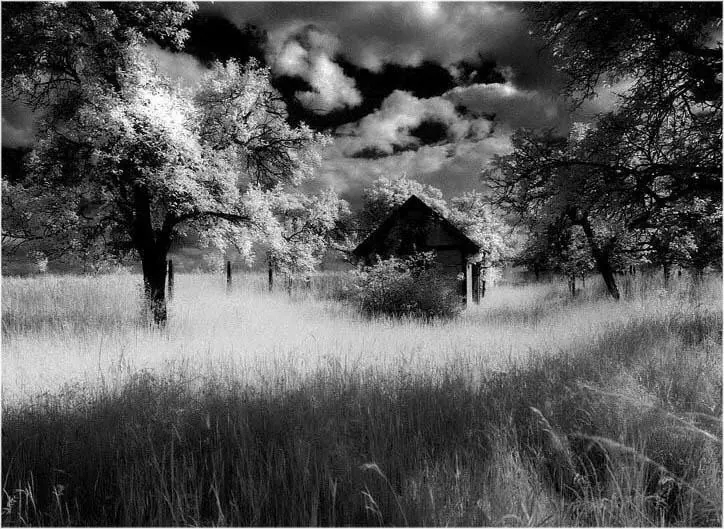
Black-and-white infrared. 1910s: Robert Wood's early infrared experiments; later experimental landscape look
Typeface · Exo 2
Reinhard Brunsch: Black and white infrared photograph. Contemporary example.Reinhard Brunsch / CC BY-SA 3.0; Wikimedia CommonsView source ↗
Prompt
Transform this image into Black-and-White Infrared photography with snowy white foliage wherever present, deeply darkened blue skies, and unusually pale skin. Use luminous material contrasts, rich black water, fine monochrome grain, and gentle highlight halation for an uncanny sunlit appearance. Keep the original subject and composition.
Compare leaves, sky, and water with anormal black and white photo.
Background
Robert W. Wood was one of the pioneers of infrared photography. The Wood effect, named after him, describes the striking brightness of vegetation in such images. Special films and filters later made this invisible spectrum accessible for experimental landscape and portrait photography. Some modern films only have extended red sensitivity; their results therefore depend heavily on the filter used and the shooting conditions.
Aftermath
Adifferent spectrum changes the hierarchy of image brightness.
Further examples · 8 images
02Bodie city infrared Black and white with puffy cloud in the sky - Flickr - Knowles GalleryA wooden house sits before hills in Bodie under a single cloud. The black sky and luminous ground illustrate extreme tonal shifts in infrared photography.Charles Knowles from Meridian Idaho, USA · CC BY 2.0 · Wikimedia Commons03Infrared Bodrum 03168 20040724114325Palm trees are framed by a stone archway in this scene. The bright white leaves contrast with the dark sky, highlighting the reflection of infrared light.Nevit Dilmen · CC BY-SA 3.0 · Wikimedia Commons04Infrared Bodrum 03147 20040724113030A person walks along a path lined with palm trees. The glowing white fronds and black sky represent typical characteristics of the infrared spectrum.Nevit Dilmen · CC BY-SA 3.0 · Wikimedia Commons05Infrared Bodrum 03202 20040724152114A stone fountain sits before a dense background of palms and tropical plants. The vegetation appears strikingly white, showcasing the distinctive Wood effect.Nevit Dilmen · CC BY-SA 3.0 · Wikimedia Commons06Infrared photograph of American flagAn American flag flies on a pole beside a tree. The dark sky and bright, glowing leaves create a high-contrast aesthetic typical of infrared materials.--b-- · CC BY-SA 2.0 · Wikimedia Commons07Infrared Bodrum 03172 20040724114505A motorcycle is parked on a sidewalk near palm trees and a harbor. Bright foliage and a dark sky provide a clear example of infrared sensitivity.Nevit Dilmen · CC BY-SA 3.0 · Wikimedia Commons08Infrared Bodrum 03164 20040724114047A car is parked in a driveway beneath a large tree. The white, glowing leaves provide a strong contrast against the dark background and car.Nevit Dilmen · CC BY-SA 3.0 · Wikimedia Commons
Question
Does white foliage in an infrared photo indicate that the leaves are hot?
Show possible answer +Hide answer −
No. The typical impression is created by the reflection of near-infrared light, not by atemperature measurement.