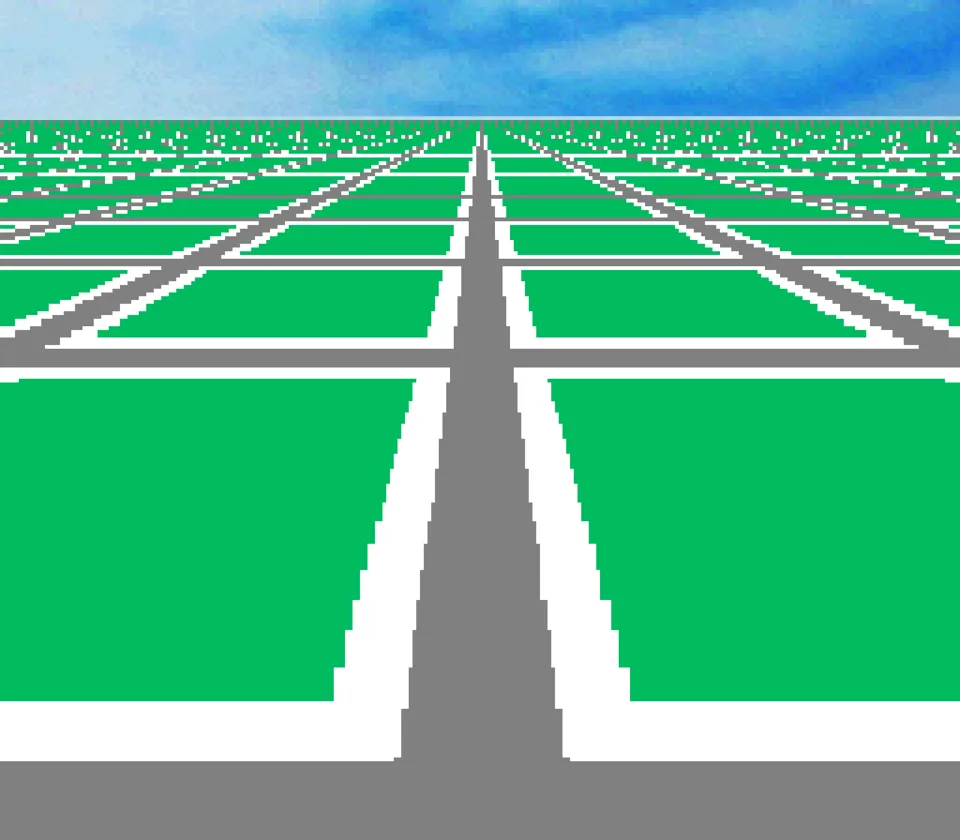
Perspective Grid on a Flat Ground Plane. A pixelated green ground plane divided by gray lanes and white borders recedes toward a blue horizon.Anomie · CC BY-SA 3.0 · via Wikimedia CommonsView source ↗
Prompt
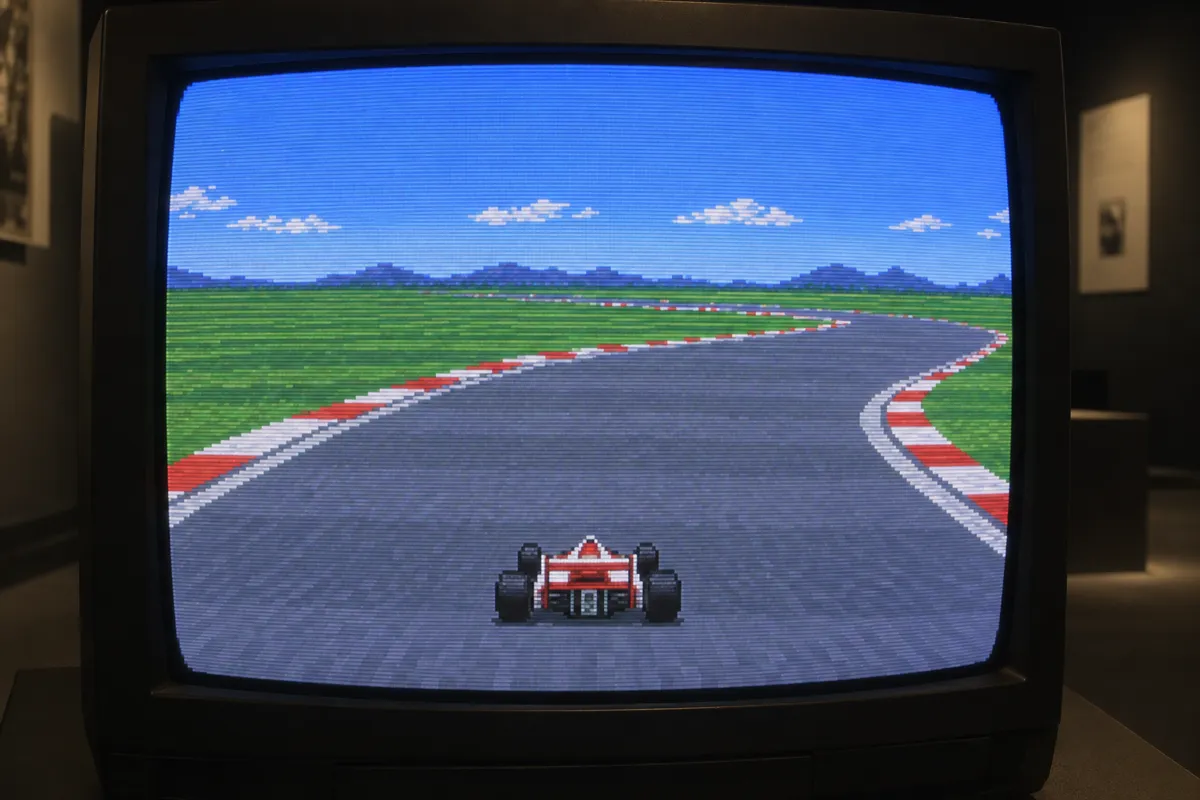
Apply a Mode 7 effect, rendering the existing ground or lower background as a flat pixelated texture plane stretching toward the horizon. Enlarge foreground texels, tightly compress distant rows, and use a limited palette with crisp sprite-like subjects rather than detailed geometry. Keep the original subject and composition.
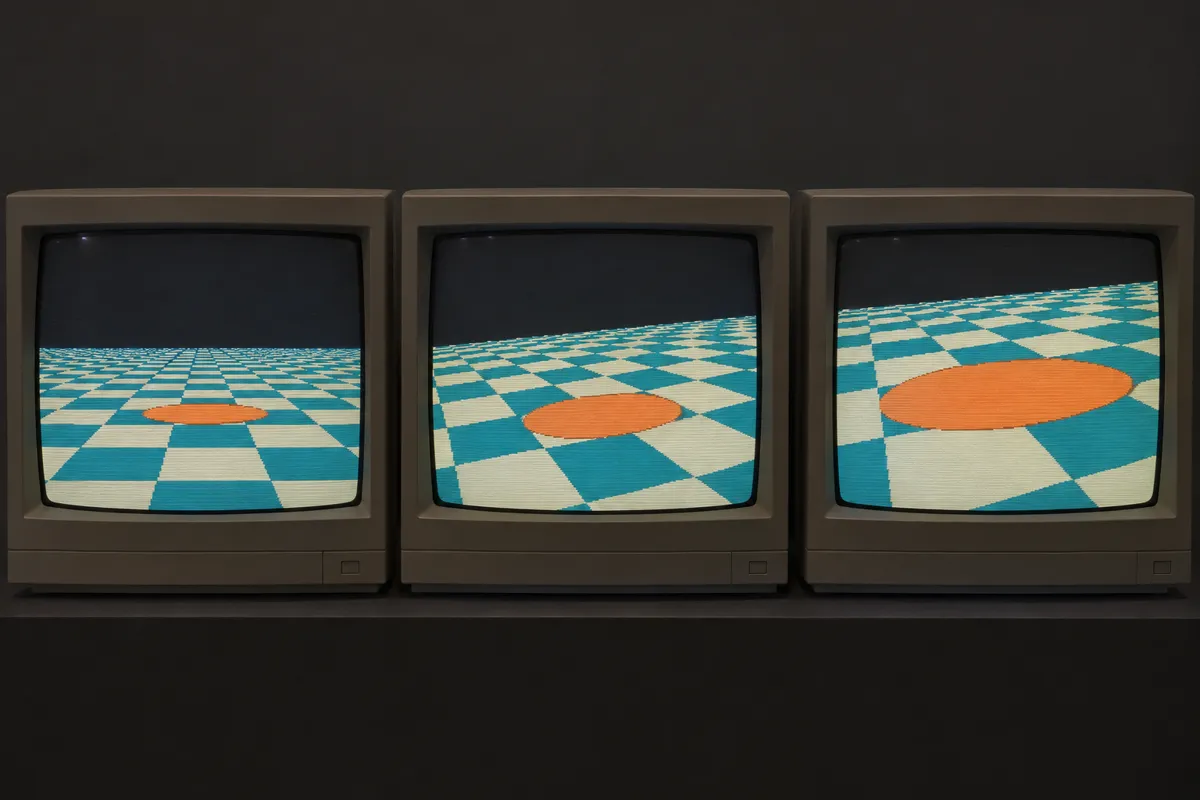
You see aflat, [pixelated ground plane]stretching into the distance. This floor can [rotate and scale smoothly]beneath the camera.
Principle
Hardware calculates grid transformations1line-by-line during the screen drawing process. This stretches and squashes a2D map to [simulate 3D perspective].
Example
Nintendo EAD: Super Mario Kart, 1992.
Try it out
Watch gameplay of F-Zero and notice how objects on the track look flat painted, rather than standing up.
Background
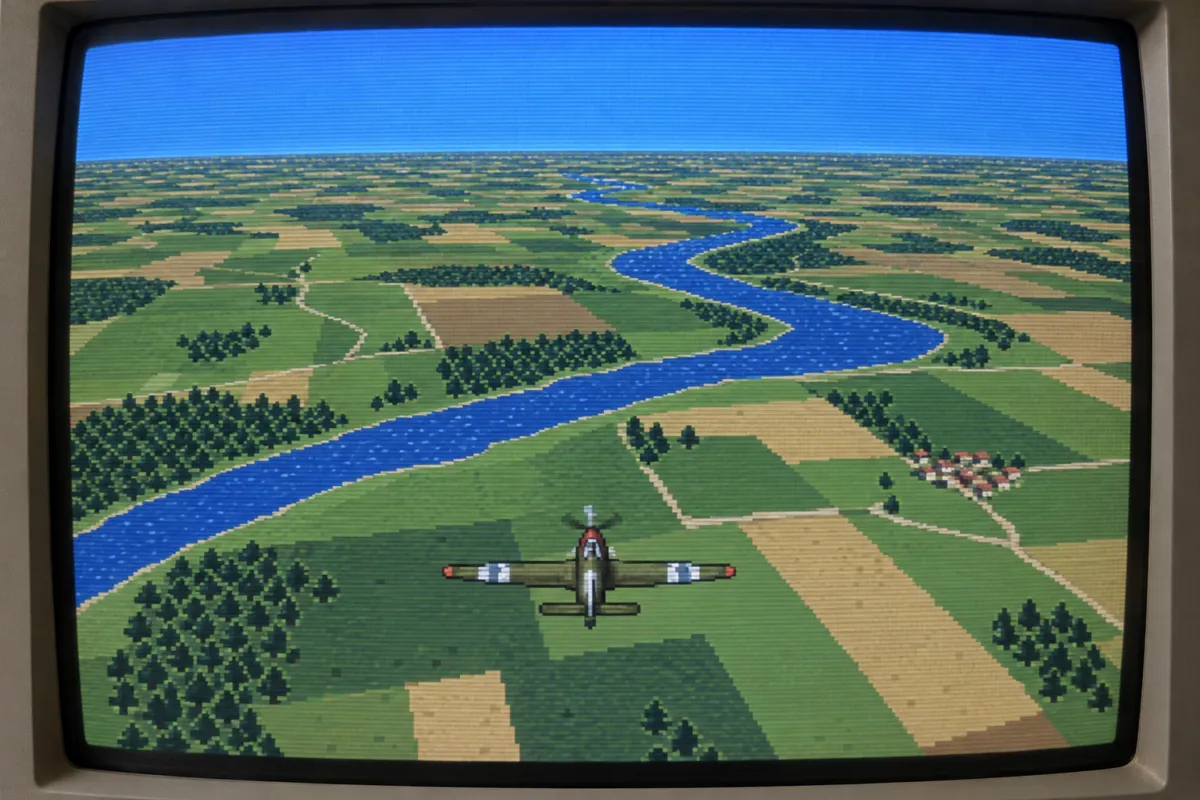
Mode 7 was the seventh background graphics mode on the Super Nintendo. Standard game consoles of the era built 2D worlds using rigid tiles. Mode 7 instead allowed asingle massive background layer to be scaled and rotated freely by the hardware. By changing the scaling factor on each horizontal scanline2as the screen drew, programmers could create afake 3D floor. The horizon line usually hid the fact that no actual 3D math was calculating depth. This breakthrough allowed high-speed racing and flying games to exist without requiring complex polygonal rendering3chips.
Distinction
Unlike true 3D graphics, Mode 7 does not calculate XYZ coordinates for vertices. It only distorts aflat 2D image.
Aftermath
It shows how creative hardware tricks can simulate spatial depth using only 2D image distortion.
Further examples · 7 images
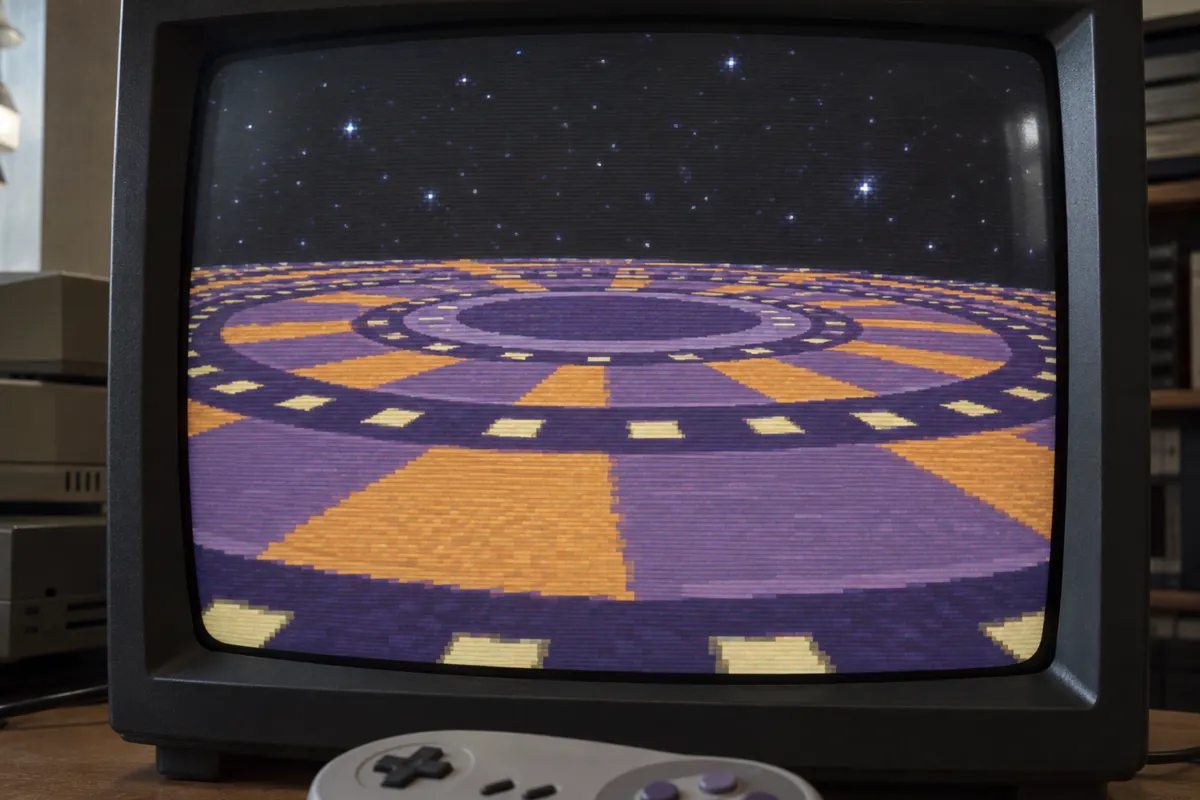
02Mode 7 Track Transformation DiagramThree stacked diagrams show a brown circuit on green ground, overlaid with differently angled and spaced sampling lines. The sequence demonstrates how rotation and line-by-line scaling transform a flat track into a Mode 7 perspective view.Leovilok · CC BY-SA 3.0 · Wikimedia Commons03Super Mario Kart in Split ScreenTwo seated players face a television displaying a split-screen Super Mario Kart race. The visible racing surfaces use Mode 7 to turn flat track graphics into receding ground beneath the racers.Frédéric BISSON from Rouen, France · CC BY 2.0 · Wikimedia Commons04AI illustration: Racing game simulated perspective on CRT monitorA racing car sits on a grey track that recedes toward a flat horizon line under a blue sky. The image captures the characteristic way a 2D map is tilted and scaled to provide a sense of forward motion and depth.Illustration generated for the Atlas (AI)05AI illustration: Aerial perspective through hardware-accelerated map scalingAn aircraft flies over a sprawling patchwork of green fields and a blue river that stretches to the top of the screen. This aerial view demonstrates the rotation and scaling of a single large background layer to simulate a three-dimensional landscape.Illustration generated for the Atlas (AI)06AI illustration: Rotation and scaling of a tiled 2D planeThree monitors display a checkered floor at various angles of rotation and zoom. These sequential frames illustrate the technical ability to manipulate a flat plane in real-time to imply camera movement.Illustration generated for the Atlas (AI)07AI illustration: Perspective projection of a patterned floor graphicA purple and gold patterned circular arena is shown stretching into a starry void on a television screen. The pixelated floor illustrates the line-by-line transformation process that allows a flat graphic to appear as a receding 3D surface.Illustration generated for the Atlas (AI)
Question
Why do characters and items in Mode 7 games often look totally flat?
Show possible answer +Hide answer −
The hardware could only distort the background floor layer. Characters were regular 2D sprites drawn on top, scaling as they moved away.