2000s, growing use of digital focus stacking in macro photography
Typeface · Victor Mono
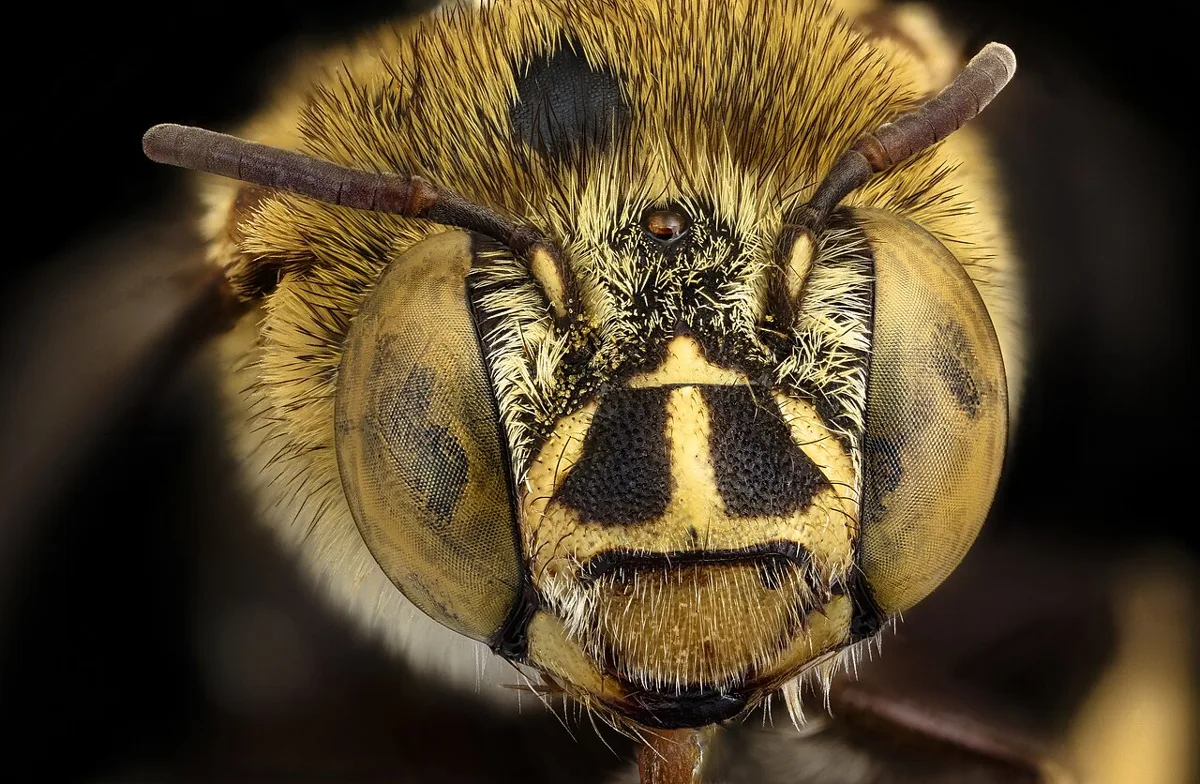
Golden Bee Face in Extended Focus. A bee’s face fills the frame, revealing finely textured eyes, segmented antennae, and dense golden hairs.USGS Bee Inventory and Monitoring Lab from Beltsville, Maryland, USA · Public domain · via Wikimedia CommonsView source ↗
Prompt
Apply Focus Stacking to extend crisp detail across the subject’s near and far surfaces. Resolve fine textures, delicate edges, and small structural features at multiple depths while preserving natural background softness. Use seamless sharpness transitions without halos, doubled contours, or exaggerated microcontrast. Keep the original subject and composition.
Tiny subjects show [sharp detail]across several depths, from nearby antennae to distant wings. This extended sharpness can coexist with ablurred background.
Principle
Software aligns separate exposures taken at [different focus distances], then blends their sharp regions. The composite extends apparent [depth of field1]without increasing the optical sharpness of any individual exposure.
Example
Levon Biss: Microsculpture, 2016.
Try it out
Photograph astationary flower at three focus distances, then compare which parts are sharp before blending the images.
Background
Focus stacking became more accessible during the 2000s as digital cameras and specialist software spread. It addressed afamiliar macro problem: high magnification leaves very little depth of field. Photographers record successive focus slices2by adjusting focus or moving the camera along arail. Software aligns these images and combines their sharp regions after capture. Earlier microscopy methods also combined information from different focal planes. Stacking does not require asmaller aperture, which can soften fine detail through diffraction3. Moving subjects and overlapping edges can produce blending errors.
Distinction
Stopping down increases depth of field within one exposure, but can introduce diffraction blur. Focus stacking combines multiple exposures, so subject movement can disrupt the result.
Aftermath
Focus stacking shows that aphotograph's apparent sharpness can come from combining observations rather than from one optical view.
Further examples · 11 images
02Compound Eyes and Sculpted Facial DetailAn insect’s dark face is framed by pale compound eyes, with tiny hairs and sculpted mouthparts clearly resolved. Sharp detail across the rounded eyes and differently recessed facial structures demonstrates the expanded depth of a focus-stacked macro photograph.USGS Bee Inventory and Monitoring Lab from Beltsville, Maryland, USA · Public domain · Wikimedia Commons03Metallic Blue Head in Layered FocusA metallic blue insect head displays dense surface pits, reddish compound eyes, and individual pale hairs. Fine detail remains legible across the curved forehead, antennae, and lower face, demonstrating focus stacking at high magnification.USGS Native Bee Inventory and Monitoring Laboratory · Public domain · Wikimedia Commons04Bee Profile with Comprehensive Macro DetailA bee in side view reveals golden body hairs, overlapping veined wings, curled legs, and a striped abdomen. Consistent fine detail across the head, limbs, wings, and body demonstrates the broad apparent depth of field achieved by focus stacking.USGS Native Bee Inventory and Monitoring Laboratory from Beltsville, USA · Public domain · Wikimedia Commons05Bee Profile with Wings and Banded AbdomenA bee’s side profile shows a glossy eye, dense yellow hairs, folded wings, and a dark banded abdomen. Fine detail extends across overlapping limbs and differently positioned body surfaces, clearly demonstrating the expanded focus of a stacked macro image.USGS Bee Inventory and Monitoring Lab from Beltsville, Maryland, USA · Public domain · Wikimedia Commons06Metallic Blue Head in Extended FocusA metallic blue insect head reveals finely textured eyes, segmented antennae, and golden mouthpart hairs. Extended sharpness across these projecting structures demonstrates focus stacking while the body behind remains blurred.USGS Bee Inventory and Monitoring Lab from Beltsville, Maryland, USA · Public domain · Wikimedia Commons07Orange and Black Insect in ProfileAn orange-and-black insect appears in profile against black, revealing fine hairs, folded limbs, and segmented antennae. The extensive sharpness across overlapping anatomical structures shows the depth-extending effect of focus stacking.USGS Native Bee Inventory and Monitoring Laboratory from Beltsville, USA · Public domain · Wikimedia Commons08Dark Insect Face with Fine HairsA dark insect face fills the frame, with crisp eye facets, pale facial hairs, and antennae stretching sideways. Sharpness across the antennae, curved eyes, and central face demonstrates focus stacking against a softly rendered body.USGS Bee Inventory and Monitoring Lab from Beltsville, Maryland, USA · Public domain · Wikimedia Commons09Angled Head and Bristly ForelegsAn angled insect head shows reddish facial plates, pale antennae, and bristly forelegs framing the mouth. Fine detail across these staggered surfaces demonstrates the extended apparent depth of field produced by focus stacking.USGS Bee Inventory and Monitoring Lab from Beltsville, Maryland, USA · Public domain · Wikimedia Commons10Extended Antennae and Open MouthpartsA front-facing insect presents widely extended antennae, large compound eyes, and open mouthparts between raised forelegs. Simultaneous detail across these different depths demonstrates focus stacking while the rear body falls out of focus.USGS Bee Inventory and Monitoring Lab from Beltsville, Maryland, USA · Public domain · Wikimedia Commons11Pale Eyes and Layered ForelegsA pale-eyed insect faces forward, its white facial hairs, crossing antennae, and overlapping forelegs sharply articulated. This unusually deep zone of fine macro detail demonstrates focus stacking without requiring the distant structures to remain sharp.USGS Native Bee Inventory and Monitoring Laboratory from Beltsville, USA · Public domain · Wikimedia Commons
Question
Why not simply use the smallest aperture instead of stacking?
Show possible answer +Hide answer −
Asmaller aperture increases depth of field, but diffraction reduces fine detail. Stacking can retain detail while extending the visibly sharp range.